
 •
Versione 1
Rating:
•
Versione 1
Rating:
THE REVIEW
Synopsis
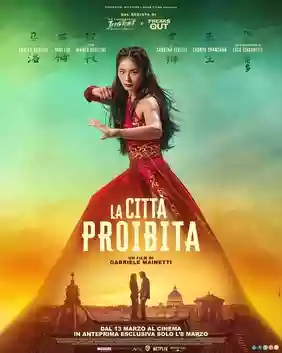
The synopsis sounds like that of a 1970s exploitation movie. And in part, it is, but only in part.
Ah, this partiality is Everything.
The film, with its opening scenes, starts in China.
1995; the one-child policy in full force.
The parents of little Yun and Mei decide to keep their second daughter a secret to avoid being reported. From childhood, both daughters are trained in martial arts.
Thirty years later, Mei arrives in Rome, in the Esquilino neighborhood, searching for her missing sister. She will find a Chinese restaurant that is also a brothel, an Italian-Chinese crime boss, an awkward and warm-hearted Roman cook, a family in crisis, and more violence than she was looking for.
And how good is this Mainetti. To be a Top Player, he still lacks the overall vision, that evocative bird’s-eye view. But then again, that belongs only to the Greats.
But he’s already quite something. The opening fight scene is one of the film’s high points; the director sought out a young Chinese stuntwoman, Yaxi Liu, specifically looking for a girl who had truly grown up with martial arts.
Because a body that truly knows how to fight possesses a craftsmanship in movement that cannot be replicated, and I say this to you, lovers of vinyl who still know what is sacred and what is digital. The difference is in that flutter of wings, and that flutter is everything in cinema. It’s in the gaze and in the tense pupils that betray the heart’s racing beats, it’s in those sighs that are eternal moments, in the instant when a true martial artist reads the situation before acting, in the way the body’s weight shifts, in the breath that vibrates in the air. Mainetti turned to an exceptional fight coordinator, the Chinese talent Liang Yang, who has already worked with Tom Cruise, to create something that probably had never been seen in our cinema, at least not in these terms. The first fight starts in an Asian-style kitchen and then spills out onto the streets of the Roman Esquilino quarter, following all the classic genre rules. First and foremost: weapons are not brought, they are found at the scene. The first fight in the kitchens uses oils and stoves as lethal weapons. The second key is the fluidity of action, which is always clear and precise—there are not too many cuts, everything flows smoothly; direction alternates between wide shots and surgical close-ups on the most important blows, keeping the tension palpable. The third element is the physicality of sound, a refined sound design that makes you feel the blows viscerally—the influence of Hong Kong cinema, which understood that the sound of martial arts is almost more important than the image; the crack of a joint, the hiss of a blow through the air, the dull thud of a body hitting the floor: these sounds work directly on the viewer’s nervous system, bypassing intellectual mediation.
After this first scene and its dizzying impact on the rest of the film, we get to the heart of the problem—and the miracle. That impossible atlas of genre—the fact is, La città proibita is not a movie of one genre—it crosses at least five or six genres with the speed of a train that doesn’t stop at minor stations, and the legitimate question is: is this a strength or a structural weakness?
From a certain point onward, Mainetti mixes everything: China and Rome, kung fu and feelings, Steno-style comedy and revenge story, martial violence and Roman indolence, family melodrama and the complications of the underworld, noodles with amatriciana. This mix, even if sometimes chaotic, is the result of a precise cultural and cinematic choice: the typically Eastern approach of bringing together the most disparate genres. Shot in Rome’s Esquilino quarter, a place where Italy physically confronts its own demographic transformation every day—between tourists looking for the Baths of Diocletian and third-generation immigrants speaking in Roman dialect, in a modern twist on Wyler's Roman Holiday (quoted in the relationship between the foreign woman in Rome and Marcello, who becomes her unwitting guide), with the scenario inverted and stripped of innocent sweetness to be immersed in the violence of a Rome that does not host princesses but exploited immigrant women.
And then there’s that critical point—after the courage, the ardor so well depicted in the surrender to fighting, and that multicultural Rome so far from social hardship but colored with picturesque folklore, comes that moment of vanity where the film challenges itself, and loses.
The romantic angle in the film’s second half and certain moods and deja vus would visibly recall the romantic stylings of Wong Kar-wai, but in that original physicality, the peaks are simply too high to replicate. This is the sore spot: the love between Mei and Marcello, the emotional backbone of the second half, is where the film pays most dearly for its ambition. Wong Kar-wai builds that distance and romantic tension through years spent perfecting an aesthetic of suspended time that’s almost unattainable, especially in 2026. Mainetti references it but does not achieve it, and the risk is that the second half feels like it gives in to what the first half so carefully avoided: sentimentality as an emotional shortcut.
Considering all the risks that a film of this kind, produced and distributed in Italy, carries on its shoulders, in itself the film as a whole takes the luxury of failing big. And to fail big, when you start from genuine ambition, is worth infinitely more than succeeding in small things.
Loading comments slowly
Summary by Bot
This review explores Gabriele Mainetti’s La città proibita, highlighting its distinctive approach to storytelling and direction. The film is praised for its artistic execution and compelling narrative, earning a strong 4 out of 5 rating. Mainetti's creative vision is recognized as a key strength, with the reviewer encouraging viewers to experience the film. The analysis notes both the film's strengths and its unique atmosphere. Overall, a strong recommendation for fans of Italian cinema.
Gabriele Mainetti
Italian film director and screenwriter from Rome. Broke out with Lo chiamavano Jeeg Robot (2015/2016), which won multiple David di Donatello awards including Best New Director, and followed with Freaks Out (2021). Known for blending genre cinema with vivid Roman settings.05 Reviews
