
• Versione 1 Rating:
THE REVIEW
There are two schools of thought about dealing with trauma.
- The first consists in burying it as deep as possible and pretending nothing happened.
- The second involves picking at the wound endlessly, analysing every detail, revisiting every decision and, if possible, trying to set right what cannot be set right.
Since I belong firmly to the second school, I could not help sympathising with Joe Parkson (Robert Ryan), the man who simply cannot let go.
Yet "letting go" was exactly what post-war America wanted to do. Which may explain why Act of Violence was not a great success when it appeared in January 1949. The world was trying to move on from the horrors of World War II. Veterans were returning home, families were rebuilding their lives and few people were eager to examine the psychological wreckage left behind. It would take another decade or two before the ghosts returned in force through memoirs, revelations about the concentration camps, Cold War anxieties and a broader willingness to discuss trauma.
Act of Violence arrived too early for that conversation.
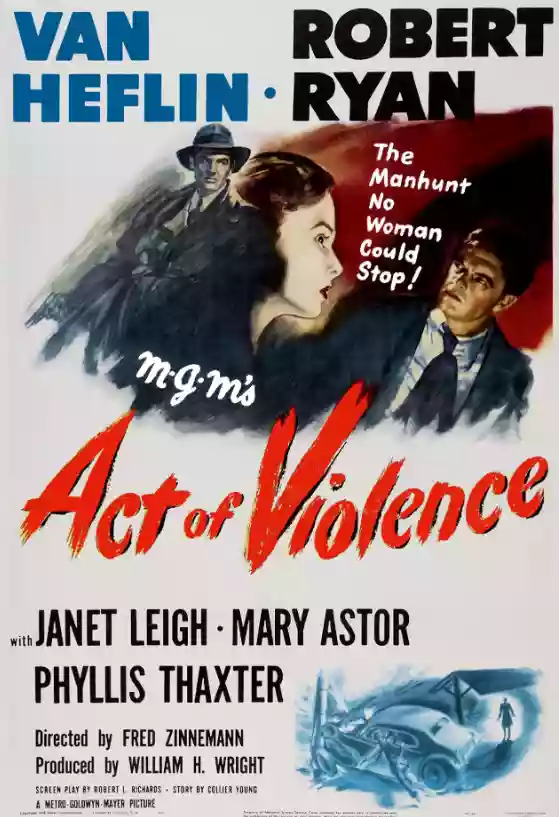
The film opens with a limping stranger stepping off a bus in Los Angeles. Joe Parkson's arrival immediately casts a shadow over the celebrations being held for local war hero Frank Enley (Van Heflin), a respected veteran, husband and father. Frank has everything that symbolised success in post-war America: a beautiful wife, Edith (Janet Leigh, bound for glory with Touch of Evil and especially Psycho), a child and the admiration of his community.
Joe, meanwhile, looks like trouble. And because he is played by Robert Ryan, one of noir's great specialists in damaged and dangerous men, we instinctively assume the worst.
But appearances are deceptive.
As Joe relentlessly stalks Frank through the city, we gradually learn that the two men share a dark history. During the war they were prisoners in a German POW camp. When a group of prisoners planned an escape, Frank informed the camp commandant after receiving assurances that no serious harm would come to the men involved. Trusting a Nazi officer, however, turns out to have been catastrophic foolishness. Joe paid the price for Frank's decision, and years later he is still carrying the physical and emotional scars.
The genius of Act of Violence lies in the fact that it refuses to offer easy moral categories. Frank is neither hero nor villain. Was he a coward? Was he trying to save lives? Was he rationalising his own fear? Under those circumstances, would any of us have behaved differently?
The film never answers these questions, and it is stronger for it.
Joe, meanwhile, appears at first to be the antagonist, driven by obsession and vengeance. Yet as the story unfolds he increasingly emerges as something else: the conscience of the film itself. While Frank has built a comfortable suburban existence upon silence and concealment, Joe refuses to participate in the collective lie. His obsession may be destructive, but he is also the living embodiment of a past that everyone else would rather forget.
What follows is a tense and pitiless cat-and-mouse game between two damaged men trapped by a shared history neither can escape. There are no real victories to be won here, only painful truths waiting to be acknowledged.
Although often classified as a film noir, Act of Violence possesses a darker moral vision than many of the genre's more conventional examples. It contains most of the familiar ingredients, including a memorable appearance by Mary Astor as Pat, a weary prostitute who becomes entangled in the story during its final act. Astor, forever immortalised by The Maltese Falcon, brings warmth and humanity to a role that could easily have been little more than a plot device.
The film's atmosphere grows steadily darker as Joe's quest for justice threatens to spiral into something even more destructive. By the time the inevitable climax arrives, the audience is left contemplating not simply guilt and revenge, but the impossibility of escaping one's own past.
Director Fred Zinnemann was himself profoundly affected by the war. An Austrian émigré, he learned after the conflict that both of his parents had perished and this no doubt influenced the bleak and cynical world he created in this movie.
Zinnemann would go on to win Academy Awards for films as varied as High Noon, From Here to Eternity, Oklahoma! and A Man for All Seasons, demonstrating a versatility few directors could match. Yet Act of Violence remains one of his most haunting achievements.
Personally, I am also very fond of his later thriller The Day of the Jackal (1973), another film built around relentless pursuit and moral ambiguity.
The film is currently available to stream free through the Internet Archive.
Loading comments slowly
Summary by Bot
This review explores 'Act of Violence,' a film noir that delves into trauma, guilt, and moral ambiguity in post-war America. The story follows two veterans with a complicated past, refusing to offer easy answers. The film's dark, complex vision and nuanced performances, especially from Robert Ryan and Mary Astor, set it apart from classic noir. Fred Zinnemann's personal history infuses the work with authenticity, making it one of his most powerful achievements.
Fred Zinnemann
Austrian-born, later American, Fred Zinnemann directed classics across genres, including High Noon (1952), From Here to Eternity (1953), Oklahoma! (1955), A Man for All Seasons (1966) and The Day of the Jackal (1973). He won two Academy Awards for Best Director (From Here to Eternity; A Man for All Seasons).03 Reviews
