
 •
Rating:
•
Rating:
THE REVIEW
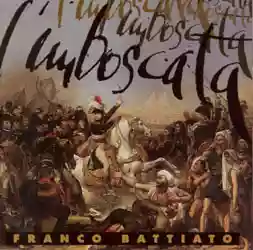
This man never ceases to amaze us: you may say that for more than two decades now he has converted to the pop song form, but in reality, he has never stopped experimenting for a moment. Is there anyone else capable of weaving in phrases like "I will overcome gravitational currents" or "I know the laws of the world and I'll give them to you" in one of the most beautiful love songs of the '90s ("La cura") without making it sound ridiculous, but on the contrary, managing to move us? And it couldn't be otherwise: just listen to the symphonic theme of the string orchestra that repeatedly accompanies the verses, inspired even if a bit challenging. And can something like "Ein Tag aus dem Leben des kleinen Johannes" still be defined as a song, where sweet notes from a 19th-century Lied piano make their way through the dull beats of a cheap drum machine? In a thicket of verses and German muttering, one can glimpse the little hand and soft brown curls of a little Johannes (Brahms? In the imagination of us classical music lovers he always appears mature and with a majestic beard like his symphonies, but he must have been a child too...).
The innovative genius is ever active, and as if that weren't enough, another mind is at work, that of the old philosopher Manlio Sgalambro, who with his booming voice cites Heraclitus, strictly in Greek, to tell us the most obvious thing in the world, but also the one most often forgotten: that we are all "Passing through". Philosophy and song: it seems like madness, but with these two (mad? no, just original) the combination works. And the idea of having two songs proceed almost in parallel, only to intertwine them at the end, when "Strani giorni" overlaps with "Strange Days", who else could have thought of it, if not Battiato? One senses the contrast between a nostalgic motif, rather 60s, and an unyielding rhythm (something akin to the old "Cuccuruccucu"), yet it is a contrast that does not jar.
Besides, Battiato is a bit like the Mahler of the song: just as the Bohemian composer was capable of drawing sublime melodies from organ-grinder tunes, so our own is capable of making the best use of what he himself has defined as "musical rubbish". The juxtaposition of the celestial and the trite is a constant for him, and there are examples of this even in this album. "Amata solitudine" starts with sparse piano notes and a dreamy atmosphere to evolve into a syncopated, almost reggae rhythm, which, however, never entirely smothers the sweetness of the beginning, which resurfaces at the end of the track. The best shots are all fired at the beginning, so the finale is somewhat disappointing: the quality remains high only thanks to the dark charm, very modern and barely Portuguese, of "Segunda feira" and the pathetic orchestral accompaniment that evokes childhood memories in "Memorie di Giulia". Overall it remains an excellent album and above all, once again, very original.
Loading comments slowly
Summary by Bot
Franco Battiato's L'imboscata is a highly original album that combines pop songs with deep experimentation and philosophical reflection. Known for blending classical and modern elements, Battiato collaborates with philosopher Manlio Sgalambro to create tracks with profound lyrical and musical textures. The album showcases contrasts between simplicity and complexity, melancholy and rhythm, resulting in an emotionally moving and unique listening experience. Despite a somewhat weaker finale, the overall quality and creativity remain high.Tracklist Lyrics Videos
Franco Battiato
Italian singer-songwriter and composer from Sicily, Battiato moved from 1970s electronic/progressive experimentation to chart-topping pop with La voce del padrone, and later to spiritual, orchestral and operatic works. He frequently collaborated with arranger Giusto Pio and philosopher Manlio Sgalambro.100 Reviews
