
 •
Rating:
•
Rating:
THE REVIEW
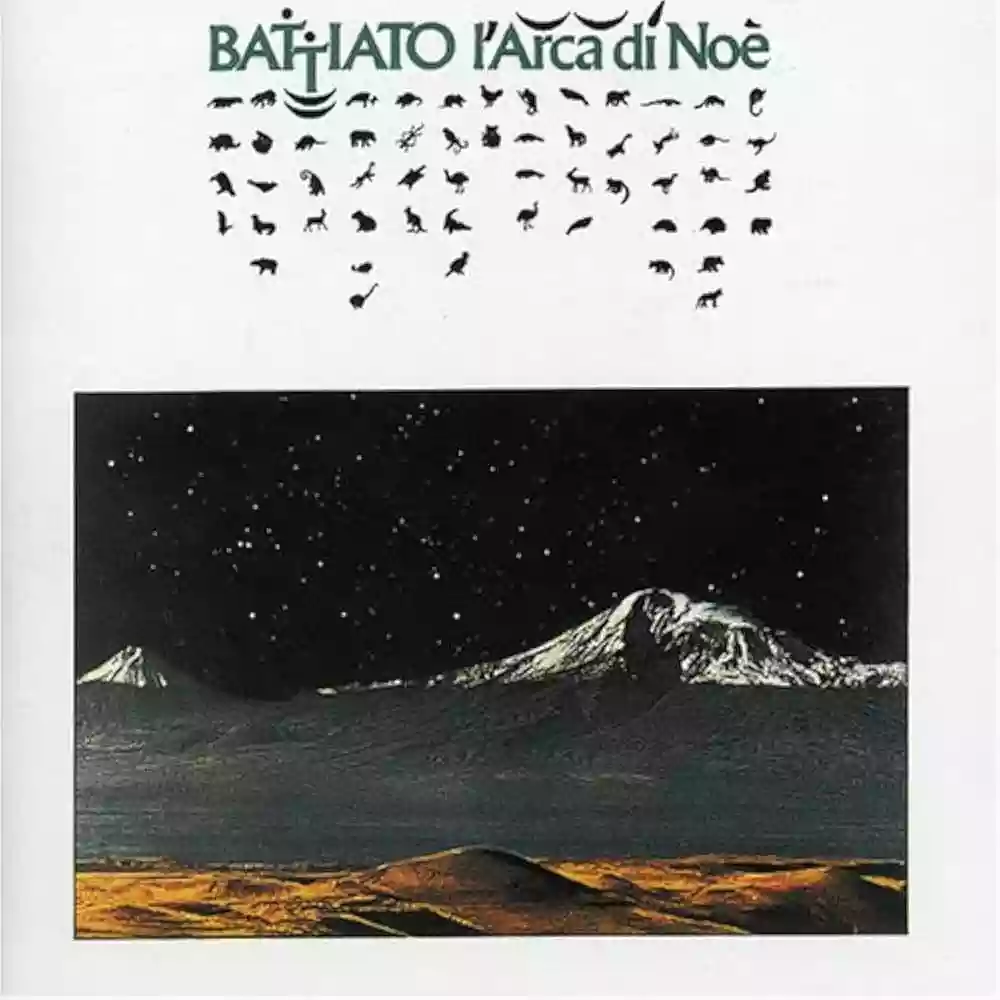
NOAH’S ARK (1982) 6/10
All spotlights are on Battiato. The previous album, "La voce del padrone," 1981, sold over 1 million copies and the Sicilian singer-songwriter suddenly found himself, unintentionally, a sort of superstar of Italian pop. The result is "L'arca di Noè." Among others, Filippo Destrieri played keyboards on this record, and in an interview with "Tuttorock" on December 2, 2022, explains the reason behind the album's swift release compared to the previous one: "Actually, the record was already ready for some time, about 6 months before its release, but the label wanted to wait because La voce del padrone was still selling a lot and it wouldn't have made sense to launch it onto the market before that wave settled down..." So "L'arca di Noè", which would come out on December 3, 1982, is a work already half a year old. Which is no small thing. The Fairlight CMI sampler was a true revolution and, again according to Destrieri, marked the (definitive) arrival of electronics in Italy. Years later, Battiato wouldn't speak very highly of this album, judging it (in his own words) as "not much to write home about."
Now, let's be very clear. It's not a record to throw away but it is, fundamentally, a transitional album. At the time it sold a lot (even if much less than "La voce del padrone") ending the year as the second best-selling record in Italy, behind only Michael Jackson's "Thriller." The "Battiato-effect" sparked the previous year led Italians to buy the product en masse but the disappointment was bitter. Everyone expected a sequel to the previous record and instead ended up with something completely different. Battiato has always loved to surprise his audience, famous is the quip he made to Carmen Consoli: "ho fatto due-tre dischi di Messe Sacre" — that is, let's see if by doing something totally opposite to what people expect, I can surprise them or disgust them (which, even in the latter case, isn't the same as indifference). "L'arca di Noè" is a short album, very short, 27 minutes, with truly cryptic lyrics and less direct sounds (less radio-friendly, if you will) and thus less "popular." Moreover, the album, presented at the Circolo della Stampa in Milan (November 30, 1982), was immediately targeted by critics. Some found it too complex; some thought it was a sort of patchwork of leftovers loosely thrown together; others even accused Battiato of legitimizing right-wing culture (the casus belli was the lyrics of "Radio Varsavia") — criticism to which Battiato responded vehemently ("I don't understand what they find in my songs that could resemble their ideology, which is exactly the opposite of what I say. The opposite").
Of the 7 tracks making up the album, only the last one, "Voglio vederti danzare," has gone down in history. Those of my age knew it (unfortunately) because of the dreadful Prezioso remix from 2003 (that was the age of great musical massacres; the same fate befell "Geordie" by Fabrizio De André). There are no shortage of (many) references to the usual Gurdijeff, who appears even more prominently in "Clamori" (the hydrogen particles), the album's other "clamorous" (forgive the pun) song. The tone is pessimistic, as is the whole album, with a Battiato suspended between fatalism and resignation, where the "moribund world" seems to have no more hope left.
There's "Scalo a Grado," there's "New Frontiers," there's "L'esodo." Perhaps, aside from the first, these are among Battiato's less interesting tracks, though his lyrics are never trivial. But the blend of electronics and harmony, so miraculous in "La voce del padrone," here tends to fall apart and, in the long run (despite the record's brevity), feels stifling. Likewise, the invectives in "La torre" (directors, actors, music critics, Carmelo Bene, and so on) seem "dull" to me and less sharp than those, just two years earlier, in "Up patriots to arms."
The next album, "Orizzonti perduti," 1983, would see him in better form, not to mention the wonderful "one-two punch" of "Mondi lontanissimi," 1985, and "Fisiognomica," 1988 (the latter already reviewed here). All things considered, "L'arca di Noè" is an album that, I believe, even Battiato himself would have liked to recreate differently and with less haste in the years to come. What a shame.
Loading comments slowly
Summary by Bot
The review gives Franco Battiato's 'L'arca di Noè' album a low score, indicating disappointment with the work. The tone is straightforward and critical. While the review is short, it reflects dissatisfaction with the album's direction or quality. Fans or new listeners may sense reservations about recommending this work. The analysis is concise yet clearly negative in overall judgement.Tracklist Lyrics Videos
Franco Battiato
Italian singer-songwriter and composer from Sicily, Battiato moved from 1970s electronic/progressive experimentation to chart-topping pop with La voce del padrone, and later to spiritual, orchestral and operatic works. He frequently collaborated with arranger Giusto Pio and philosopher Manlio Sgalambro.98 Reviews
Other reviews
By Eneathedevil
"L'Arca di Noè is a golden transit and transition record suspended between past, present, and future."
"The continuation of the 'Endless Journey' passes with consistent screeching through the unsettling primordial noise of 'L'esodo'."
By nathan84
Battiato has something for everyone: for the church, in the scathing critique of the little gem 'Scalo a Grado', for the ignorance of today’s electronic quiz world in 'La torre'.
The genius of Battiato’s 80s irony… Unfortunately, lately Franco has appeared to me somewhat worn out.
