
 •
Rating:
•
Rating:
THE REVIEW
If one day the world frees itself from Single Thought, from the societal model based on money, image, and competition, the most difficult task, even more so than rebuilding a bit of social justice and a fair distribution of wealth, will be to recreate from scratch the sense of belonging to the world around us, that is, to revive our roots. Yes, I am taking a broad perspective and philosophizing a bit, but to introduce such a profound and significant work, it seems appropriate.
"Radici" is a treasure of testimonies, stories, and reflections that only someone like Francesco Guccini could put into song form. If among singer-songwriters De André is the poet par excellence, Guccini is the storyteller, so much so that in the end, his inexhaustible vein found an outlet in true novels.
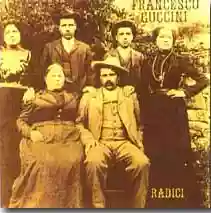
The common thread of this 1972 masterpiece is precisely identifying with a people, a community, even in the stones of a house. This is reiterated by the cover, where three or four generations of Guccini appear, starting with the namesake great-grandfather Francesco.
The seven songs of the album will become just as many classics, with the exclusion of "Radici" itself, perhaps the deepest of all, where every corner of the house where the ancestors lived has its own life. A place like others, a mill-house near Pàvana, on the Tuscan-Emilian Apennines, but at the same time a world, a theater of events that will then find space in an entire book ("Croniche Epafaniche").
Roots are also the "past myths" to which an old man abandons himself while describing to a child what the plain they are watching was like in his time: covered in wheat, with fruits, colors, green trees, with "the rhythm of man and the seasons" not yet erased by "development." "Il Vecchio E Il Bambino" was originally conceived as a song against nuclear holocaust, but at its heart remains the heartbreaking nostalgia for a lost world, which the old man remembers crying (and we cry with him). "The Rhythm of Man and the Seasons" is also the theme of "Canzone Dei Dodici Mesi," rich with references to poets who in various ways have celebrated the seasons, and especially rich in images that only those who try to live still connected to the cycles of nature can manage to create. And Guccini is undoubtedly one of them.
Roots also exist in the city, in the city where one grew up, especially if it is a "Small City" like Modena, "bastard place" and "strange enemy," but also a magical backdrop of adolescence. "Piccola Città" practically summarizes another novel by Guccini: "Vacca D'Un Cane." Modena, a city "once ours and now incredible and cold," also serves as the setting for "Incontro," one of Guccini’s most intimate songs, where the melancholic meeting with a friend, who narrates the events, even tragic ones, of ten years of life lived, unfolds in an atmosphere that a verse like "nostalgia-colored dishes" alone is enough to represent.
And the stories passed down from father to son, are they not precious roots as well? Like that, which really happened, of an anarchist engineer who, at the beginning of the 1900s, crazily drove towards a "gentlemen's" train. From this came "La Locomotiva," forever overloaded with political meanings, as if the event were summed up in that triple "may proletarian justice triumph..." And where do we place the epic side, the celebration of this courageous and suicidal act? At the center of the touching "Canzone Della Bambina Portoghese" is disorientation, feeling like "a point" or "nothing," the loss, albeit temporary, of one's references, with the immense Atlantic as an accomplice.
For a record none of whose words should be lost, the musical aspect seems secondary, but Pier Farri, as creative as he was clumsy an arranger, deserves mention for having attempted in every way to spoil Guccini’s masterpiece. Just one example: the sinister drill-like noise that introduces "Il Vecchio E Il Bambino," which fortunately then continues with a more human guitar. After all, the Moog was the novelty of the moment and experimenting was considered almost an obligation. Here, however, there is so much substance that it really doesn’t feel necessary.
Loading comments slowly
Summary by Bot
Francesco Guccini’s 1972 album Radici is celebrated as a profound exploration of roots, identity, and community. The songs blend storytelling with social and emotional reflections on belonging and nostalgia. Each track is a classic, capturing the cycles of nature, memories of childhood and city life, and political courage. Despite experimental arrangements, the album’s substance is undeniable, marking it as a masterpiece of Italian songwriting.Tracklist Lyrics Videos
Francesco Guccini
Francesco Guccini (born 1940) is an Italian singer-songwriter and author, active since the 1960s and known for poetic, narrative lyrics and a long career as one of Italy's major cantautori.48 Reviews
