
 •
Rating:
•
Rating:
THE REVIEW
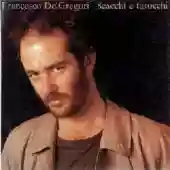
After a masterpiece like "Titanic" and a nice Q-Disc like "La donna cannone," it is difficult, indeed very difficult, to stay afloat. De Gregori tries with "Scacchi e tarocchi," a highly ambitious mid-Eighties album.
The ambitions, however, exceed the skill. De Gregori makes an effort, increases the rock charge, attempts to distance himself from poetic and traditional Italian songwriting (which should neither be repudiated nor despised) and seeks great critical and, above all, popular consensus.
The attempt fails miserably: on one hand, De Gregori manages to craft a handful of almost miraculous songs ("La storia," "A Pà" dedicated to Pier Paolo Pasolini), on the other, he notably and bewilderingly falters ("I cowboys," "Sotto le stelle del Messico a trapanar"). De Gregori's intention is to plunge the knife into the wound and strike at the heart of modern society's drama and pain: he sketches a political and stern discourse that, however, almost always risks being banal and moralizing. "La storia" is undoubtedly an effective and committed piece ("...ed è per questo che la storia dà i brividi, perché nessuno la può fermare"), whereas "Scacchi e tarocchi," dedicated to the years of lead, lacks the spark to amaze and, deep down, the courage to dare. Great deployment of sounds and light music, an unusual and curious way of conceiving music (De Gregori has never wanted to flaunt great melodies and musicality), yet, this time, with the craftsmanship of Carlton Barrett and Aisley Dunbar, the Prince manages to refine, sometimes even masterfully, the music and melodies of some seemingly imperfect tracks (see "Miracolo a Venezia").
A record, therefore, engraved more with the mind than with the heart. It lacks the literary originality and the songwriting courage of albums like "Buffalo Bill" ("Disastro aereo sul canale di Sicilia" is much more daring than "Scacchi e tarocchi") and, at times, even lacks spontaneity. Perhaps it is for these and other reasons that the album failed to climb to the top of the charts, and it is for this reason that De Gregori, from now on, will tend to focus a lot on the musical aspect (moving from melodic to homemade rock) and will tend to underestimate the literary function (the lyrics will become increasingly boring and poor, culminating in disastrous songs like "Bellamore" and "Prendere e lasciare").
For those who, like myself, loved and esteemed the committed and courageous De Gregori of the mid-Seventies, "Scacchi e tarocchi" will represent the end, and thus the death, of a different and unconventional idol. Produced by Ivano Fossati.
Loading comments slowly
Summary by Bot
Francesco De Gregori's 'Scacchi e Tarocchi' is an ambitious mid-80s album that attempts to blend rock with political and poetic themes but struggles to deliver fully. While it contains a few standout tracks like 'La storia' and 'A Pà,' much of the album falls flat, lacking originality and courage. The record marks a turning point where De Gregori shifts away from his prior daring songwriting toward a more musically refined yet lyrically weaker approach.Tracklist Lyrics Videos
Francesco De Gregori
Francesco De Gregori (born 1951, Rome) is an Italian singer‑songwriter known for poetic, often hermetic lyrics and a distinctive vocal style. Active since the early 1970s, he has cited Bob Dylan and Leonard Cohen among his influences. Key albums include Rimmel (1975), Bufalo Bill (1976) and Titanic (1982); signature songs include La donna cannone, Generale and Viva l’Italia.67 Reviews
Other reviews
By GustavoTanz
"Scacchi e Tarocchi, in the vast discography of Francesco De Gregori, is a gem, without ifs and buts."
"For those like me, Scacchi e Tarocchi is a confirmation that those like De Gregori are capable of remaining themselves without being monotonous or charlatans."
