
 •
Rating:
•
Rating:
THE REVIEW
At the end of the '70s (the decade that put the very Sixtiees single to rest in favor of the album, with the invention of concept-albums), the music market was already creaking, and the professionals came up with the idea of the mini-LP: a short record (maximum 7 tracks) with a total duration not exceeding 25 minutes (half an hour at most). A goldmine for artists: little output, lots of gain. Indeed, for a few years (not many, to be honest), the mini reigned in world charts, and also in Italy several examples (almost all from singer-songwriters) appeared.
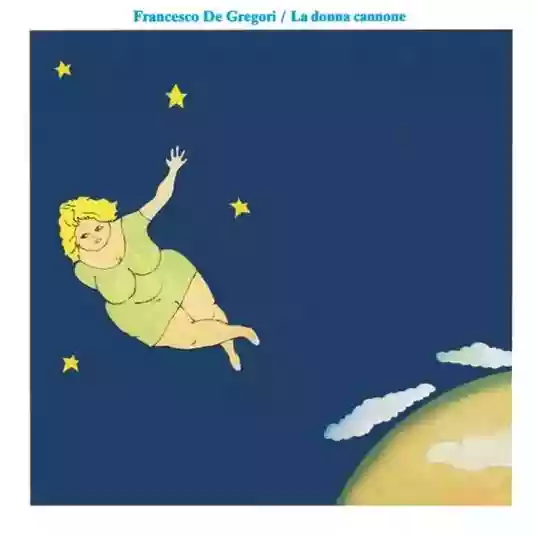
At the end of 1983, in Italy, possibly the most famous (certainly the top-selling) mini was released, "La donna cannone": obviously, its commercial success is owed entirely to the title track, which, for many reasons, made history. In reality, the music was composed by De Gregori for a film (it was his first experience with cinema), "Flirt" (1983), directed by Roberto Russo, starring, among others, Monica Vitti, Jean-Luc Bideau, and Alessandro Haber (briefly, it’s about the story of a bored middle-aged couple whose lives are shaken up by female fantasies embodied by a ghostly lover). The film, lackluster, earned a fair sum, was quickly forgotten, but the soundtrack remained. The mini contains 5 songs, 2 of which are instrumentals, simply titled "Flirt#1" and "Flirt#2", the latter with a very (no coincidence) Dylan-esque harmonic arrangement. The director, Russo (Monica Vitti’s lifelong partner), asked De Gregori to work after the success of the album "Titanic" (1982), which had definitively established his musical course.
The 3 non-instrumental songs, besides the already mentioned title-track, are "La ragazza e la miniera" and "Canta canta". Now, everyone knows "La donna cannone", and everyone has sung it (among them: Ornella Vanoni; Anna Oxa; Mango; Fiorella Mannoia; Ivana Spagna; Gianna Nannini—shall I go on?), it has a piano intro everyone recognizes (so simple, yet so effective) and originates from a story De Gregori randomly read about a ramshackle circus that, in the early 1900s, lost its main attraction: the human cannonball. A news story reported in the press of the time as follows:
«Siamo agli inizi del Novecento, in uno di quei capannoni destinati ai circensi. In uno di quegli attimi morti, mentre la gente va via dal circo, mentre gli artisti riposano le stanche membra, due occhi si incrociano.. due anime sentono di doversi amare.. Ma la regola lo vieta. Non avrebbero potuto esaudire il loro puro desiderio di condividere le proprie emozioni con l'altro perché "le regole del circo" non consentivano. Così la donna cannone, quell'enorme mistero, volò.»
Over the years, it was said to be dedicated to Mia Martini (as was "Mimì sarà", 1987), but De Gregori himself denied it. It is a wonderful, delicate, honest song. If it weren’t De Gregori (that is, someone who has produced loads of beautiful, truly beautiful songs), one could say, with a fair amount of rhetoric, that it’s the song worth a lifetime’s career.
Special mention goes to "La ragazza e la miniera" which, talking about emigration, brings us to a world of work—in the mines, to be precise—girls singing to chase away fatigue and sadness, barely budding love stories, and life choices that, perhaps, one would not make again. Emigration, as in "Pablo", has always been a central theme in the Prince’s (De Gregori’s) body of work, and this song, so beautiful yet so underrated, is one of its highest expressions (and, according to some, it even surpasses the title-track). Exaggeration aside, it is a fine example of Luciano Torani’s piano skills and De Gregori’s lyric writing (in an album where, among others, Renato Serio and the ever-present Mimmo Locasciulli play).
"Canta canta" (translation of Sing Sing, the famous prison), chosen mysteriously as the B-side, is a bit less effective, even if the image of a man just out of jail who asks for a spiked coffee and discreetly coughs with a hand over his mouth in general indifference isn’t half bad (the music, according to Torani’s testimony, was an old melody that De Gregori had set aside in the ‘70s and revived for the occasion).
Obviously, being a mini-LP, it wouldn’t be right to give it a very high score; it doesn’t have the complexity and facets of a real album, not to mention that the 2 instrumentals (though extremely well played) haven’t, so to speak, made history. But, in my opinion, nothing from De Gregori ever goes to waste.
Loading comments slowly
Summary by Bot
The review assesses Francesco De Gregori's album 'La donna cannone', offering a measured rating of 3 out of 5. It notes both the strengths and limitations of the album. The author explores the musical style, songwriting, and overall impact. This balanced perspective helps readers weigh if the album suits their tastes.
Francesco De Gregori
Francesco De Gregori (born 1951, Rome) is an Italian singer-songwriter known for poetic, often hermetic lyrics and a pivotal role in modern Italian canzone. His catalogue spans intimate ballads, historical narratives and politically charged pieces.68 Reviews
Other reviews
By nickbelane
"La donna cannone is one of the most well-known songs in the Italian music scene: an unforgettable ballad."
"The album still has its own reason for existing even outside of La donna cannone."
By Kurtd
I have cried and cry when I listen to this song.
The piano at the end, those few final notes touch my heart, they wrench and touch my heart like nothing else.
