
 •
Rating:
•
Rating:
THE REVIEW
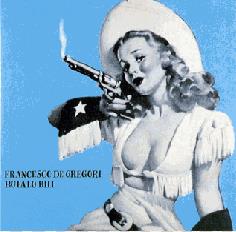
A year after the enormous success of Rimmel, De Gregori releases Bufalo Bill, one of his most unique albums, but also, according to him, the one that resembles him the most. Rich with ideas, both in the music and the lyrics, it is exuberant in execution and singing but might have benefited from better arrangement and production. Apart from this small flaw, it is a high-level record, with various frescoes, characters, and situations that come together to form a single thematic painting.
The entire album is indeed permeated by a critical spirit towards society, primarily the American one, which controls and influences people through conventions and interests.
"Bufalo Bill" is America encompassed between the myth of the frontier and the economic boom of the early 1900s, seen through the eyes of one of its legendary characters, who perfectly embodied its spirit. The structure of the song is not linear but consists of many different vignettes that come together in the grand finale. Almost a suite, if we want to stretch the definition a bit.
"Giovane Esploratore Tobia", written together with Dalla, retains his musical style and singing. A funny little portrait, another character who does not command his life but is commanded by others and conventions.
"L'Uccisione di Babbo Natale" is an amoral tale, where "the son of the flower child" together with "Dolly, daughter of miners" meet and kill a Santa Claus "loaded with iron and coal" and then return to their parents. Perhaps the fake bourgeois and the proletarian who kill the bourgeoisie and then return to it or more simply the dramatic farewell to childhood and the myth of Santa Claus.
"Ninetto e la Colonia" takes place in a cinema, during a marine raid; they shoot everyone, then some officials in suits and ties come in and take away all the fruits that belonged to Ninetto and his friends. The song refers to American agro-industrial multinationals that have taken over all the plantations in Central and South America.
"Disastro Aereo sul Canale di Sicilia" deals with a news event, a NATO plane fallen in those waters.
"Ipercarmela" depicts a social snapshot typical of the era: in an industrialized city, two immigrants live their lives through the myth of owning a house and women's magazines. In this apathetic squalor, a baby is born, Carmela, a star in a city "clean and violent", who always laughs and never cries.
"Ultimo Discorso Registrato" is fun and rhythmical, but one has no idea what it means. "Festival" is instead dedicated to the sad end of Luigi Tenco at the San Remo of '67, and the disgraceful world surrounding the event.
Just deviating from the theme that supports the whole record, we arrive at the two jewels of the work. "Atlantide", the only love song, is rich with suggestive and original images, characterized by a dreamy and suffering atmosphere.
"Santa Lucia", on the other hand, is a secular, universal prayer, for everyone, splendid without ever falling into rhetoric, filled with evocative and moving images. It is dedicated to those who do not see the obvious things, the important things, winners and losers, portrayed with a loving and sweet gaze. The concluding passage is both the frame and the best brushstroke of the painting, the masterstroke that elevates the entire album. The tones of irony and drama used so far are softened in a disarming sweetness, and they bid us farewell with a strong emotion from this beautiful and challenging record.
Loading comments slowly
Summary by Bot
Bufalo Bill, released after the success of Rimmel, is one of Francesco De Gregori's most personal and unique albums. It features rich, vivid storytelling and a critical view of American society and conventions. The album blends evocative characters and social commentary with poetic lyrics, despite some minor production flaws. Highlights include tributes to Luigi Tenco and evocative tracks like 'Atlantide' and 'Santa Lucia.' Overall, it is a challenging yet emotionally rewarding record.Tracklist Lyrics Videos
Francesco De Gregori
Francesco De Gregori (born 1951, Rome) is an Italian singer‑songwriter known for poetic, often hermetic lyrics and a distinctive vocal style. Active since the early 1970s, he has cited Bob Dylan and Leonard Cohen among his influences. Key albums include Rimmel (1975), Bufalo Bill (1976) and Titanic (1982); signature songs include La donna cannone, Generale and Viva l’Italia.67 Reviews
Other reviews
By giores
"Bufalo Bill is my cross and delight: ... I did it bare and essential, to punish myself for having made Rimmel which had sold too much... crazy stuff!"
"Santa Lucia, the album’s closure, is a splendid piano-voice piece, a secular prayer supported by sincere and immense phrases."
By killrockstar76
"Bufalo Bill is the album De Gregori himself prefers, the one he has always considered the most complete, ambitious."
"With Bufalo Bill he delegitimizes his accusers who saw in him only a boy with good readings, too attached to his ‘myths’... but just Francesco De Gregori."
By withor
'Bufalo Bill' is this cross and delight of mine: well, if I could, I would probably redo it with better attention to sounds and arrangements.
All that was missing was the castor oil…
