
 •
Rating:
•
Rating:
THE REVIEW
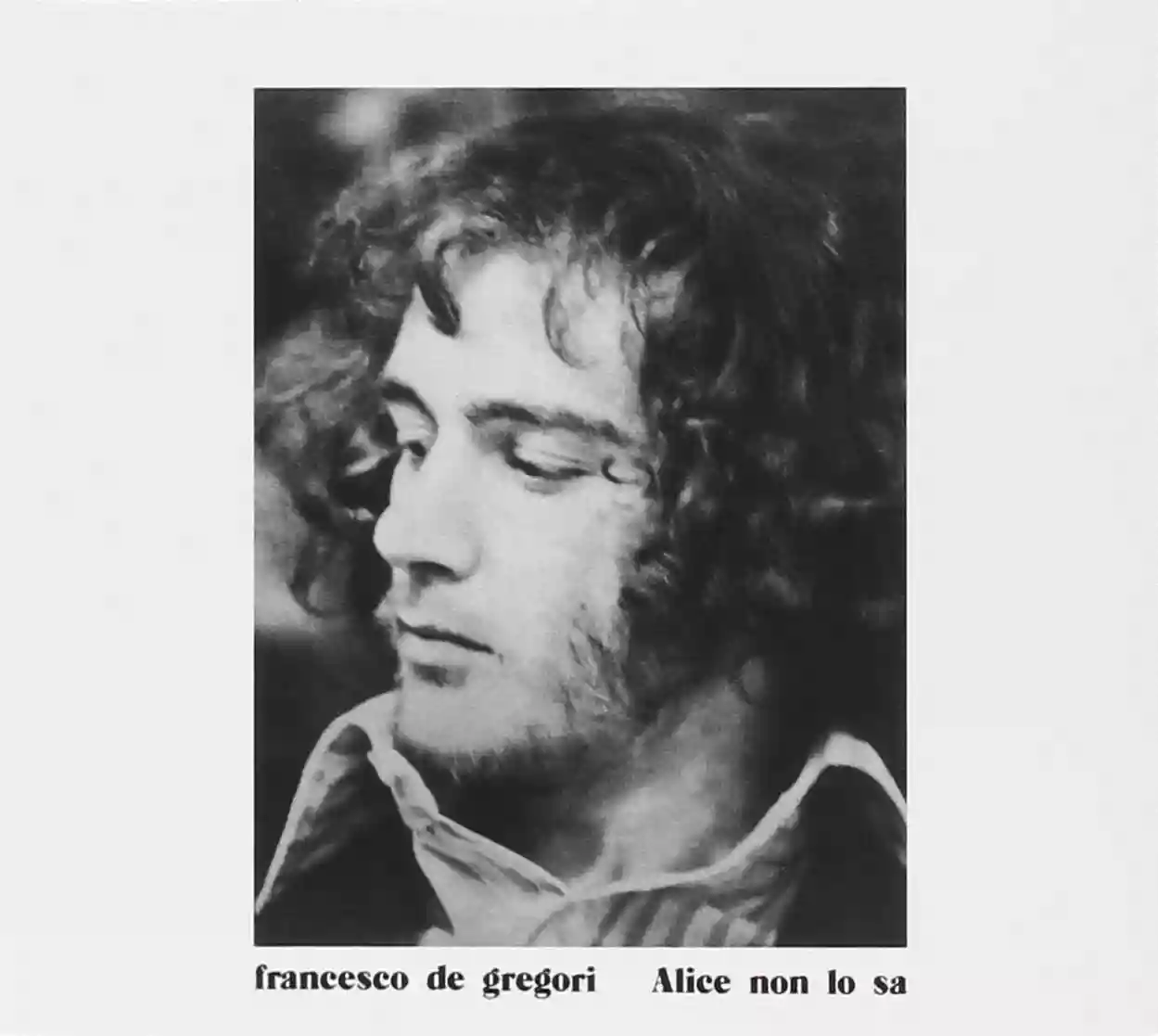
ALICE DOESN'T KNOW (1973) 6.5/10
Released without much fanfare in April 1973, Francesco De Gregori’s first solo album should be taken for what it is: a good debut album. Of course, nothing could have hinted at the powerful leap in quality (and maturity) that his next record, "Francesco De Gregori", 1974, would bring to the career of the very young Roman singer-songwriter. Here, he’s still in a somewhat rough stage, with some beautiful things, some much less so, and an (over)abundant use of the orchestra (the strings, arranged by maestro Luigi Zito) that remains too closely tied to a certain classic Italian melody.
But this is the album of "Alice", his first (half) hit. I say half because the longed-for participation in Disco per l’Estate (which De Gregori insisted on at all costs) ended with a dismal last place and vague accusations of excessive hermeticism (to which the author replied the following year, with the song “Niente da capire”). However, De Gregori’s name started to spread by word of mouth and began to resonate in the juke-boxes. The sales, on the other hand, stopped at 3,000 copies for the single and 6,000 for the LP: let’s say, not record-breaking numbers. And yet, something had changed substantially compared to the debut the previous year, that "Theorius Campus" shared with Venditti, where the latter already appeared dramatically more mature compared to his shyer, more reserved colleague. With "Alice non lo sa", the substance starts to come through. "Alice" is a wonderful song, halfway between dream and reality, with definite echoes of Lewis Carroll’s Alice but an endless array of references (literary, cinematic, musical) that leave you amazed: Angela Davis; Cesare Pavese; Lilì Marlene. The verse about Pavese is a showstopper, and recounts an event that truly happened: poor Pavese was to meet a dancer outside the theater after the show, she never showed up, he waited all night while incessant rain soaked the streets of Turin and to which he dedicated a poem "O ballerina ballerina bruna" (the dancer in question, a certain Pucci, was actually named Carolina Mignone). RAI (“Mamma Rai, non ti abbandona mai,” as Renato Zero would say years later) insisted on censoring the line "il mendicante arabo ha un cancro nel cappello," replacing it with the milder "ha qualcosa nel cappello."
Around this track, De Gregori builds the entire album, made up of 12 songs. The collaborators are top-notch, to name a few: Edoardo De Angelis; le Baba Yaga; Edda Dell’Orso; Renzo Zenobi. The best pieces are those in which our artist lets his singer-songwriter side run free, less bound to Italian tradition (Cohen; Dylan). Over time, the excellent "La casa di Hilde" has found its own place in his live sets: the song was born from a story by De Angelis, to whom something similar actually happened as a child, when he lived in the Dolomites (smuggling diamonds hidden inside a zither). The lyrics are beautiful, because it's like a film—you see everything: the mountain path; the father’s shadow "two times my size/I walked and he ran"; Hilde serenely playing the zither; the disheartened customs officer leaving; the return to the mountain trails and the coming of age (“ed io mi sentivo già uomo”). The theme of youthful loneliness is also touched upon in "Il ragazzo", which is truly a spectacle, a perfect mix of pre-teen sadness and pride in one’s own solitude (“il ragazzo cresce solo/e non si sente solo mai”). A note is also deserved for two other tracks, in my opinion very beautiful: the portrayal of France invaded by Hitler and Italy entering the war, seen through the eyes of the author’s mother (besides wonderful lyrics, I’ve always loved the counterpoint of the drums) in "1940" and the interesting (actually something more than interesting, to tell the truth) "Marianna al bivio", which already signals the De Gregori guitar-and-voice style that, as I said at the beginning, would be the foundation of the following album (a track, moreover, packed with quotes: Antonello Venditti; Lilli Greco; Cohen's Suzanne and the "la luna che sembra una patata" already heard the year before in “Theorius Campus”, track "La casa del pazzo").
In its own way, "Le strade di lei" is also fascinating, even if the remaining songs have, justifiably, fallen into the forgotten corners of memory. Some are more like concert experiments ("I musicanti"), others “tasteless” tracks ("Suonatori di flauto"; "Saigon"). Even so, in "Buonanotte fratello", the passage "ed ero ingenuo come una bestemmia" would deserve a review all its own.
Loading comments slowly
Summary by Bot
This review provides a moderate evaluation of Francesco De Gregori’s debut solo album, 'Alice non lo sa.' It highlights the subtle folk and poetic qualities in De Gregori's songwriting. The analysis recognizes the album’s thoughtful lyrics and understated arrangements. The reviewer remains balanced, offering both appreciation and critique. Overall, it’s seen as a notable but not groundbreaking work in De Gregori’s career.
Francesco De Gregori
Francesco De Gregori (born 1951, Rome) is an Italian singer‑songwriter known for poetic, often hermetic lyrics and a distinctive vocal style. Active since the early 1970s, he has cited Bob Dylan and Leonard Cohen among his influences. Key albums include Rimmel (1975), Bufalo Bill (1976) and Titanic (1982); signature songs include La donna cannone, Generale and Viva l’Italia.66 Reviews
Other reviews
By T.V
Alice, which will remain a symbol of his artistic youth.
A good album with some instrumental flaws typical of the era.
By Viva Lì
The first thing to do was to make himself comfortable. And carefully weigh the words he would have to say.
By alessioIRIDE
Put this record on and people go silent, listen as if they are weighing the words that De Gregori sings.
It is an escape, nothing else, it is my madeleine, leading to a past never left too aside.
By Olsen Olsen
I like to think of this album as a Linus blanket. An object you never want to part with...
'1940' is a stunning depiction of our nation’s entry into war, seen through the eyes of a mother.
