
 •
Rating:
•
Rating: THE REVIEW
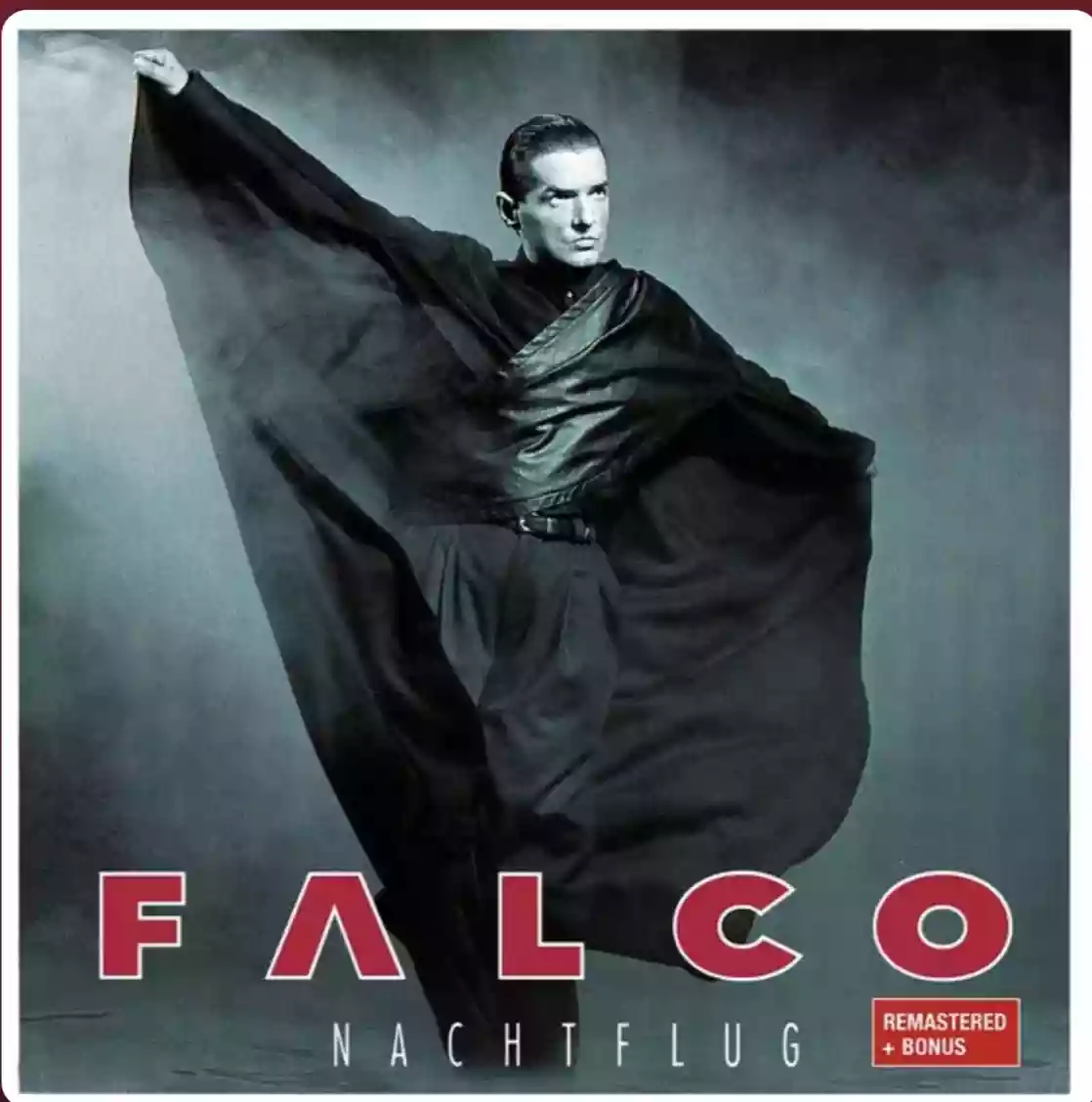
The seventh album, "Nachtflug", was a significant work for more than one reason.
To begin with, it was marked by yet another return of the Bolland brothers as producers.
Moreover, it brought Falco back to the top of the charts—albeit only “at home”—and also provided the opportunity for a new tour, with a series of live shows scheduled in smaller venues than the typical arenas, due to a much smaller fan base compared to that of the previous decade.
It would also, sadly, become known as the last album released during his lifetime.
Once the contractual ties with his historic labels had come to an end, Falco found himself signing a new deal with the major label EMI, thanks in part to the decisive intercession of an executive who was an avid admirer of his work.
Motivated by this latest “new beginning,” the Viennese popstar managed, among other things, to find the strength, spirit, and a considerable amount of humility to reconnect once again with the beloved-yet-loathed Dutch producers who had brought him so much commercial success in the past.
And the Bollands answered present, crafting for the new LP a sound that was highly dynamic and powerful, with many nods to the established style everyone remembered and probably expected, lyrics included. Sarcasm, cynicism, decadence, and rampant hedonism returned as part of Falco’s stylistic signature.
The new work was heralded by the impetuous, splendid "Titanic," which, thanks also to a video clip in classic “stile Dolezal” (director of many of his historic videos), achieved good media and commercial success.
The highly successful Comeback contains many other great tracks, such as a “Monarchy Now” that at times stylistically recalls the little-known but bright “Garbo” from the album Wiener Blut, and a sort of Modern-Tango in the relentless “Dance Mephisto,” which was boldly chosen as the second single but failed to achieve notable results. Then there’s the power of “Psychos,” the reggae openness of the sunny “Yah-Vibration,” and the intense gem that gives the album its name—further enriching the whole, thus marking Falco’s grand return to the Pop scene.
Yet too many years had passed since his worldwide triumphs; it was no longer realistically conceivable that a third wave of popularity could happen, after the mega-hits “Der Kommissar” and “Rock me Amadeus.” Falco thus had to settle for a return to success limited to Austria alone—even there, the number one spot on the album chart was only nearly reached—crowned in 1993 by a massive show during Vienna’s traditional Donauinsel festival, where he performed before more than one hundred thousand people.
An historic concert, subsequently released in the market many times over the years in every possible format (DVD, CD, vinyl in various editions).
Equally memorable was the performance with a Symphony Orchestra, in 1994, with all his old and new songs cloaked in a classicism that both surprised and enchanted.
Those were his last years spent in Europe, before a controversial move to the Caribbean.
Hans Hoelzel—who in 1993 suffered a devastating blow in his private life, with the news of his “non-fatherhood” of his ex-wife’s daughter—left Austria to escape various pressures, seeking peace and inspiration.
Beyond sporadic and superficial appearances, in essence, he found none of this, instead entering a humanly tumultuous period; brief and frustrating relationships, long periods of island solitude, and incessant toxic temptations of various kinds that, as usual, he yielded to with little resistance.
In 1995, there was a final, great intuition—indeed more commercial than truly artistic—which took Falco back to the top of the Central European charts (albeit under the pseudonym "T-MA"): the reimagining of an old German folk song in Happy Hardcore style, a techno subgenre that was all the rage in those years. With "Mutter, der Mann mit dem Koks ist da" Falco once again penned a provocative lyrics on the subject of drugs—in this case, his beloved cocaine—managing to make headlines once more, while making new generations of listeners/clubbers/ravers discover him.
A follow-up was immediately put into production, the terrible "Naked," which was released in 1996 as the project's second single under the pseudonym, and garnered little more than crumbs.
Meanwhile, in his home studio in Santo Domingo, Falco was working on lyrics and demos for a future, hypothetical new album under his own name, without much conviction and certainly no clear creative direction.
Some "rough" material was sent to EMI for consideration; other pieces were later discarded by him personally.
His attempts to return to the spotlight as a protagonist of Pop music were constantly foiled by a certain laziness that had always characterized him, his excessive perfectionism, and of course, his ever-present inner demons.
Soon, those demons would lead him into another clash—the final and fatal one.
The Hawk’s flight was about to end.
Loading comments slowly
Summary by Bot
This review praises Falco's 'Nachtflug' album as a strong entry in his discography, highlighting its solid production and engaging tracks. The review appreciates the album's fresh energy while acknowledging its importance in Falco's career timeline. Overall, it's seen as a dynamic and worthwhile listen for fans and newcomers.Tracklist
Falco
Falco (Johann “Hans” Hölzel) was an Austrian singer and rapper associated with the Neue Deutsche Welle. He achieved worldwide fame with Rock Me Amadeus—topping the US Billboard Hot 100—and hits like Der Kommissar, Vienna Calling, and Jeanny. He died in a car accident in the Dominican Republic in 1998.11 Reviews
