
 •
Rating:
•
Rating:
THE REVIEW
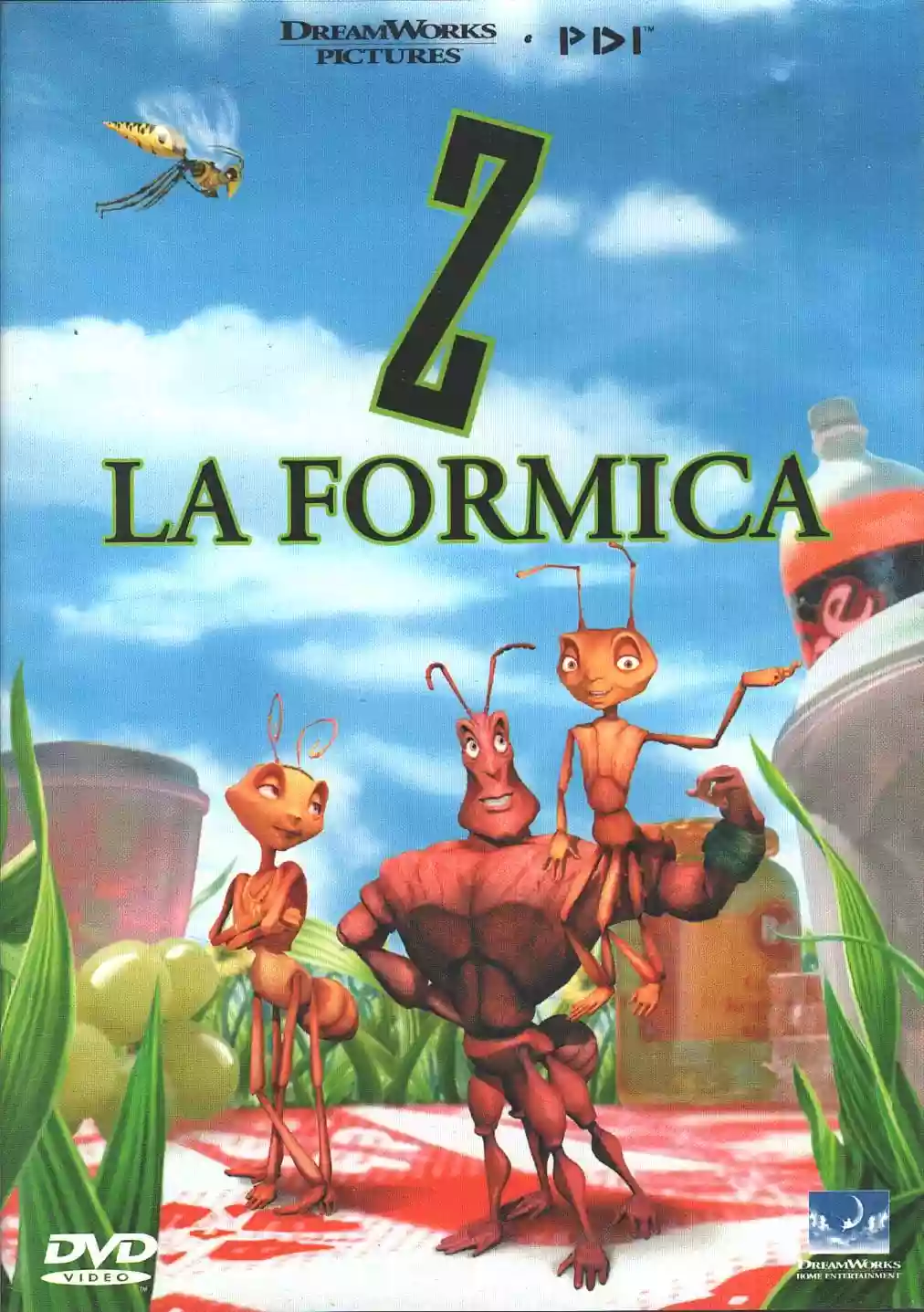
I remember 1998, the cinema rivalry was between this and “A Bug’s Life”, CGI animated films (an absolute novelty at the time) that talked about insects. I was just nine years old and in the end, I didn’t see either of them. In the years that followed, however, I remained a bit curious about this title, because it seemed to address some interesting themes.
In fact, it feels more like a short treatise on sociology and politics, a study in mass psychology explained in a simple way. I think I’ll show it at school, because in that sense it’s perfect. There are crowds of workers, armies, roles predetermined by those in power, conformity and rebellion. Z is a six-legged Woody Allen, the classic depressed nonconformist who doesn’t understand the rules that society imposes on us. It really does feel like watching Woody behind that gaunt little ant face.
Right from the start, the movie stands out as a small gem of “outside the box” thinking. Workers digging, soldiers marching to war against termites: but what’s the point? Why does everyone dance the same way? And what do they see in those drinks, or in those ladies?
Everything changes when the spark of love ignites. Z will do the impossible for his princess, even go to war. And here too, we find a series of jabs at the insane logic of military hierarchies, like the idea of relying on sheer numbers, or—at its satirical peak—the joy of victory for “1 to 0” when thousands of insects were fighting, on both sides.
We have the war hero, narrowly saved, who gets co-opted by the political-military power as a useful idiot for General Mandible’s nefarious ends. But this is above all a film about rebellion, so Z, partly by chance and word of mouth, becomes a revolutionary hero, and the masses start to follow him. Only to then settle for the first concession made by those in power.
We even have a utopian dream. “Insettopia”, a sort of promised land, a hippie dream of life released from duties, from which you soon wake up. At the end of the adventure, which is pleasing for its straightforwardness and effectiveness of metaphorical play, we even reach a kind of total conflict between the dictatorial model based on social Darwinism and the solidarity-based one, a kind of socialism of ants where only together can they save themselves from catastrophe.
Very useful for young people, as I was saying. As an adult, however, I still find several merits and a few flaws. The effect of estrangement is powerful: Z and his friends are us, those ants are humankind. But the strength of the story does not so much lie in the parallels between insects and humans, or between a trash can and the promised land. Rather, it lies in the inevitable observations we are led to make as a result: if the colony is an oppressive regime, the utopian dream is a brief side flicker, short-lived. Soon enough, there too arises the need to organize things, somehow.
A bleak and desolate vision of existence as a fratricidal struggle, a demagogic game in which the greatest and most insurmountable barriers are the ideas instilled in individuals’ minds by those in power. And everything unfolds in a patch of earth, between a fountain and a trash bin, in a park. It’s us, just like in Ginestra by Leopardi. Even utopian escapes cannot go beyond an Eden made of apple cores and Pepsi cans. Our own limitations constrain us, restrict us, and so we must look at things from a new angle—that is, the perspective proposed in the finale, where cohesion and unity of purpose, with no hidden motive, finally prevail. In the end, Z reevaluates his world, not because it’s better, but because this time he has chosen it.
An almost socialist fable that can come across as a bit formulaic, for sure. I think, for example, of some of Miyazaki’s films, where the political and sociological references have a few more nuances. But those in “Z” remain appreciable cues, above all because they come across strongly, hit hard with words and images, even without the benefit of a particularly captivating look, even for the time. Somber settings, lots of brown faces all alike, big eyes and fixed stares, terrifying monsters (the termites are scary), and a gallery of deformed, grotesque creatures. There is nothing here that invites a lighthearted viewing.
In short, cinema of a certain merit, even in its staging. In the distant 1998, people still believed—rightly so—that rudimentary CGI was enough to create terrifying, memorable sequences, and above all to spark a flicker of reflection on our own lives.
Loading comments slowly
Summary by Bot
The review praises 'Z la Formica' for its clever storytelling and engaging animation. Directors Eric Darnell and Tim Johnson deliver a film that's fun for both kids and adults. With sharp humor and memorable characters, the movie stands out among 90s animated features. The film receives a strong rating, highlighting its overall quality and entertainment value.
Eric Darnell e Tim Johnson
American animation directors best known together for Antz (1998). Eric Darnell later co-directed the Madagascar films; Tim Johnson directed Over the Hedge and Home.00 Reviews
