
 •
Rating:
•
Rating:
THE REVIEW
There are records that shout their worth, and others that assert it with silent elegance: “Wahoo!” (BST 84191) belongs to this second category.
In tune with the description made by Stephen Thomas Erlewine for AllMusic, I could sum it up for you with a single adjective: wonderful. This hard bop jazz album was recorded in November 1964 by Columbus Calvin “Duke” Pearson Jr., who was already an arranger, performer, producer and, after the death of Ike Quebec, the main talent scout for Blue Note Records under Alfred Lion and Francis Wolff.
Born in Atlanta, Georgia in August 1932, he began studying brass instruments at the age of five, but soon, due to dental arch problems, he was forced to devote himself almost exclusively to the piano. His precocious talent inspired his uncle, who guided him in his music studies, to give him the nickname Duke in honor of the jazz legend Duke Ellington.
His unmistakable piano style was inspired by the brilliant, fast, and daring phrasing of Bud Powell, but also by the rhythmic precision of Wynton Kelly and bassist Sonny Clark. Hired by the Jazztet of Art Farmer and Benny Golson, he moved to New York, where he was noticed by Donald Byrd, who immediately saw his potential as an arranger, so much so that he entrusted him with the arrangements for his historic album “A new perspective” (1963).
Duke Pearson played a very important role in directing the artistic trajectory of the label throughout the ‘60s, right up until the departure of its founders Lion and Wolff when they sold their brand to Liberty Records. His engaging arrangements were fundamental to the success of many Blue Note sessions. I especially recall such captivating compositions as “Cristo Redentor” for Byrd, those with an almost cinematic touch thanks to the flowing arpeggios in “Idle Moments” for Grant Green, or those from his own albums with a bouncy boogaloo theme (in the style of “The Sidewinder”) like “Sweet Honey Bee” and “The Phantom”, but above all the modal arrangements of “Wahoo!”.
Pearson recruited his line-up by calling: Donald Byrd on trumpet, James Spaulding on alto sax and flute, Joe Henderson on tenor sax, Bob Cranshaw on bass, and Mickey Roker on drums. However, what stands out is not so much the prestige of the musicians, but rather the internal balance of the groove they achieved. Pearson writes for the horns with an almost orchestral compactness, crafting incisive themes that serve as a springboard for solos that are always measured and never self-indulgent. In other words, this is not simply a modern jazz album, but a coherent project, architected with the precision of an arranger and the sensitivity of a melodist.
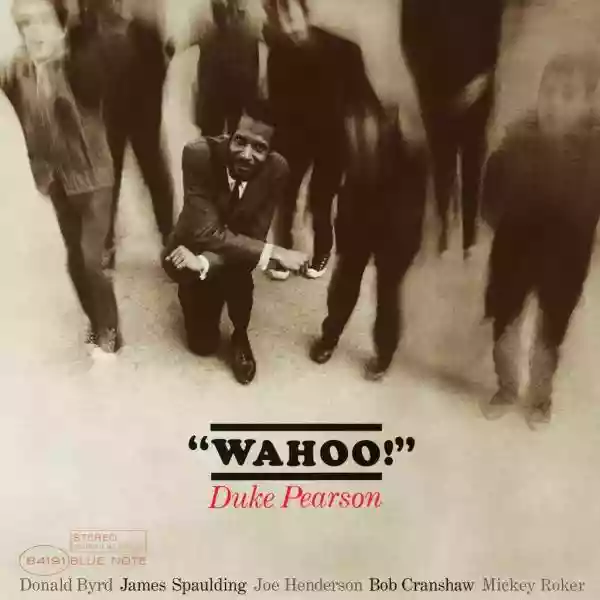
Now let yourself be transported back to 1964 by the magnificent cover photo taken by Francis Wolff. Duke is the only “fixed point” in a context of moving figures that seem almost evanescent. The cover art of Blue Note jazz albums was not just about aesthetics. It was an integral part of the record's cultural, political, and musical message, guiding the listener’s journey toward the recorded music. It had to capture the spirit of the artist and the group visually, often with a sense of elegance, modernity, and reflection. The original cover composition is attributed to Reid Miles, the legendary designer for the label, who unfailingly managed to combine Wolff’s shots (official photographer) with creative use of typography and graphic layout. Miles remains to this day one of the most influential jazz cover designers of the ‘50s and ‘60s, precisely because of his lean and minimalist style that has become iconic and highly recognizable in the history of music packaging.
The opening track, “Amanda”, immediately sets the tone: energy, thematic clarity, tight interplay. “Bedouin”, on the other hand, introduces a modal atmosphere and exotic suggestions that broaden the harmonic palette without losing stylistic coherence. In “Farewell Machelle” emerges the pianist’s most lyrical side, with elegant and melancholy writing that lets the melody breathe. The title track “Wahoo!” brings the focus back to the most vibrant hard bop, with Henderson particularly inspired and a rhythm section that pulses with ease. The record also includes "ESP," where the harmony creates a sense of “suspension,” consistent with the title (ESP = extrasensory perception), and the closing "Fly Little Bird Fly" composed by Byrd.
The album’s real strength lies precisely in its ability to hold together structure and spontaneity. Pearson never overdoes it; every arrangement has a clear design, yet the spaces for improvisation remain wide and vital. His piano does not seek muscular protagonism; rather, it works by subtraction, suggesting, framing, and dialoguing.
Listened to again today, “Wahoo!” appears as one of the lesser-known but most solid gems of the Blue Note Sixties catalog. It’s a record that does not rely on special effects, but on intelligent writing, mature interplay, and melodies destined to linger in the listener’s memory.
Loading comments slowly
Summary by Bot
This review highly praises Duke Pearson's 'Wahoo!', highlighting its innovative compositions and top-tier musicianship. The writer emphasizes its significance within the jazz genre and notes its enduring appeal. With exceptional arrangements and a stellar lineup, 'Wahoo!' is recognized as a must-listen for jazz fans. The review positions the album as both a quintessential Blue Note release and a timeless classic.
Duke Pearson
Duke Pearson (1932–1980) was an American jazz pianist, composer, arranger, and producer from Atlanta, Georgia. A key A&R figure at Blue Note Records in the 1960s, he collaborated closely with Donald Byrd and led sessions that yielded classics such as Wahoo!, Sweet Honey Bee, and The Right Touch.01 Reviews
