
 •
Rating:
•
Rating:
THE REVIEW
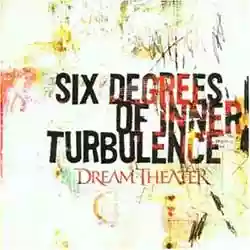
In February 2002, I decided to treat myself to a nice big record for my birthday. The choice could only fall on the brand new album by Dream Theater; this resulted in the considerable expense of L. 49,900, but I also considered the fact that it was a double album.
At first glance, "Six Degrees of Inner Turbulence" may seem a somewhat demanding album to listen to. It is.
The entire work has a total duration of almost one hundred minutes: the first disc consists of 5 songs, which have an average duration of ten minutes; the second is occupied by a single forty-two-minute song, actually divided into seven parts.
Anyone who has listened to the previous album "Scenes From a Memory" can't help but smile when they realize that the first track, "The Glass Prison," starts where that one, with "Finally Free," had ended: a slight sound like interference. Then two bell chimes. At the third one, we're in, it begins.
Distorted guitar strike and Portnoy eager to make the double bass drum sing: "The Glass Prison" is powerful and fast and leads the listening to the beautiful "Blind Faith," which then gives way to the calmer "Misunderstood." Hammering "The Great Debate" referring to the events of September 11, 2001, and finally "Disappear," slow, fascinating, wonderful.
The problem is that in my opinion, this would have been sufficient, but no, the Dream Theater adds a second disc with a track, bordered by "Overture" (they enjoyed it) with melody copied from Bach (cute, anyway) and "Grand Finale," thus another kind of theatrical text set to music. But it doesn't thrill me.
So what? As for the five, they've changed their hairstyles, except for the always thick LaBrie, who also decides to rest his vocal cords aiming at notes no longer as high as we were used to; from a musical standpoint, the inclusion of some DJ "scratches" is noticeable at one point. The rest is healthy prog-rock that we love so much.
Therefore: it's a very nice record and definitely worthy of purchase, but it has a weak, treacherous point: the quantity. In my opinion, the album is "too much," and this time the quantity somewhat annoys the quality ("The Test that Stumped Them All" I really do not like, but the whole Disc2 seems pervaded by a fundamental carelessness).
Moreover, this almost prevents the listener from fully understanding the work in its entirety. Too unravelled, excessive. A step back from 1999.
Loading comments slowly
Summary by Bot
This review praises Dream Theater's ambitious double album for its powerful prog-rock and notable tracks like 'The Glass Prison.' However, the extensive length and the second disc's composition are seen as a drawback. While still highly recommended, the reviewer feels the album sometimes sacrifices quality for quantity compared to their previous work.Tracklist Lyrics
Dream Theater
American progressive metal band formed in 1985, known for virtuosic musicianship and landmark albums such as Images And Words and Metropolis Pt. 2.160 Reviews
Other reviews
By Piccio
I believe this is an album worthy of being purchased, but it’s also true that only after many listens can its beauty be grasped.
It starts with a sequence of piano chords from the great Jordan Rudess that gives you chills on the spine from the very first listen.
By Dreamtheater
"Only after many hearings can you appreciate the beauty of this double effort."
"The final track is worth the price of the CD — beautiful, truly fascinating with a melancholic atmosphere."
By splinter
"Six Degrees Of Inner Turbulence marks a serious turning point in Dream Theater’s music."
"An album worthy of the best Dream Theater, almost on par with Images And Words, Awake, and Scenes From A Memory."
By mauro60
A stroke of genius!: a wonderful album, one of their best that contains all these forms.
"The Great Debate" is a phantasmagoric kaleidoscope of times, rhythms, original notes but with a classic aftertaste.
