
 •
Rating:
•
Rating:
THE REVIEW
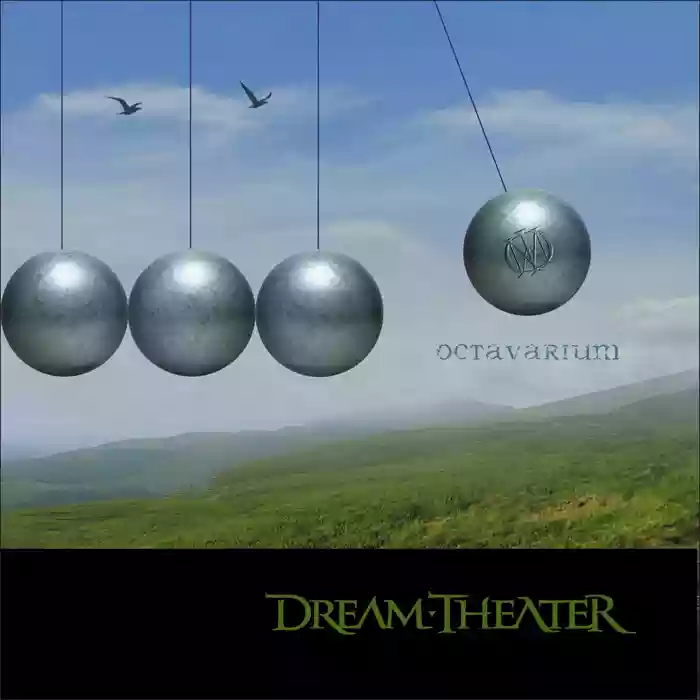
After the experimental "Train Of Thought," which somewhat echoed the dark and somber sounds of "Awake" without quite matching it, Dream Theater has released an album called "Octavarium," their eighth studio work. Thus, the symbolic number for this album is eight; indeed, there are 8 tracks that we will analyze, each revolving around different key signatures, except for the last and first tracks which both revolve around F, all to make everything a "perfect circle" and thus mirror an octave.
The lineup for this album consists of: John Petrucci, the virtuoso guitarist emerging from his solo project, who presented some excerpts at the G3, where he played with Satriani and Vai; then we have keyboardist Jordan Rudess, drummer Mike Portnoy, bassist John Myung, and singer James LaBrie.
We start with a solemn F pressed by Rudess's finger and some electronic effects accompanied by Portnoy's strong beat and Petrucci's enigmatic guitar: "The Root Of All Evil" is a track that takes over your body, it gets inside you with that voice and those truly aggressive riffs that feel like a cry of liberation. The chorus is wonderful, especially lyrically; the piece indeed continues the "saga" on alcoholism by Sir Portnoy, which began in '94 with "The Mirror" (a monumental piece) and continued with "The Glass Prison" and "This Dying Soul." The solos by Petrucci and Rudess also stand out a lot. A great start for the quintet, truly explosive. With a piano melody, we move to some chirping and then back to the piano and James's voice, which seems in great shape and at ease with this melody. "The Answer Lies Within" is a truly pleasant ballad that passes by like a sea breeze, and it's well-positioned in the album, especially as it perfectly contrasts with the previous piece. The following track is "These Walls," which revolves around a good synth melody by Rudess. The song fluctuates, with a crescendo from the verses to the chorus. The lyrics will appeal to those who, like me, are shy and erect walls in relationships with people, especially with women. Now comes the episode inspired by the sound of U2, namely "I Walk Beside You," easy for Petrucci & Co. It's the worst in my opinion of the album, though it's not bad or outright ugly, but it's clear it's less inspired and less personal sound-wise: I consider it a homage to U2's sound, who are, obviously, technically less compared to our quintet. But it's okay to have such an episode.
"Panic Attack" is introduced by the nervous riff of the timid Myung, who opens the dance for his colleagues with heavy and engaging riffs. This track, along with the following "Never Enough," is much inspired by the sound of Muse, but it does better than the latter, which I consider the second worst of the album, with Rudess wanting to overdo it with the keyboards. We move to "Sacrificed Sons," whose lyrics reference the 9/11 attack, thus more politically engaged. Musically, however, it starts very dramatically, also due to LaBrie's vocals, which don't poorly present the lyrics, the middle part is pure instrumental prog metal, with which the 5 have pampered and accustomed us. Finally, we have "Octavarium," a suite divided into 5 parts, paying homage to the great artists who inspired Dream, and, let me say, it is one of the most beautiful compositions I have ever heard from this lineup. It starts with a psychedelic atmosphere of pure Pink Floyd style, enriched by the continuum, an innovative musical instrument if used brilliantly as our Rudess does. Then it moves to an explosion of all the instruments, then flowing into a more Genesis-style sound, with that acoustic guitar and flute. The piece then opens by accelerating the tempos and energizing the atmosphere full of solo movements and truly ingenious things. Every element is in its place in this suite and takes center stage. The final part is something explosive never heard and will never be heard again from Dream Theater, the final solo then gives us a mix of endless emotions that cannot be described.
In conclusion, the album is neither the best nor the worst, an album not very personal from the band, excelling only for a few tracks like "Root" and "Sacrificed," and for the suite. The rest is quite decent, as it is well-played and with great dignity, so it deserves all 4 stars.
Loading comments slowly
Summary by Bot
Dream Theater's 'Octavarium' is an impressive eighth studio album featuring eight key-themed tracks, including the grand title suite. The album showcases virtuoso playing and strong lyrical themes, with standout songs like 'The Root of All Evil' and 'Sacrificed Sons.' Despite some less inspired moments, the album remains a dignified and powerful progressive metal experience deserving of four stars.Tracklist Lyrics Videos
Dream Theater
American progressive metal band formed in 1985, known for virtuosic musicianship and landmark albums such as Images And Words and Metropolis Pt. 2.160 Reviews
Other reviews
By Stratocontact
"This album showcases a different configuration from the previous ones, with less intricate sounds aiming for greater melody."
"After 75 minutes of listening, Dream Theater has achieved their goal; the quality of the product has not changed, whether one likes them or not."
By Lordsandreik
Let’s be honest, the Dream are NO longer the ultra-tech metal-prog-band they wanted to appear to be.
Maybe Dream, after reaching a good level worldwide, want to relax and enjoy fame and money, but I don’t think music, in general, can benefit from this.
By AndJusticeForAll
A disappointment? Yes. From Dream Theater, one expects something entirely different.
"Panic Attack" is literally a masterpiece, the song that makes the album worth it.
By Vinpe75
DT’s prog is back, listen to believe.
Notably, each song ends with the intro of the next.
By Metropolis79
Octavarium is the epitome of this, especially for the precise use of the real orchestra behind the New York quintet.
DT 'demonstrates they don’t need to prove' to anyone their technical prowess.
