 •
Rating:
•
Rating:
THE REVIEW
Here we are, this is my first review on this site, I hope to do a good job and pay homage with my writings to the groups/albums that I will be reviewing.
The first album I have decided to review is "Octavarium" by Dream Theater, a challenging album for the New York band to produce, still reminiscent of the glories of their early masterpieces (among others "Images & Words" and "Metropolis Pt.2") and of the penultimate 2004 album "Train Of Thought".
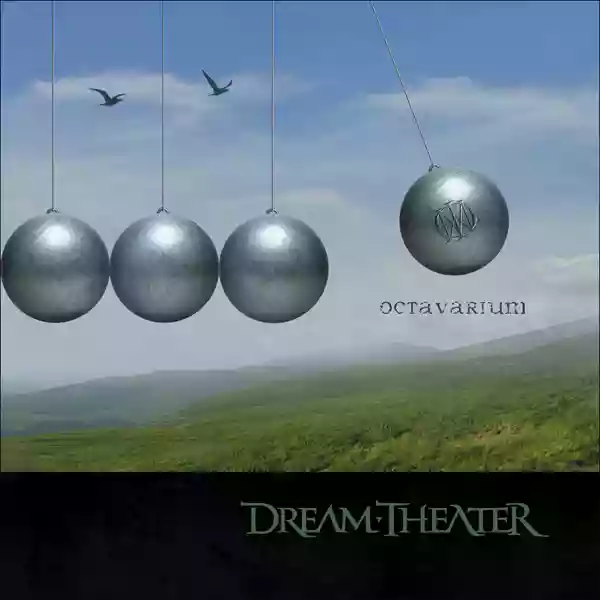
Let's start with the title, "Octavarium", which is meant to signify the eighth effort, work, (masterpiece?) of the American quintet, and with the artwork, which depicts a series of Chinese balls (those used for the conservation of momentum, if you know what I mean) where the last one has the band's symbol carved into it, and it's about to hit the other balls, against a background of green hills. The interpretation of this artwork could be that Dream Theater, with this new album, intends to replicate the success they had in the past with their other albums, using precisely the "physical" expedient of the conservation of momentum.
Now I'll say a few words about the Line-Up, which hasn't changed since the previous album, and consists of the "founders" of Dream (the band was originally called Majesty, in 1985) Myung, Petrucci, Portnoy, the now well-established James Labrie (who has produced all albums except "When Day And Dream Unite" with Dream Theater) and Jordan Rudess on keyboard.
I imagine that many readers, even before reading this review, will be thinking, "Here we go, another fanboy of Dream Theater! It's just technique for its own sake!" In reality, this album, regardless of one's opinion of Dream Theater, showcases a different configuration from the previous ones, there are indeed less intricate sounds (a result of constant refinement work or an attempt to achieve greater melody?) with songs that immediately strike the listener's ear, something that couldn't be said of previous albums, and represents an innovation, a challenge Dream Theater wanted to launch, and only time will tell if it was successful (there's the risk that the greater immediacy might, in the long run, bore those who listen to the album, especially those accustomed to Dream Theater's Prog).
The album consists of 8 tracks, and echoes the predominantly more thrash style (as already seen in Train Of Thought) of the American band in recent years.
The first track is The Root Of All Evil, where we have a mix of "Classic Prog" Theater sound and synthetic sounds, alternating melodic pieces with others more aggressive, showing influences from "This Dying Soul".
With the second and fourth tracks (respectively The Answer Lies Within and I Walk Beside You) the album assumes those melodic and, forgive me the term which doesn't intend to be negative, sweetened traits, which in the past characterized songs like Space Dye Vest or Wait For Sleep, pieces that demonstrate, among other things, the unfoundedness of some perhaps too hasty comments from critics "It's technique for its own sake! they don't show passion!" [...]
Here we are at track number 3, These Walls: an explosion of pure prog and melody, arpeggios and sounds worthy of the renowned Pull Me Under.
Panic Attack reveals itself as an ambiguous piece, indeed after a beginning, in my opinion, similar to those of System Of A Down (hence to Nu Metal), it falls back into Dream's prog/thrash standards, and the impact with the track can be problematic for the most devoted fans of this group.
After tracks 6 and 7, which follow the same line as the previous ones, we reach the last piece, Octavarium: just by reading its duration you can already sense the glories of A Change Of Season, 24 minutes where calm and sweet/melodic parts alternate with others of frenzied and prog rhythm, not forgetting the "usual" (again here I don't use the term in a derogatory sense, on the contrary!) solos and virtuosities of Mr. Petrucci's band.
In short, after 75 minutes of listening, at the end of this "eighth effort" I can state with relative certainty that once again Dream Theater has achieved their goal, despite the introduction of these new sounds, the quality of the product has not changed, whether one likes them or not. Well done.
Loading comments slowly
Summary by Bot
This review covers Dream Theater's eighth studio album, Octavarium, highlighting its blend of thrash and melodic progressive rock. The lineup remains strong and consistent, with refined compositions that balance virtuosity and accessible melodies. Noted for innovative songwriting and thematic depth, the album successfully builds on the band’s glorious past without sacrificing quality. The 24-minute title track encapsulates the album’s musical ambition and craftsmanship.Tracklist Lyrics Videos
Dream Theater
American progressive metal band formed in 1985, known for virtuosic musicianship and landmark albums such as Images And Words and Metropolis Pt. 2.160 Reviews
Other reviews
By Lordsandreik
Let’s be honest, the Dream are NO longer the ultra-tech metal-prog-band they wanted to appear to be.
Maybe Dream, after reaching a good level worldwide, want to relax and enjoy fame and money, but I don’t think music, in general, can benefit from this.
By AndJusticeForAll
A disappointment? Yes. From Dream Theater, one expects something entirely different.
"Panic Attack" is literally a masterpiece, the song that makes the album worth it.
By Vinpe75
DT’s prog is back, listen to believe.
Notably, each song ends with the intro of the next.
By Metropolis79
Octavarium is the epitome of this, especially for the precise use of the real orchestra behind the New York quintet.
DT 'demonstrates they don’t need to prove' to anyone their technical prowess.
By raziel054911
Octavarium is truly a masterpiece... a tribute to Pink Floyd, not just a simple cover inserted into the song.
This Octavarium seems to collect a bit of all the sounds heard so far, perhaps in a more catchy version, and ends with this 24-minute monument which frankly clashes a bit.
