
 •
Rating:
•
Rating:
THE REVIEW
"Minstrel" is a somewhat overused term these days: apart from the original meaning of a medieval singer-jester, in current language it generally refers to a composer of acoustic ballads making extensive use of unconventional instruments for modern music, associated with the very traditional use of the common guitar. But then by extension, it has become synonymous with anyone who started from folk roots, and in this way even someone like Bob Dylan, who had already decisively veered toward rock in 1965, ended up being forever labeled as a minstrel. A perfect specimen, in full rule, perhaps the very first to boast this title, was Philip Donovan Leitch, simply known as Donovan, who in the second half of the '60s managed to impose on a wide audience his somewhat naive sound, made of pastel colors, bucolic scenes drawn with classical instruments like violins, flutes, and harpsichords, but also exotic ones like the sitar.
A much richer and more flamboyant bloom of spectacular sounds with an ancient flavor would explode starting from the early '70s with the great progressive groups, but this Scottish singer-songwriter's undeniable merit remains that of having sparked this trend with his simple intuition, a trend that continued with ups and downs until the '90s, with the rediscovery of Celtic music and its contamination with modern electronic sounds.
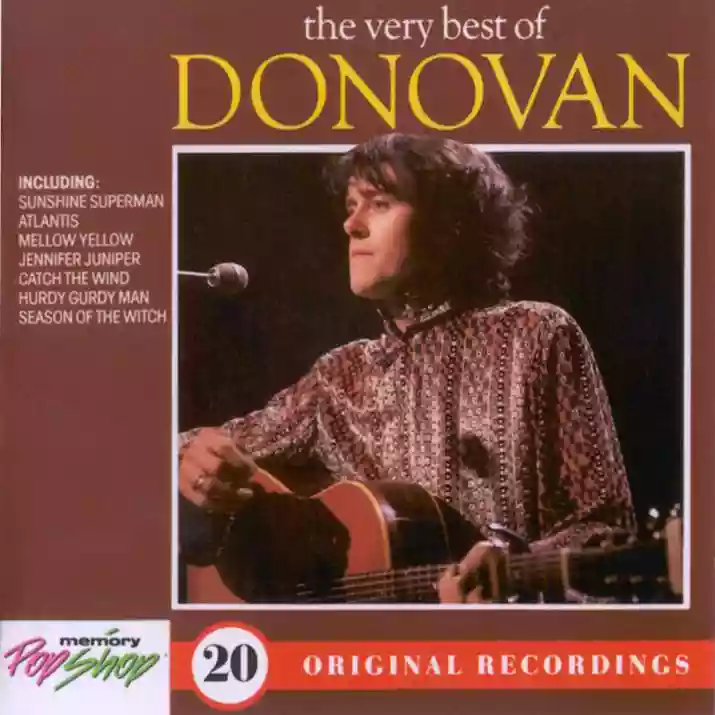
The rich collection "The Very Best Of Donovan" covers a period starting from 1965, in the midst of the Beatles era, the prehistory of modern light music, and ending precisely in the '70s. From the start, Donovan was oriented towards this type of folk, almost always based on a masterful use of acoustic guitars. In this, he was a precursor to Cat Stevens, who a few years later would bring the genre of acoustic ballad "à l'anglaise" to its peak. Among these delicate and relaxing songs stand out "Catch The Wind" and "Atlantis," great hits of the time, but much more interesting are some of the lesser-known ones, like the enchanting "Guinevere," where a peaceful pastoral bliss miraculously coexists with an Indian sitar, the almost equally poignant "Sailing Homeward," where Donovan's shy, soft, and slightly weak voice is supported by sublime acoustic guitar arpeggios, as well as in the sweet and dreamy "Lalena," where angelic flutes join in. "Celeste" is a deep dive into a remote time marked by the trill of the harpsichord, and other successful visions of enchanted and now lost worlds are "Colours" and "Jennifer Juniper," the latter with such a rustic flavor that someone deemed it suitable to accompany the picturesque but fake images of a Mulino Bianco commercial. Fairy tales and dreams are undoubtedly Donovan's ideal habitat: nothing could be further from the tangible and concrete anguish of Bob Dylan, who precisely in those years had almost definitively left the old folk path behind.
Conversations with fairies, gnomes, and elves can often reach celestial heights, but there is a risk of slipping disastrously towards nursery rhymes: it's the Achilles' heel of minstrels, including our own Branduardi. Thus, things like "Maria Magenta," "Barabajagal," and "Riki Tiki Tavi" emerge: for the latter two, the titles speak for themselves, and at the end even what remains his greatest hit, "Sunshine Superman," is saved only thanks to its asymmetric and original rhythm. "Hurdy Gurdy Man" stands apart a bit: here the soft colors are somewhat muddied, to the point that even a distorted electric guitar appears, grafted onto a rich acoustic base. "Mellow Yellow," another great success, is another "unicum" of the Scottish singer-songwriter, with its fusion of Beatlesque liveliness and vaguely jazzy cadences. Nevertheless, overall this collection is excellent for those who want to visit the visionary world of Donovan, with its peaks and its slips.
Loading comments slowly
Summary by Bot
This review highlights Donovan as a pioneering folk minstrel whose gentle acoustic ballads with exotic touches brought a unique sound in the 60s and 70s. The Very Best Of Donovan compilation captures his pastoral, dreamy style through both popular hits and charming deeper cuts. His work contrasts with contemporaries like Bob Dylan in its peaceful and imaginative themes. The collection is praised for showcasing both successes and whimsical moments, making it ideal for listeners seeking a visionary folk experience.Tracklist Lyrics Videos
Donovan
Donovan (born Philip Donovan Leitch) is a Scottish singer-songwriter who rose to prominence in the 1960s, moving from acoustic folk into psychedelic pop and related styles. Reviews frequently describe him as an underrated peer of the era, often compared to Bob Dylan, with a reputation for strong melodies, poetic imagery, and stylistic flexibility across decades.24 Reviews
