
 •
Rating:
•
Rating:
THE REVIEW
In September 1982, while listening to the top-selling singles charts on the radio in the Beautiful Country, I heard the announcer mention the name Dire Straits and a rather sappy track (which would later be revealed as "Private Investigations") with an omnipresent acoustic guitar intent on accompanying almost the entire composition, which left me a bit pensive.
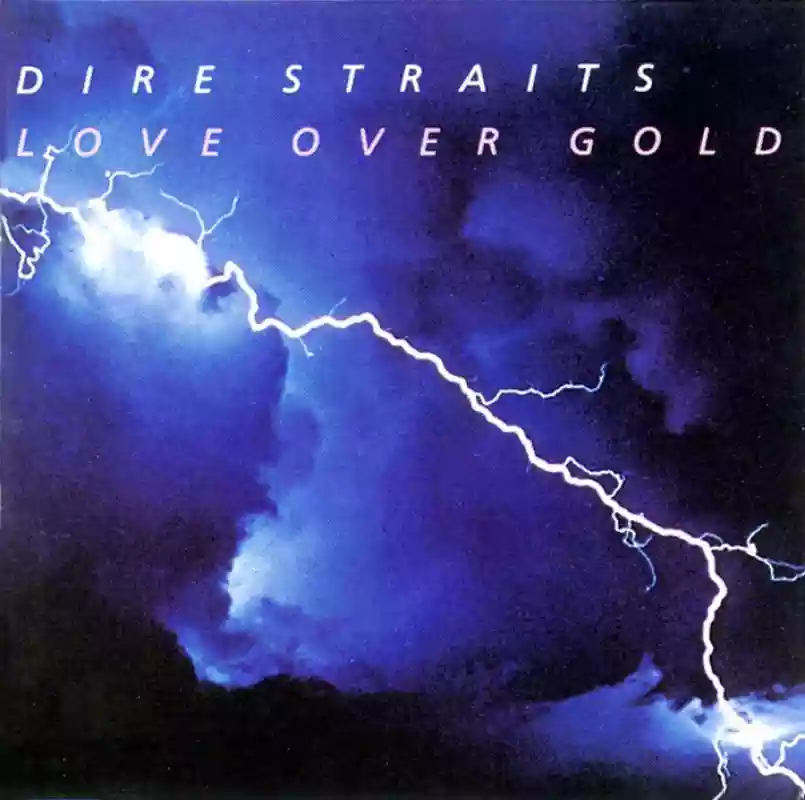
It certainly wasn't the track I expected to bridge "Making Movies" and its (more than worthy) successor "Love Over Gold." Indeed, with this album, several things have changed, starting with the official inclusion in the band of the highly capable Californian Hal Lindes (rhythm guitar) and the very talented Alan Clark (keyboards), and ending with the production work entirely taken over by Mark Knopfler. Additionally, the tracks are reduced to five, with a lengthening at the end (sometimes even forced?!) by at least a good minute and a half.
It starts with what I would define as the most provocative and complete track: "Telegraph Road." In this song, we find all the elements that characterize the Dire Straits sound: a slow and touching vocal performance that gradually becomes more rigid as the track takes off (and you enthusiasts know what I mean), the guitars and keyboards magically manage to walk on two parallel tracks, superbly merging into a unified whole in the lavish finale. In "T.R." as well as in "P.I.", the leader's inclination towards the western sound we've already discussed elsewhere becomes (as the attentive listener and perhaps even the less attentive one may have noticed :-)) a pivotal element for the Dire Straits of the '80s, and more than a premonition of what M.K.'s next future will hold.
Side two is inaugurated by "Industrial Disease," a track I would call a cheerful harbinger of good humor, revolving around a fun keyboard riff (now essential!!) and a mockery of industrial disasters that could occur. The title track is a real gem, an acoustic guitar that dominates the scene as well as one of the most intense vocal performances, and murky instrumental interludes that would well accompany a love encounter on celluloid (soundtracks on the way?). "It Never Rains," which impresses with its straightforwardness, reminds us that even Mark Knopfler knows how to compose captivating songs without producing a multitude of chords each time, and that anyhow, the endings are always the ultimate expression of his love for that instrument, which even today (and perhaps more in the past) more than others has marked most of the rock groups in history.
In conclusion, a product that, although less easy than the previous ones, represents the proper continuation of what has been musically conceived up to that point.
Loading comments slowly
Summary by Bot
The review praises Dire Straits' 1982 album Love Over Gold for its sophisticated sound and evolution from previous records. It highlights key tracks like "Telegraph Road" and "Private Investigations," notes the addition of new band members, and praises Mark Knopfler's production and songwriting. The album’s complex arrangements and emotional depth are recognized as a natural step forward in the band’s career.Tracklist Lyrics Videos
Other reviews
By Torre Ste
Dire Straits are capable not only of being romantic and cheerful but also very dark, capable of writing melodies like Pink Floyd.
Certainly the most underrated album by the group, not having a famous piece, but definitely the most complete.
By AJM
"Telegraph Road, ladies and gentlemen, is Knopfler’s Colosseum, it is Dire Straits’ Piazza Duomo, the Eiffel Tower of Love Over Gold."
"It’s a caress on the head, it’s the image of a woman seen crying through the window... you can’t help but love someone."
By Bromike
Mark Knopfler is one of the best English rock instrumentalists, easily surpassing the likes of Harrison, May, Richards, etc.
Telegraph Road describes a struggle against unemployment and society’s selfishness with remarkable solos and rich keyboard phrases.
