
 •
Rating:
•
Rating:
THE REVIEW
By now accustomed to a long sequence of - excellent - performances by our band, delving into a rather obscure and unknown past, as is appropriate for a band of such a genre, we would expect to find a style comparable in every way to recent releases such as Death Cult Armageddon, Enthrone Darkness Triumphant, or In Sorte Diaboli. None of this.
That is, the usual hallmark that will forever make Dimmu Borgir recognizable in their genre, and from lesser-caliber groups, is present in the usual manner, and no factor in this album is inferior to the standard that some self-proclaimed purists of the genre claim to have "established" and not found in this work.
What changes is probably only the dose of gratuitous malice which, in my opinion, is much more present in this first full-length of the band than in other releases, starting with the subsequent "Stormblåst." Malice perhaps dictated by a certain immaturity, some enthusiasm, or maybe due to a different lineup (Shagrath was behind the drums then, while future drummer Tjodalv was playing the guitar). Malice that nonetheless does not worsen, on the contrary!, the depth of the songwriting, of which some say is lacking due to the weak contribution of the keyboards... But let's leave that aside and return to the album.
"For All Tid" (For All Time) opens with an unusually slow piece, "Det Nye Riket" (The New Kingdom), of a clearly gothic flavor, composed mainly of those keyboards that, rightly so, would make the fame of our band. The base, alone worthy of the value of the track, guides a recitation that speaks of hate and darkness, leading seamlessly into the next track, accustoming and forcing the listener into a state of trance, from which they will suddenly awaken with the very first notes of "Under Korpens Vinger."
The track is a true gem of evil, nihilistic, bloody black, where little remains of the Borgir symphonism. The violence of the track, erroneously defined as instrumental and thus officially lacking lyrics, is amply demonstrated by sick and acidic screaming, supported by minimalist keyboards and a riff as icy and dark as the title of the song (Under the Wings of the Corpses, or something like that...)
The next track is "Over Bleknede Blåner Til Dommedag" (On the Fading Horizons in Blue Towards Judgment Day), the most "viking" track of the entire CD. Viking in terms of lyrics, and Viking in terms of the guiding riff, a pompous and grandiloquent riff leading a refrain with unmistakable Nordic flavor sung in clean voice. Otherwise, truth be told, the song consists of an alternation of verses sung with harsh screaming and others recited in clean vocals, of somewhat dubious taste, to be honest. However, the presence of perfect and fitting keyboards still leaves the piece a cut above the average.
The brief "Stien" (The Path) follows, the first true filler piece of the album, which adds little to what was created by the three preceding tracks. Still, it's pleasant to listen to, fast, aggressive, with a remarkable final nod by Shagrath.
Moving on to the second instrumental, "Glittertind" (Glittering Peaks), thoughtfully composed and structured, albeit not at the levels of Under Korpens Vinger or Den Gjemte Sannhets Herskar. Another gem of the album follows, the title-track "For All Tid." In my opinion, it is the true symbol of the album, beyond the title: a cold, aggressive, hate-filled piece, as distant as ever, where the symphonic component plays an absolutely fundamental role. A piece to dedicate to those you hate the most yet love the most.
Next is undoubtedly the least successful chapter of this black book: "Hunnerkongens Sorgsvarte Ferd Over Steppene" (The Black Sorrowful Journey of the Hun King Over the Steppes). Predictable flow, zero depth, terrible production, a downright ridiculous chorus...
But Shagrath and the others come back with great mastery in "Raabjørn Speiler Draugheimens Skodde," justifiably considered by many as the masterpiece within this masterpiece. The piece features a marked technique, the articulation of different components - the atmospheric part, an integral part of the entire full-length, the evilness pushed here to the extreme, and the undeniable nod to the '80s heavy-death which Dimmu Borgir are singers of as much as Wagner or Dvorak's symphonies. It continues with the much-acclaimed "Den Gjemte Sannhets Herskar" (The Lord of the Hidden Truth), a falsely instrumental piece, chilling in its slowness and tranquility, accompanied by Shagrath's usual vocal performance, better than in recent albums, whatever one may say.
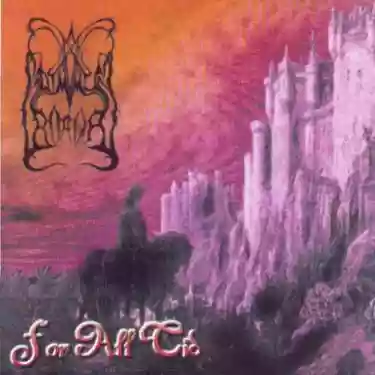
And so the album as produced by No Colour Records ended, with a black and white cover and a truly darkthronian production. But in more recent years, Nuclear Blast decided to rediscover this gem of the genre, preventing it from being forgotten, overshadowed by recent performances: thus the cover was filled with color, losing part of its medieval tone, and the album was complemented by two bonus tracks, taken from the previous demo Inn I Evighetens Mørke (the title-track and its part 2), the first instrumental and the second with truly infernal speed and aggression, to live up to their name (In the Darkness of Eternity).
In conclusion, an album not to be missed to rediscover the true Dimmu Borgir, even for those who firmly claim to hate their recent sound, focused on "commercialism" and "posism"...
Loading comments slowly
Summary by Bot
This detailed review praises Dimmu Borgir's debut album 'For All Tid' for its raw malice, gothic atmosphere, and strong symphonic black metal style. It highlights standout tracks like 'Under Korpens Vinger' and the title track, while acknowledging minor flaws. The album is recommended for fans wanting to discover the band's authentic early sound, distinct from their later more polished works.Tracklist Lyrics Videos
Dimmu Borgir
Dimmu Borgir is a Norwegian symphonic black metal band known for combining extreme metal with prominent keyboards, choirs, and orchestral arrangements.23 Reviews
Other reviews
By wwwhatemoornet
If this had been the CD of an unknown group, Nuclear Blast wouldn’t have reissued it… allowing the luminaries of print and virtual media to weave endless praises on the melancholic mood, on the complex Norwegianness of the compositions, and on other bullshit that even they don’t know what the hell they mean.
Ultimately, a decent album that rearranged would become a MASTERPIECE.
By sly
The keyboards... manage to give the tracks an almost mystical aura.
Every time he sings, I feel a pang in my heart.
By Broderskapet
Black metal played differently: terrifying, unsettling, cruel, magical, damnably moving, and sincere.
The nine songs on the album are black gems that shine for their intensity.
