
 •
Rating:
•
Rating:
THE REVIEW
Uh-oh! We are pointed out that this review also appears (in whole or in part) on truemetal.it
Year 1979, a boy who loves bands like Thin Lizzy and UFO decides one day to start his own band with some schoolmates, and he chooses the name "Def Leppard" (from a distortion of deaf leopard: "deafened leopard").
That boy was the now-famous Joe Elliott and his friends were Rick Savage (bassist), Steve Clark (guitar), Pete Willis (guitar), and Rick Allen (drummer)... the latter was only fifteen at the time! After a period of rehearsals, the newly formed band recorded its first EP entitled "Getcha Rock Off," which miraculously began to be played on the radio quite frequently. It was thanks to this fortunate promotional launch that the British combo had the opportunity to open for famous artists like Sammy Hagar and even ACDC, all of which further increased the group's popularity in Great Britain.
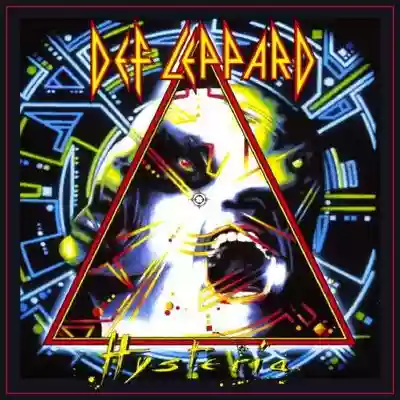
The year 1980 marked the official recording debut for the band led by Elliott, which recorded "On through the night" produced by Tom Allom, already a producer for Judas Priest. The record had a fair amount of success, climbing the charts, and taking the band on tour in the States in support of ACDC and Ted Nugent. After a second album that only consolidated the moderate success the band had achieved so far, and the release of the third excellent "Pyromania" (1983), 1984 opened a dark chapter for Def Leppard that would later threaten the very foundations of the entire musical project. In fact, the drummer of the British combo was the victim of a serious accident that left him with a severed arm. The band, with much courage and determination, decided not to break the alliance among the founding members and, after a period of rehabilitation and training for the drummer on a drum kit specially built for him by Simmons, they ventured into composing the album that is still considered their greatest success (both commercially and compositionally), "Hysteria."
The album was released in 1987 and marked a kind of turning point in terms of arrangements, feeling and, why not, approach to the hard rock that had been played by the British band until then. The compositions on this album are more sophisticated, arranged with a very refined taste for melody and with a truly fit Elliott.
The work starts with "Women" a piece with a cadenced drum pace that soon allows the guitars to intervene, creating a very engaging harmony. The rapport among the instrumentalists is on very high levels and Rick Allen's electronic drums fit perfectly in the slightly more hard rock parts that permeate the song. The piece manages to capture the listener's attention, and the great class of the arrangements, a true surprise of the album, makes the entire track smooth and enjoyable. An intro entrusted to a kind of "radio contact" between an airbase and perhaps the band itself introduces us to the following track, "Rocket". The cadenced pace of this song truly expresses the essence of the title, emphasized in the choruses that are forcefully inserted multiple times throughout the duration of the piece. With "Animal", we enter the true musical discourse set by this album, with a very well-crafted melody, superb arrangement, and a catchy chorus that immediately sticks in your head. The piece has a very captivating start with two guitars well-synchronized on simple yet not banal harmonies, "Love Bites" is a very sweet ballad in its "discreet" pace, with few arpeggios creating an almost "sensual" atmosphere and hitting the title's meaning right on point. Here too, Elliott's good performance cannot escape the listener's attention, who can let themselves be "carried away" in a very captivating refrain. The following "Pour Some Sugar on Me" has a "rocking" pace in its riffing and chorus, with a very spirited Elliott in his role as vocalist. The chorus is catchy, and the cleanliness of execution is, as usual, remarkable although at some points the song seems to "lose itself" in superfluous "pauses". "Armageddon It" brings us back to energetic and vital sounds, yet never losing the standard elegance of the vocal and instrumental execution. This time the piece is also played with multiple atmospheres: from the more impactful one to the melodic until it culminates towards the end of the track in a guitar interplay that gives the piece a touch of "brightness". The following "Gods of War" features an evocative intro, with clearly audible background sounds of gunfire, followed by a classic opening riff that later finds its outlet in a leading arpeggio performed with the usual grace by the Clark/Willis duo.
With "Don't Shoot Shotgun" the rock soul of the band comes out again and here too the group's talent is evident in nailing simple and "uplifting" riffs alternated with elegant arpeggios throughout the piece's duration. The piece, although very discreet, hints at a certain hard-rock sound reminiscent of AC/DC, especially in a well-executed "plucked" riff typical of the band led by the Young brothers. The ninth track, "Run Riot", has a sustained rhythm and gritty riffs, and Elliott's vocal performance in these moments is perfectly at ease, giving the song notable vitality and depth at the same time. With the title track, "Hysteria", the band returns to explore warm and melodic sounds. The piece has the structure of a semi-ballad and is almost entirely centered on a delightful yet simple arpeggio. The song flows smoothly, and a beautiful solo, very melodic in its arrangement, embellishes its arrangement. The penultimate piece, "Excitable", has a very "catchy" riff supported by a vigorous rhythmic section. Almost the entire track is played on catchy yet appealing and almost "sensual" riffs, although the refrain might be repeated a few too many times without finding alternative developments to the overall musical line the piece takes.
The album closes with "Love and Affection", a piece that perfectly maintains the "elegant" standard of the entire work, resulting, despite the excellent arrangement and execution, more of a filler than a fundamental song of the album.
In essence, we can say that with this album the "heavy-rock" cycle started by the band with albums like "On through the night" and "Pyromania" came to a close, and another one opened, more oriented towards a melodic and refined hard-rock but always performed with the typical class of the "Deafened Leopards".
Loading comments slowly
Summary by Bot
This review delves into Def Leppard's landmark 1987 album Hysteria, highlighting the band's resilience after a tragic accident and their musical evolution toward more sophisticated melodies. It provides detailed track analyses, praising the arrangements and performances. The album marks a turning point from heavier rock to a refined melodic hard rock style, showcasing the band's talent and class.Tracklist Lyrics Videos
Def Leppard
Def Leppard are a British rock band from Sheffield, formed in 1977. They became global stars with Pyromania (1983) and Hysteria (1987). Drummer Rick Allen lost his left arm in a 1984 car accident but continued with a custom kit; guitarist Steve Clark died in 1991. Their polished, chorus‑driven hard rock bridged NWOBHM and pop‑metal.14 Reviews
Other reviews
By SmknToyz87
A pure concentrate of Energy (yes, with a capital E), a succession of potential chart hits from the eighties that follow one after the other.
One of the greatest living examples of a musician, tenacious and professional.
By Theisland
Hysteria is the platinum standard for what 80s rock could be.
Every song is a polished anthem that still echoes through rock history.
