
 •
Rating:
•
Rating:
THE REVIEW
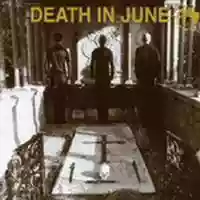
Released in 1984, "Nada!" can truly be considered the real first album by Death in June, the work in which the distinctive traits that will characterize the Death in June ethos throughout their subsequent production emerge in explicit and complete form. Here, in fact, blossom ideas that were only sketched out on the previous "The Guilty has no Pride", certainly a good debut but undoubtedly still too anchored to certain stylistic elements typical of the early 1980s post-punk/dark scene (did someone say Joy Division?).
Having lost Tony Wakeford along the way (who will go on to form the equally seminal Sol Invictus, another pillar of apocalyptic folk), and with him the punk fury of their beginnings, the project comes under the artistic direction of Douglas Pearce, who reinterprets Death in June's music with a more intimate and spiritual perspective. Supporting him, we still find the indispensable Patrick Leagas, whom I consider a truly charismatic and often underestimated figure: an immensely powerful drummer (watch the filmed evidence of their early live appearances), as well as a competent singer and a providential trumpeter, he, in my opinion, contributed greatly to building the martial and Central European component of Death in June, an aspect that, at least initially, helped them emerge and stand out from the rest of the scene. And his imprint can certainly be felt in this "Nada!", which also constitutes the last Death in June album as a group.
The work, perhaps the most varied and eclectic in the entire Death in June production, shines due to the contrasting personalities of its two authors, one introverted, the other exuberant: on one side, Douglas refines his acoustic and intimate balladry, which will subsequently become a real trend and the group's trademark; on the other, there are industrial tracks with a strong percussive element, where Leagas' contribution was certainly significant. The entire album seems to play on the contrast of these two elements, so we're not surprised to find two songs like the beautiful and poignant "The Honour of Silence" (a true anthem to solitude, with its acoustic gait and its pained and resigned singing, it encapsulates all the elements of the forthcoming Death in June philosophy) and the relentless "The Calling" (characterized by the dance rhythms of an aggressive drum machine and Leagas' baritone voice in full Bauhaus style) side by side. And continuing with the listening, one will frequently encounter a decidedly varied range of sounds: from the mournful singing of a trumpet to the roar of military percussion, from melancholic keyboard layers to the pulsation of minimal electronics, all set in a pessimistic and paranoid framework, where the legacy of late 70s British industrial music (one name above all: Throbbing Gristle) and the influence of a certain early decade electronic wave are crucial. Not to forget a slight noisiness that might recall certain works of early Einsturzende Neubauten.
"Nada!" thus represents a phase of transition, a laboratory where one attempts to focus on their identity, a sort of brainstorming session where the most disparate expressive vehicles are surveyed. But it is precisely the absence of a formal constraint that gives this work an intrinsic freshness, a bursting force, and a sense of freedom that we might not find in the project's subsequent production (which will progressively crystallize into a well-defined form until reaching the downright mannerism of their latest works). It is not a coincidence that we encounter the finest results, the absolute classics of the repertoire, both on the acoustic side, like the brief, Morricone-esque (due to their epic gait) "Leper Lord" and "Behind the Rose (Fields of Rape)" or the stirring "She Said Destroid" (a true anthem to be sung at the top of one's lungs), and on the industrial/noise side, like the percussive and declaiming "C'est a Reve", still performed live today, or the very sad "Crush my Love".
What makes the difference is the strong and complex personality of Douglas P., capable of wrapping the dark imagery of the era in unprecedented shades, absorbing its elements and reinterpreting them in his own way, not without a good dose of irony and sense of the absurd, transforming it into something different and highly original, a way of understanding music that, despite its extreme simplicity, no one has been able to match. But it is not only the undeniable talent of the artist that gives unity to the whole, the various elements indeed find coherence and homogeneity in the tense and martial atmosphere that permeates the entire work, a strange blend of anger and impotence, struggle and resignation, defeat and honor, tragedy and disillusionment, a sense of imminent end and nostalgia for an irretrievable past. Here the fate of the old and glorious Europe is sung and wept, a land now in decline, losing its identity and leadership role, whose values are experiencing a moment of disintegration, obscured by the uselessness, ignorance, superficiality, and cowardice prevalent in a mass and consumerist society like the one we live in, dominated by an economic system that aims precisely at intellectual flattening, homogenization, and leveling of the individuals who are part of it.
Hence the disorientation and the sense of impotence, hence the adoption of war imagery as an expressive vehicle to extrinsicate and mask the neuroses and existential discomfort of the artist, and at the same time as a symbol of the necessity of struggle (in a Nietzschean sense), as a warning not to give up despite the inevitable end. The penalty for the end of Man. These themes and moods will become the group's distinctive trait and will be better conceptualized in subsequent works and particularly in that Brown Book which will be celebrated as the manifesto of apocalyptic folk.
What can I say, in my humble opinion we are facing the absolute masterpiece of Death in June (at least regarding the first era), the year zero of apocalyptic folk, a true must for anyone wanting to approach the group and the entire genre for the first time. The fact that the right-wing references aren't too intrusive here also makes it appealing to all those who have always struggled to digest such an attitude.
In a word: essential.
Loading comments slowly
Summary by Bot
Released in 1984, 'Nada!' marks Death In June's defining moment, blending intimate folk ballads with industrial and martial sounds. Douglas Pearce and Patrick Leagas's contrasting styles create a varied, eclectic album that laid the groundwork for apocalyptic folk. The album's themes evoke European decline, struggle, and nostalgia, wrapped in dark, poignant imagery. Regarded as the group's masterpiece, 'Nada!' remains a must-listen for fans and newcomers alike.Tracklist Lyrics Videos
Death in June
British music project led by Douglas Pearce (Douglas P.), formed in 1981, known for apocalyptic folk, martial/post-punk inflections, influential 1980s–1990s albums and contentious wartime imagery.36 Reviews
Other reviews
By Rocky Marciano
"Nada! marks an important turning point in Death in June’s career, incorporating electronic sounds and neo-folk hints into the band’s dark and shadowy sound fabrics."
"‘The Honour Of Silence’ engenders exhilarating epiphanies and serious atmospheres, Douglas P.’s voice standing proudly over acoustic guitar arpeggios and triumphant trumpet inserts."
