
 •
Rating:
•
Rating:
THE REVIEW
Guys/girls, what a book, what a book… I won't add anything else, actually no, I'll say more, um, I'll be brief:
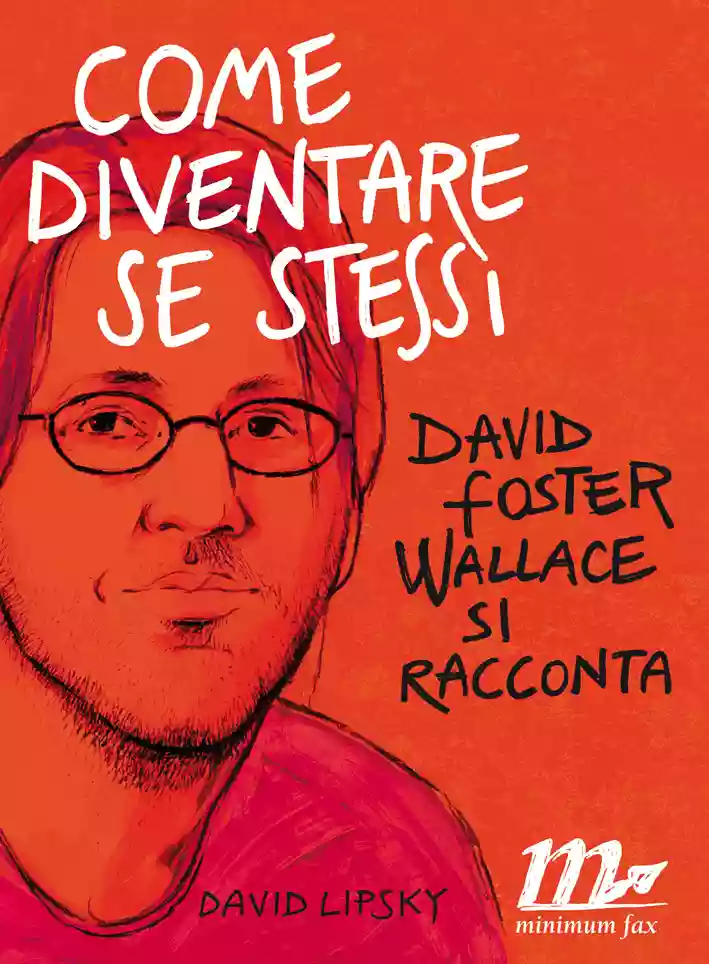
The original title would be “Although of Course You End Up Becoming Yourself” and its subtitle remains “A Road Trip with David Foster Wallace” transcribed by David Lipsky (son of the um, famous painter Patricia Sutton “Pat” Lipsky…) after freezing (for about fourteen years) the interview he conducted with DFW back in ’96 on behalf of the magazine "Rolling Stone" (an American periodical of music, politics, and pop culture).
After finishing reading this extensive interview, which consisted of a good 443 little pages, I can only say that DFW's figure comes out somewhat downsized (especially by himself), as it reveals a profound emotional and psychological fragility that he had been dragging along since his youth, towards life and other human beings (excluding family), a fragility that becomes strength, or rather because it will push him to write, eventually making him stronger towards what's outside, but alas not in what he carried inside (and the sad end he met is known to all of us who have already read something of his).
In addition to DFW and his success as a writer, the book also talks about different music and cinema, and of course (ça va sans dire) about the literature with which he had to coexist, here en passant are some film titles:
“When Harry Met Sally” by Rob Reiner, ‘89.
“Eraserhead” by David Lynch, ‘77.
“Twin Peaks” also by David Lynch, ‘90-‘92.
“Blue Velvet” of ‘86, “Lost Highway” again by David Lynch, ‘97 (of which he will say “the movie wasn't much”; he will call it «a half flop»,
«David Lynch doesn't lose his head», «In Lynch there is a coldness and malice that I don't like but at the same time fascinate me. In short, we like to watch sadism from a certain distance»).
“Miller’s Crossing” by the Coen Brothers, ’90.
“Thief” by Michael Mann, ’81.
“Die Hard” by John McTiernan, ‘88.
“Metropolis” by Fritz Lang, 1927.
“The Cabinet of Dr. Caligari” by Robert Wiene, 1920.
“Braveheart” by Mel Gibson, ‘95.
“Always” by Steven Spielberg, ‘89.
“Schindler’s List” also by Steven Spielberg, ‘93.
“Brazil” by Terry Gilliam, ‘85.
“True Romance” written by Quentin Tarantino and directed by Tony Scott, ‘93.
“Crimson Tide” also by Tony Scott, ‘95.
“Glory” by Edward Zwick, ’89.
“Broadcast News” by James L. Brooks, ’87.
“The Hit” by Stephen Frears, ‘84.
“Four Rooms” by Quentin Tarantino (and others), ‘95.
“Blade Runner” by Ridley Scott, ‘82.
“The Dirty Dozen” by Robert Aldrich, ‘67.
“Kelly's Heroes” by Brian G. Hutton, ‘70.
Ok, here, I don't want to bore you too much with the (endless) lists of books and records mentioned, otherwise brevity goes to hell brùt and nothing… actually no, now that I remember, from this interview first recorded on mini cassettes and then transcribed, the film "The End of the Tour - A Trip with David Foster Wallace" was made, directed by James Adam Ponsoldt, presented during the Sundance Film Festival 2015. (which I haven't had the pleasure of seeing)
Loading comments slowly
Summary by Bot
This review praises David Lipsky's book capturing a deep 1996 interview with David Foster Wallace. It reveals Wallace's emotional vulnerability alongside his creative strength. The book also explores cultural references in music, film, and literature. The review highlights the book's rich detail and lasting significance. It also notes the film adaptation, The End of the Tour.
David Lipsky
American novelist and journalist, author of The Art Fair, Absolutely American, and the transcribed Rolling Stone interview with David Foster Wallace (Although Of Course You End Up Becoming Yourself).01 Reviews
