
 •
Rating:
•
Rating:
THE REVIEW
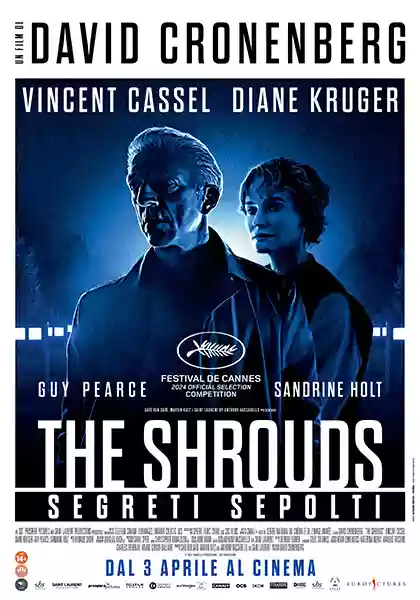
How can a world that deifies bodies in a continuous media (over)exposure cope with death and the decay of flesh? It's obvious: by transforming them into a three-dimensional interactive experience for smartphones, tablets, and various screens. There are Karsh's innovative shrouds that allow observing bodies as they disintegrate underground, as if the vision of decay could somehow preserve the integrity of feelings for a deceased wife or for other departed loved ones of his cemetery-restaurant clients.
And while the protagonist's spouse dissolves and decays, her body lives on and endures as an illusion in augmented reality, an electronic projection simulating those now-lost forms. And Karsh's love (an excellent Vincent Cassel) seems to cling only to those, like a fetish, unable to rise a little higher and beyond.
Cronenberg seems to construct a dual reflection-puzzle. On one hand, there's his figure as a filmmaker, the director-author represented by the same Karsh questioning his fame morbidly tied to corporeality and all its degenerations. On the other hand, the film seems to deliberately derail into an incomprehensible labyrinthine nightmare that clearly parodies the current world dominated by post-truth, extreme conspiracy theories, the pervasiveness of technology and AI (always a bit suspicious), by a carnal hedonism now devoid of soul and values.
And paradoxically (only seemingly), the quintessential body horror director arrives at a harsh critique of a society of exposed and revered bodies as the only value. The wife Rebecca (Diane Kruger) shatters, is mutilated, but not due to a Russian-Chinese conspiracy, nor to the dark schemes of her former lover professor stationed in Iceland. It is Karsh's feelings corrupted by carnal vice (new women and lovers always a little "unorthodox") that mortify, mutilating her projection in the woman's virtual reality.
As if to say: there is no technology capable of preserving the ideal forms of love, and it is not death that kills, but the corruption of the soul. In a labyrinthine world, where the surplus of information distances from truth instead of bringing closer, the individual’s moral path towards wisdom and understanding-acceptance of pain becomes increasingly difficult, if not impossible.
We are lost among our fetishes, each with its conspiracy, its pathetic portion of truth, its large or small dose of perversion fueled by screens, videos, smartphones that will haunt us even in the grave.
Loading comments slowly
Summary by Bot
The Shrouds by David Cronenberg delves into the clash between corporeal decay and modern technology, exploring how augmented reality shapes our perception of death and love. The film is a dark, labyrinthine reflection on media obsession, post-truth culture, and the corruption of the soul. Through haunting body horror and nuanced characters, it critiques society’s fixation on physical appearances and technology’s failure to preserve true feelings. Vincent Cassel and Diane Kruger deliver compelling performances in this thought-provoking narrative.
David Cronenberg
David Cronenberg is a Canadian film director known for films that explore the body, identity, technology, sex, and psychological transformation, and he is widely associated with body horror and the notion of the “new flesh.”24 Reviews
