
 •
Rating:
•
Rating:
THE REVIEW
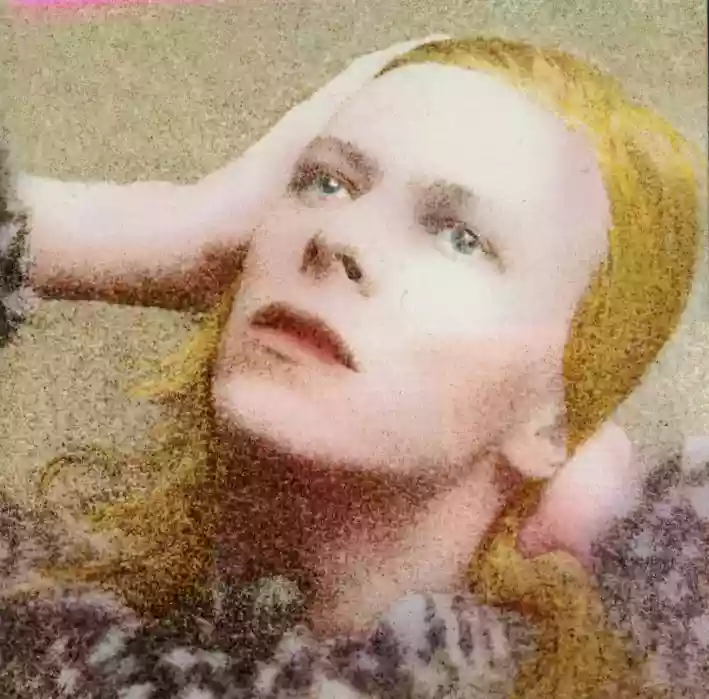
We are in 1971. In the same year as The Man Who Sold The World, Hunky Dory is also released. And the cover is clear: it is no longer possible to tell if Bowie, in the fiction of the pop-art image, but especially in reality, is a man or a woman. The artist clearly embraces the nascent glam rock (especially thanks to the work of Marc Bolan's T. Rex), but his contribution will be crucial in renewing the genre.
Uninhibited pop, distortion of American country, an aesthetic based on ambiguity and transformation. Hence the famous Changes, a striking beginning of an album destined to leave a mark in the entire history of rock. Simply Changes, simply changes. Simply evaluations on transformations, modifications, masks to wear in life. And it is precisely a mask that Oh You Pretty Things, the second song and classic of the album, wears. The ballad dresses up in musical disengagement characterized by simple evanescence, but what is substantive is the distorted voice, the unabashed and mocking tone: Bowie assumes the androgynous guise of Bowie, and what remains will be an indelible trace in glam rock. Then follows the ballad Eight Line Poem with the syncopated rhythm of a delicate piano and brief guitar lines. In three pieces Bowie demonstrates singing in three totally different vocal registers. But the best is yet to come.
Life On Mars?. It's hard not to appreciate this track. Both from the perspective of an expert music critic and from the viewpoint of a rock layman accustomed to pop songs by Robbie Williams. The majestic orchestrations, one of the most beautiful and convincing choruses in history, perfect arrangements in their expressive effectiveness. All permeated by a visionary text characterized by characters like John Lennon and Mickey Mouse. Naturally, there's more: the song ranges from parody to genre hybridism, the plunge into consumerism is declared the moment a film's fiction becomes more reassuring than reality itself.
So. In conclusion. Life On Mars? is the most beautiful song ever written by Bowie. Maybe it's true. But maybe instead it's just a stage of his fickle journey with its many faces (or masks). Let's not forget that the following year David Bowie would release another masterpiece. The extraordinary rock opera on the subsequent transformation of the artist into Ziggy Stardust of which Life On Mars? is clearly the anticipation.
Kooks is dedicated to his son Zowie, and it's a tune with simple listening characterized by clear and genuine trumpet appearances by Trevor Bolder. The subsequent Quicksand is also an acoustic ballad, but the atmosphere is darker, and the lyrics are marked by obscure references. Once again, Mick Ronson's orchestrations are extraordinary, as is Rick Wakeman's piano work, future keyboardist of Yes. Wakeman accompanies Bowie's ungraceful voice in Fill Your Heart (a cover of a song composed by Biff Rose). A track with an alternating rhythm just like the melodic segments traced by the wind instruments and arrangements.
It follows with the trilogy dedicated to characters whose influence was decisive in this initial phase of Bowie's career. It begins with Andy Warhol, and the start is delirious. On the last notes of the previous song, the singer begins to utter in a quasi-maniacal state the name of the pop-art creator. Then starts this ironic and profaning song in an amateur style, although the intent is manifestly affectionate. Song For Bob Dylan is even more intimate. Bowie assimilates Dylan's folk-rock and turns it upside down to argue the idea that Dylan is losing the guiding role that characterized him in the previous decade. Queen Bitch is dedicated to Lou Reed, but it's more than a simple tribute. Bowie sings like Reed. He reinterprets the lesson of the ex-Velvet Underground, but with a difference: his style is already glam. It is significant in this respect the imminent role reversal, when even Lou Reed will embrace the glam genre, and he will feel indebted to David Bowie. The album closes with The Bewlay Brothers, a pseudo-psychedelic track that is sometimes folk and has a claustrophobic atmosphere. One can't help but think of Syd Barrett, another great inspirer of the album, also in virtue of the fact that the lyrics are centered on the singer's half-brother, Terry, who is undergoing psychiatric care.
Of course, when talking about a David Bowie album, merely describing the tracks can indeed be limiting. The artist's influence spilled over into the underground scenes of Swinging London, only to be revealed in the grand albums pronouncedly Glam by Roxy Music or Lou Reed. But this album, it must be reiterated once again, is just one of the stages of the erratic evolution of an artist who always wanted to surprise with his transformations. Let us remember, not even a year will have passed, and David Bowie would don the mask of the alien fallen on Earth. A planet so filled with images and sounds. So chaotic in its meanings.
And with such extreme and excessive consequences: from Syd Barrett's schizophrenic alienation to Walt Disney's conformist consumerism.
Loading comments slowly
Summary by Bot
David Bowie's 1971 album Hunky Dory is a seminal glam rock work marked by innovation and artistic transformation. The album features iconic songs like 'Life On Mars?', 'Changes', and tributes to influential figures such as Andy Warhol and Lou Reed. Bowie's diverse vocal styles and bold embrace of androgyny helped redefine the glam genre. Hunky Dory is praised for its rich arrangements, lyrical depth, and lasting impact on rock history.Tracklist Lyrics Videos
David Bowie
English singer-songwriter and actor David Bowie (born David Robert Jones, 1947–2016) was a pioneering, genre‑shifting artist known for his personas, musical experimentation and a career spanning pop, rock and avant‑garde projects.109 Reviews
Other reviews
By BrunoDP
Hunky Dory: when lightness reaches the metaphysical.
Absolute masterpiece.
By luludia
It’s that “Hunky dory” is “Hunky dory”, it’s a unique piece.
When something gets inside you, it also changes the entire context around that something.
