
 •
Rating:
•
Rating:
THE REVIEW
"How the Gods Kill" is the darkest work from the early Danzig era.
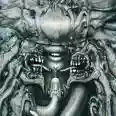
The sounds return to being rough, black as pitch, at times fading into the purple and bluish hues of a tormented, godless soul. Because at the same time, this 1992 release featuring Giger's haunting artwork on the cover is also the most spiritual, mystical, and arcane work of the former Misfits frontman.
"I ask all who have gathered here to join me in the feast.
May we always be strong in body, spirit, and mind.
And all those who would try to harm us
let them be cast aside."
So begins the opener "Godless", a manifesto of a Danzig increasingly alone and against everyone. An act of spiritual independence and artistic integrity that translates, on this occasion, into a hardening of the sound. Which makes "How the Gods Kill" also the most violent episode of Danzig, at least as far as his hard rock incarnation is concerned (a different matter for the works from "Blackacidevil" onwards, which move along the tracks of a decidedly heavier and more claustrophobic industrial-metal).
The blues moods that had contaminated the previous works are thus left in the attic or mercilessly drowned in the electricity and irascibility of the guitars. Even the ghost of the Zeppelin seems to somehow disperse, giving way to the savagery inherited from the Black Sabbath masters, always a fundamental influence, and here more present than ever.
For the rest, there aren't many significant changes in the Danzig camp, and "How the Gods Kill" is the typical album one might expect from the artist. And perhaps this is precisely the fatal issue of the third act of the saga: the fact that it reiterates an already widely tested formula, which in some respects is exhausted and worn out by overuse.
A compositional fatigue which on one hand can be justifiable as the physiological decline in inspiration of an artist reaching another chapter in a varied (and at times dazzling) career, on the other hand, exposes the weakness of a proposal made of recycling and nostalgic references.
It is logical, in fact, that Danzig's rock, which is not fresh, ingenious, or innovative at all, can endure as long as inspiration prevails: where this diminishes, what emerges can only be a limp and banal rock devoid of soul.
Drums, a bass, a guitar, and an idiot screaming on top of it.
Yet it started well because the already mentioned "Godless" is a truly engaging piece, decidedly more sophisticated than the average: after about a minute of guitars and overwhelming rhythms, the track unexpectedly collapses into ultra-doom sections, where the singer has the opportunity to properly wrench us by launching into a daring invocation that sounds like Jim Morrison undergoing an enema.
But it's only the beginning, because in the remaining portion the piece comes alive and turns into a cannonade in typical Danzig style, before once again fading into the dark ending that restores the gloominess of the beginning.
Danzig is there: indelible, true to himself, agitated, obtuse, mad, furious, visionary, convinced he's doing well. The others too, following him with a cohesion now fully achieved. The compositions, alas, are less brilliant than usual, and mostly penalized by an annoying deja-vu feeling that hovers over the entire album. "Anything" and "Bodies" indeed retrace the artist's typical clichés with less conviction than in the past. The first is the usual semi-ballad opened by an arpeggio and destined to explode halfway through, only to overwhelm in the end. The second, however, is a thunderous rock 'n' roll that demonstrates the solidification of the band's rhythm section: Eerie Von drives the track with a bass line probably stolen from John Paul Jones, and therefore irresistible, while John Biscuits pounds wonderfully, helped by a very seventies drum sound.
Danzig, for his part, screams like a damned, shouts like an obsessed man, and his vulgar screams animate a piece that is energetic, but overall predictable. Excellent, however, is the tandem of compositions that follows. The title track is an atmospheric piece, which between acoustic suggestions and guitar assaults, gives us the Danzig we like the most: the drunken titan without peace or abode, exile against God, capable of shifting in the blink of an eye from velvet to sandpaper. That's how Gods (kill themselves)!
A special commendation, furthermore, for the strong "Dirty Black Summer", the lead single and one of the most beautiful Danzig-penned tracks of all time: his dirty and black summer is painted with the dark colors of a granite heavy-rock, torn by the wind of the night and the roar of a stormy sea. A track in which the good John Christ has the opportunity to showcase not only one of the most fitting riffs of his career but also a fine solo, a rare commodity in these parts.
The remaining tracks, unfortunately, do not settle at these levels.
"Left Hand Black" is narrowly saved, but only because it boasts a rousing rhythm and a bone-crushing riff: a somewhat opportunistic gallop that only reiterates the reasons why we like rock so much and why this genre will probably never bore us. However, "Heart of the Devil" bores, a nauseating brick that tries to recover, by electrifying it, the band's blues soul, but without the enthusiasm that had occurred in the past.
Partially raising the mood, we find "Sistinas", a fascinating intimate interval, where Danzig, accompanied by solemn arpeggios and icy keyboards, once again gives in to his most romantic side, transforming into his great idol Elvis Presley for the umpteenth time. A wandering Elvis among the rubble and ruins and the sadness of a hopeless love, of an eternal and irremediable solitude ("the sun don't shine, the wind don't blow, when you go hide without your love, I'm lonely deeply inside").
Negligible, instead, are the two closing tracks: the bland "Do You Wear the Mark", saved at the last minute by a providential acceleration in the finale, and "When the Dying Calls", a typical Danzig-style metal-blues, but totally devoid of bite.
In short, it's understood that we are facing an album for fans only. For others, the argument that Danzig is the usual jerk holds true. But even for the most fervent admirers, who will still find plenty to satisfy their cravings, it is bitter to note how in this "How the Gods Kill" there is a lack of the verve, feeling, and pathos that illuminated the previous two tomes.
That a certain phase was coming to an end, after all, seems to have been understood by Danzig himself, who will already decide in the subsequent "4" to refresh the sound, well aware that rock is not made by the volume of guitars, but by heart and guts.
Loading comments slowly
Summary by Bot
Danzig III: How The Gods Kill is the darkest and most spiritual album of early Danzig, featuring heavy Black Sabbath influences and intense performances. While it offers standout tracks like "Godless" and "Dirty Black Summer," the album suffers from compositional fatigue and a repetitive formula. Some songs feel uninspired and predictable, making this release mainly suitable for established fans. The album marks a transitional phase before Danzig refreshed his sound in later works.
