
 •
Rating:
•
Rating:
THE REVIEW
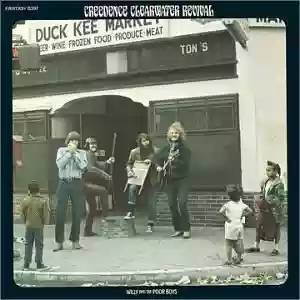
During the year of grace 1969, there was a man in America named John Cameron Fogerty, who sang and played the guitar and a great number of other instruments in a band called Creedence Clearwater Revival. Creedence was a name of a person (it seems the person in question was called Creedence Newball), Clearwater was inspired by a TV commercial about cleaning rivers (it said "It's cool, clear water"), while Revival was indicative of the group's way of understanding the traditions and roots of all music that could fall under the term "americana". At that time, the inspiration of John and his companions Tom, Doug, and Stu was at its peak and continued to churn out an impressive series of top-notch albums and singles, including this gem titled "Willy and the Poor Boys".
There are ten episodes, all (perhaps excluding "Poorboy Shuffle," little more than a folk improvisation) of enormous quality, starting with "Down on the Corner," probably one of the greatest ever-greens of all time, "It Came Out of the Sky," yet another example of how a rock'n'roll track should be, simple, direct, and powerful at the same time. The obligatory cover is "Cotton Fields" by Huddie Ledbetter, a song about the slavery of blacks who cultivated cotton fields. "Feelin' Blue" is a sharp swamp-song with John Fogerty’s essential guitar riff. With "Fortunate Son," it's rough rock'n'roll with John Fogerty's voice dirty and deadly at the same time. "This is a country song I wrote a short while ago". With these words, John used to introduce "Don't Look Now" in concerts, a fast country of just over two minutes. One of the many peaks of the album is the wonderful adaptation of a traditional American folk song, "The Midnight Special," a piece that probably had to have passed by Woody Guthrie's territory (I don't remember the author, but perhaps it was him), a song about trains, stations, and the poor life. The instrumental "Side O' the Road" is an example of the band's great cohesion, featuring excellent solo guitar by John and the precision and metronomy of Doug's bass and Stu's drums. The closing "Effigy" is a rock-blues of great impact that also leaves room for guitar improvisations (never over the top, to be honest, and always within certain parameters as was typical of the CCR).
An absolutely fantastic record that every good fan of American music must have in their personal collection. Here, we talked about simple and direct pieces. Probably simplicity was the number one prerogative of the CCR; it may seem like a limitation, but in music, it absolutely isn't; let's remember that being simple in music is NOT absolutely simple, quite the opposite. Enjoy listening.
Loading comments slowly
Summary by Bot
This review praises Creedence Clearwater Revival’s 1969 album 'Willy and the Poor Boys' as a timeless Americana rock classic. It highlights John Fogerty’s songwriting and the band's cohesive performance, emphasizing simplicity and powerful expression. Key tracks like 'Down on the Corner' and 'Fortunate Son' are discussed as examples of direct and impactful rock music. The album is recommended as essential for fans of American roots and rock music.Tracklist Lyrics Videos
Creedence Clearwater Revival
Creedence Clearwater Revival (CCR) were an American rock band formed in El Cerrito (East Bay, California), led by singer/guitarist/songwriter John Fogerty, with Tom Fogerty, Stu Cook, and Doug “Cosmo” Clifford. They became major late-1960s/early-1970s hitmakers by blending rock & roll, blues, country, and a “bayou/swamp” feel into concise, groove-driven songs.14 Reviews
