 •
Rating:
•
Rating:
THE REVIEW
The period of 1994-1996 undoubtedly represents the creative and commercial peak of Corrosion of Conformity's career. Originally starting ten years earlier as a hardcore punk band and then evolving into a more technical and darker thrash metal style, the four musicians from North Carolina changed direction once again and released the seminal album Deliverance in 1994, a raw, dusty, heavy album of pure stoner/hard rock, deeply influenced by both Black Sabbath and Lynyrd Skynyrd, where blues, rock, and southern mix and become heavier to give rise to one of the most exciting sounds in the entire 90s metal scene.
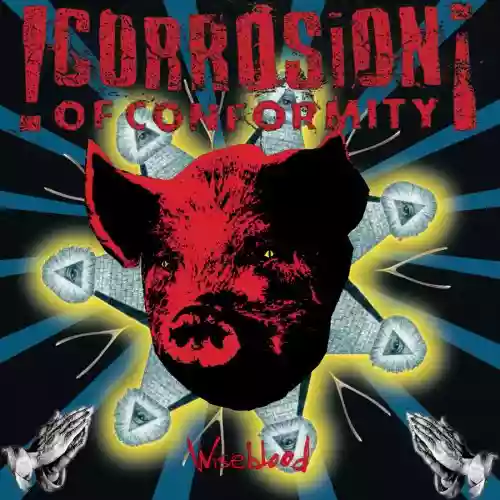
In 1996, the challenging task of succeeding the surprising "Deliverance" fell to "Wiseblood," an album that aimed to maintain the coordinates previously set by Pepper Keenan and company two years earlier. Overall, it must be acknowledged that compositionally, "Wiseblood" does not measure up to its predecessor, lacking truly winning songs like "Albatross", "Clean My Wounds", "Broken Man", "Senor Limpio", "Shake Like You", and "Shelter", and the sound seems to have been excessively cleaned and polished, probably in an attempt to attract a larger number of fans. Considering these initial points, it's equally fair to say that while "Deliverance" was a masterpiece, "Wiseblood" is nothing less than a good album, which combines powerful riffs with sharp solos, warm vocals with a precise and compact rhythm section.
The opening is cleverly entrusted to a pair of explosive tracks, the relentless "KING OF THE ROTTEN" and the sadly underrated "LONG WHIP/BIG AMERICA", with its irresistible stride, ferocious breaks, and solos of fine quality. More measured, at least rhythmically, is the title track, where energy and heaviness are certainly not lacking, though these elements alone are not enough to make it a memorable song. As one delves into the core of the album, however, one discovers a Corrosion that is perhaps too refined and with inconsistent performance: just consider a couple of episodes that are too flirtatious with grunge (the hypnotic "GOODBYE WINDOWS", "THE SNAKE HAS NO HEAD") where the traditionally abrasive guitars make only a few appearances, leaving the scene to Pepper's voice and Mike Dean's bass - nonetheless excellent - but the worst episode is undoubtedly the single "DROWNING IN THE DAYDREAM", an incredibly ingratiating track, forcibly sunny in its melodies and vocals, so much so that it becomes basically harmless like the most banal chart tune: light-years away from the dirty and ultra-heavy blues of "Albatross".
Fortunately, the album's weaknesses end here: "THE DOOR" and "WISHBONE" gift us gems of the roughest Southern hard rock, returning to walls of fuzz, to guitars roaring like rumbling Harley Davidsons, the Sabbath-like "MAN OR ASH" is enhanced by the presence of Metallica's James Hetfield on backing vocals. And who knows, perhaps James even drew inspiration, at least thematically, from the thunderous, lightning-fast "FUEL," an explosive blend of stoner sound and pounding hardcore rhythm, barely three minutes of pure adrenaline! An honorable mention goes to the excellent "REDEMPTION CITY", a semi-ballad directly from the banks of the Mississippi, which would certainly not be out of place in a Down album, and to the great closing instrumental "BOTTOM FEELER", a concentrate of power, dark riffs, and inescapable rhythms, flavored with interesting solo bass and drum interludes.
In conclusion, it can be said that "Wiseblood" was perhaps not a mind-blowing album, conditioned by a less "killer" production compared to its much more acclaimed predecessor, and by a compositional level that was not always consistent. Nonetheless, it is indisputable that COC, thanks to this album as well, were a reference point in the new Southern Metal scene, essential stylistic precursors to equally crucial bands like Down, Black Label Society, but also the Metallica of Load and Reload. It's certainly no coincidence that Pepper Keenan, the creator of that new COC, is today a cornerstone of Down, the band that most embodies the cultural and musical pride of the Deep South's offspring.
Loading comments slowly
Summary by Bot
Wiseblood follows Corrosion of Conformity's peak album Deliverance, offering solid Southern metal with heavy riffs and skilled musicianship. While it lacks some standout tracks and a raw sound, it still showcases the band's influence on the 90s metal scene. The album blends stoner rock, blues, and southern hard rock with moments of grunge and mainstream appeal. Guest vocals from James Hetfield add to its appeal. Overall, Wiseblood is a respectable but not groundbreaking release.Tracklist Lyrics Videos
Corrosion of Conformity
Corrosion of Conformity is an American heavy band formed in Raleigh, North Carolina in 1982 by Mike Dean, Woody Weatherman and Reed Mullin. Starting in hardcore/crossover, they shifted in the 90s toward a Sabbath-influenced stoner/sludge sound, releasing landmarks like Blind (1991) and Deliverance (1994). Pepper Keenan became a key vocalist/guitarist in the Deliverance era; drummer Reed Mullin passed away in 2020.10 Reviews
