
 •
Rating:
•
Rating:
THE REVIEW
Uh-oh! We are informed that this review also appears (in whole or in part) on shapeless.it
Now in the midst of the thrash decline - we are in 1991 - the only noteworthy releases in the genre are those related to bands - almost all part of the second wave - that, although starting from previously laid grooves, have managed to evolve their sonic matrix in an extremely personal way.
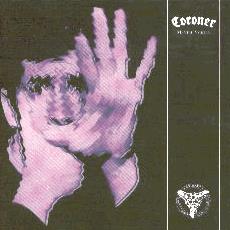
I’ve already described the Coroner's evolution (hopefully decently!) in the reviews of their previous albums, but I certainly won’t hold back in front of “Mental Vortex,” which is, in fact, the masterpiece, the definitive realization of the meticulous work that began to take shape with “Punishment For Decadence.” We spoke of spinning blades/circular saws, and even here they remain indispensable: more massive and robust, certainly cutting with its jagged edge, the record depicted on the back cover anticipates a band that perhaps wants to focus on the essentials without renouncing their musical and compositional characteristics. On the other hand, the cover, with the same theme as the previous "No More Color," further defines the themes of the lyrics, which move from the Ossian shores of the first two albums to introspective, much more rational and reflective zones, profoundly summarizing high-level concepts in a few lines.
Musically, "Mental Vortex" is the refinement, the pushing further (and higher) than the previous album. I prefer this album to "No More Color" precisely for its greater definition and care that stand out on listening, as well as encountering monumental guitar work in continuously weaving riff upon riff, in slightly more complex but also more linear architectures in medium-long duration tracks. The key of the album is the precise fusion of three elements, each directly traceable to an instrument: the dry, cadenced rhythms of the drums are the base upon which the aggressive and sharp guitar riffing rests, mediated by extremely dynamic and harmonic bass lines. The first result is a kind of 'controlled rage': fast riffs (a direct evolution of the speed of the beginnings, as "About Life" shows us) and sudden in changing tempo and meter, contrast with a squared and surgical rhythm section, giving that feeling of rational control over intrinsic rage thanks to the precision and syncopated insertions of cross-beats.
The second effect is the underlying driving groove, mainly due to Ron Royce’s work (who blends so well with the rest it becomes almost imperceptible), capable of providing an extra gear to the effectiveness of tracks like “Son Of Lilith” and the elegant stride of “Sirens”. It’s also noteworthy how the 'mental vortex' dealt with in the lyrics finds correspondences in the songwriting, both through the classic circular riff and the lyrics’ meter (which even includes triplets, allowing for greater definition in closing each round), and through the structural progression of the songs. As in the previous album, Coroner 'assigns' a different rhythmic pattern to each section of these, proposing them in a growing march up to the refrain, which closes the circle and reopens it with the new verse. It's thrilling to note the fluidity in the transitions between these sections, which are counterpointed by the insertions of purely instrumental parts, which not only 'pull' well but also greatly support the solos (excellent in “Sirens” and “Pale Sister”) and wander through atmospheric arpeggios with a characteristically decadent flavor present in “Divine Step” and “Semtex Revolution”, whose refrain will later be revisited by the Gothic period Kreator. There isn't a single track unworthy of note, apart from a relative drop in tone in the first half of “Pale Sister”; also noteworthy is the reinterpretation of the Beatles' blues in “I Want You (She’s So Heavy)” that closes the album with progressions and interwoven guitar work; but it's the whole, granitic and refined at the same time, that shines.
With the subsequent "Grin," Coroner will shift the coordinates to what is their definitive masterpiece, but I wouldn’t recommend anyone to overlook an album of the caliber of “Mental Vortex,” one of the best thrash albums if only for the excellent realization of the decadent derivations that permeate the group’s sonic matrix and for the relative future consequences to be read under the heading Meshuggah - "Chaosphere."
Loading comments slowly
Summary by Bot
Mental Vortex represents Coroner's peak artistic achievement during a challenging phase for thrash metal. The album's refined songwriting combines aggressive guitar riffs, precise rhythms, and dynamic bass lines, creating a controlled yet powerful sound. Lyrically introspective, it reflects complex concepts matched by intricate musical structures. This album is highly praised for its cohesion and impact within the genre.
Coroner
Coroner are a Swiss technical/progressive thrash trio from Zurich: Ron Royce (bass, vocals), Tommy T. Baron/Tommy Vetterli (guitars), and Marquis Marky/Markus Edelmann (drums). Emerging in the mid‑80s and long cited as underrated, they fused razor‑precise thrash with neoclassical, progressive and later industrial/dark textures across albums like R.I.P., Punishment for Decadence, No More Color, Mental Vortex and Grin. Reunited in the 2010s, they returned with Dissonance Theory (2025, per review).08 Reviews
Other reviews
By EvilSimon
Coroner was one of the few capable of creating and shaping an identity that transcended the limitations of thrash metal.
Mental Vortex manages to demonstrate Coroner’s insane ability to craft songs that are simultaneously complex, sharp, and visionary yet always accessible.
