
 •
Rating:
•
Rating:
THE REVIEW
“… my secret fear of being alone
I sit and clasp my hands
I sit and make love with myself
I have blood on my hands
I have blood on your hands
blood on our hands blood… ”
In memory of Rozz Williams.
It could only end tragically for a life laden with excesses and deep physical and intimate wounds. The usual mix of alcohol and cocaine to give courage, a rope to do the rest. The end of a sensitive boy, even in his extreme provocations. The earthly chapter of Roger Painter could only close in this manner.
He couldn't overcome loneliness, the loss of a dear friend, the depression that consumed him, and perhaps also the deep dismay for not being able to take possession of the creation he had formed and which was unjustly taken from him.
Because Christian Death is Rozz Williams, there is little debate here. If it weren't for him, America likely wouldn't have known darkwave, much to the delight of the radical Catholic lobbies that persecuted him at the time, burning his records outside the venues where he performed, similar to what the Nazis did with the works of non-aligned artists, and harassing him relentlessly with media tabloids and various anathemas.
Rozz rode the wave of that uproar, exponentially increasing his sacrilegious provocations against religion, towards which he harbored a visceral hatred perhaps dating back to the times of the rigid Baptist observance his parents tried to instill in him as a child. Feeding off the invectives from puritan U.S. society, Rozz took the stage heavily made-up, dressed as a bride, simulating communion and making sexually explicit gestures towards sacred images like no one had ever done before, in such a blasphemous and irreverent manner that no one has managed to approach his excesses to this day, with all due respect to Marylin Manson. But such excesses were not limited to performances on stage but inexorably reverberated into his private life, between psychotropic consumption and various quarrels that continuously undermined the band's stability. This instability caused the complete disintegration of the lineup following their debut album “Only Theatre of Pain” and the replacement of guitarist Rikk Agnew with Valor, who later stripped him of the paternity of the name “Christian Death”, marking perhaps the beginning of Rozz's artistic decline.
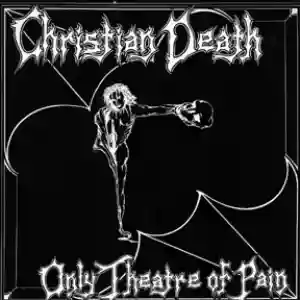
The album's title (chosen by Rozz himself, who also created the cover) encapsulates what life probably was for its author, in a premonitory vision of the one he decided to end at just over thirty years old. An anguished, claustrophobic, and intense work that mirrors the restless soul of its master. A concentration of dark-punk and gothic overtones of boundless pain where Williams's majestic and excruciating voice stands out, burning with emotion and tenebrous depth, the neural center of “Only Theatre of Pain”.
Cursed music, steeped in anti-religious references, but of absolute fascination. Classics like “Cavity – First Communion”, with its guitar distortions and icy rhythms, “Figure Theatre” with its punk nihilism, the biting and malevolent “Burnt Offerings”, the obsessive and satanic refrain of “Stairs – Incertain Journey” (be Satan, who art in heaven, be Satan hallowed be thy name, be Satan thy kingdom come, be Satan thy will be done, be Satan as in heaven so on earth.... be Satan), the diseased and furious “Romeo’s Distress”, will remain in the annals of gothic rock history. The theater of cruelty closes with “Prayer”, which is nothing more than the Lord's Prayer recited backwards by Rozz Williams and Rikk Agnew, in one last striking example of sacrilegious provocation for what is undoubtedly one of the most blasphemous albums in rock history.
This dark character, with behaviors as extreme as they clashed with the sweetness of his face, decided to end it all a few years ago, reaching out to the one he had so opposed and insulted in life. However he is considered, Rozz left us two great albums (the present and the subsequent “Catastrophe Ballet”) and a whole series of shocking exploits that will surely be remembered for a long time, increasing the mystery surrounding his figure.
Loading comments slowly
Summary by Bot
This review honors Rozz Williams and Christian Death's debut album Only Theatre Of Pain as a seminal gothic rock masterpiece. It explores the tragic life of Williams and the provocative, anti-religious themes that defined the album. The musical intensity, punk nihilism, and blasphemous content are highlighted as key elements. Despite band turmoil and personal struggles, the album remains a powerful influence on darkwave and gothic music.Tracklist Lyrics Videos
Christian Death
Christian Death are an American gothic rock/deathrock band formed in Los Angeles, widely associated with early frontman Rozz Williams and later led by Valor Kand after lineup changes.15 Reviews
Other reviews
By brrrk
The remastering work is certainly good, with a noticeable increase in dynamics... What is perhaps missing is a more incisive work on the sounds.
In short, for one of the dirtiest and most decadent albums of the ’80s, no one wanted a polished and refined cleaning of the sounds... but one might have expected more.
