
 •
Rating:
•
Rating:
THE REVIEW
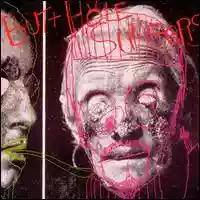
“Psychic Powerless” is one of the most extravagant rock albums of the '80s.
The Butthole Surfers are a Texan band that is very difficult to categorize, due to their indefinable mix of hardcore, psychedelia, industrial, and roots-rock. The only common denominator of their style is the madcap, parodistic, and surreal aspect, which brings them closer to the great (and sometimes unrecognized) eccentrics of rock, like Red Crayola, Holy Modal Rounders, Pere Ubu, and others.
Perhaps the flaw of this album (their first LP, dated 1985) is the inability to synthesize: there is the impression that all this boisterous creativity, this deviant attitude towards tearing apart the semantics of traditional rock genres, this aesthetics of the ugly, the excessive, and the delirious, remains somewhat self-contained, unlike, for example, that of Pere Ubu, who used a grotesque reinvention of garage-rock to express the unease of the post-industrial era. The proposal of the Surfers, on the other hand, remains a game: creative yes, provocative certainly, but still a game.
The album opens with two catastrophic sound avalanches, “Concubine” and “Eye of the Chicken”: the former is a perverse ride with the implacable advance of a steamroller, disturbed by Leary's screeching guitar and Haynes' beastly moans, filtered through a megaphone; the latter remembers the lesson of Chrome, thus setting up an obsessive frontal assault based on screeching electronics. In “Dum Dum” the rhythm section takes the lead, with Kramer's piercing bass and Teresa Taylor's tribal drums as protagonists of dizzying and paroxysmal accelerations. “Woly Boly” instead reflects the influence of the Cramps and their macabre and demonic rhythm’n’blues. “Negro Observer” is perhaps the most accessible and soft track: a guitar arpeggio, a skeletal and madcap sax, Haynes' sarcastic singing (a paranoid and tragicomic version of Johnny Rotten's monotone outburst) converge at the end in a stunning yet soft psychedelic magma.
The album now gets into the thick of it, with its strong pieces. The title-track is a supersonic hardcore, touching pure madness in the sudden stop’n’go of the final part; besides the boisterous streak (the continuous chatter in the background during the chorus, instead of the usual backup vocals), what distinguishes this track from the canonical hardcore of the Californian school is the absence of a solid and aggressive sound: Leary's guitar is much closer to the chaotic and frayed noise-making of a Mayo Thompson rather than the ferocity and compactness of a Gregg Gin. “Lady Sniff”, with its out-of-tune riff, confirms it: the track, a parody of southern rock with Haynes seemingly mimicking Lemmy, relies on a fascinating sonic ensemble of belches, raspberries, and other “concrete” sounds that, used as a counterpoint to the riff, constitute the true stylistic mark of a song among the most outrageous in rock history. “Cherub” is perhaps the masterpiece of the album: 6 minutes of Barrett-like reverberations and sudden upsurges, supported by a hypnotic rhythm and pierced by electronic disturbances and tormented vocal spasms; with this track, the Surfers steer the acid psychedelia of the sixties into the industrial era. In the latter part of the album, the dizzying surf/tex-mex of “Mexican Caravan” follows, with Leary's piercing blows, the chaotic funk-rock of “Cowboy Bop”, where the sax and megaphone reappear, with another guitar bacchanal, and the rowdy blues of “Gary Floyd”, reminiscent of Captain Beefheart's lesson, master of broken times and the most grotesque and savage avant-rock.
Comparisons with Beefheart, Red Crayola, or Pere Ubu are perhaps inappropriate: but “Psychic Powerless” remains a mine of ideas and a hymn to eccentricity and irreverence.
Loading comments slowly
Summary by Bot
Psychic Powerless is an extravagant and chaotic 80s rock album by the Texan band Butthole Surfers. The album defies easy categorization with its mix of hardcore, psychedelia, industrial, and roots rock. It showcases madcap, surreal creativity through strong tracks like 'Cherub' and 'Lady Sniff.' Though it feels more like a provocative game than a fully synthesized statement, it remains a notable mine of ideas and eccentricity.
Butthole Surfers
Butthole Surfers are an American rock band from Texas, frequently described as hard to categorize for their mix of hardcore, psychedelia, noise, and surreal provocation, with a strong performance-art reputation.11 Reviews
Other reviews
By Sanjuro
"Psychic Powerless the highest peak of the Butthole Surfers... avant-garde redneck with vitriol."
"They fuck your mother, your father, your sister, and then when you think they’re fucking your grandmother, they talk to her cordially and make yarn together, rocking pleasantly on the chair."
