
 •
Rating:
•
Rating:
THE REVIEW
There was a saying in the lower Romagna, where I grew up about twenty years ago: when someone with a certain inclination started to become aware of their talent and knowingly master it—no matter what the activity was—it was said that ‘he’d put in the NOS’.
I hadn’t thought about this saying in I don’t know how long.
Then, after finishing the ritual of my first listen of “Perché Non Si Sa Mai,” something must have clicked somewhere in my memory, so much so that it felt natural to wonder at what point in their journey Bull Brigade put in the NOS.
Because whenever punk/hc is discussed, there are purists jumping out from everywhere, right?
For some, “Vita Libertá” (2016) was already lacking bite, for others “Il Fuoco Non Si È Spento” (2021) turned out to be the exact opposite of what its name suggests.
For many, the kids from ‘MotorCity’ brought in the NOS with their debut “Strade Smarrite” (2008), right after Eugenio Borra’s experience with Banda Del Rione ended.
Personally, I think it’s just a matter of perspective.
The fourth full-length from the Turin combo carries the heavy legacy of one of the scene’s most important releases, as well as—the detractors will have to accept it—their entire history.
“Il Fuoco Non Si È Spento” was the first Bull Brigade record to include more than one hand in songwriting. The result was an album that was less ‘straightforward’, definitely missing the Oi! matrix that was the signature of their first two records, and precisely for this reason able to broaden their following and swing open the gates towards a series of important opportunities previously unexplored.
Chiederci ancora
Chi è che sono
E chi è che sei
Guarda che cosa
Mi fa diventare
Sang Eugy in “Anche Se.”
No verse was ever more symbolic.
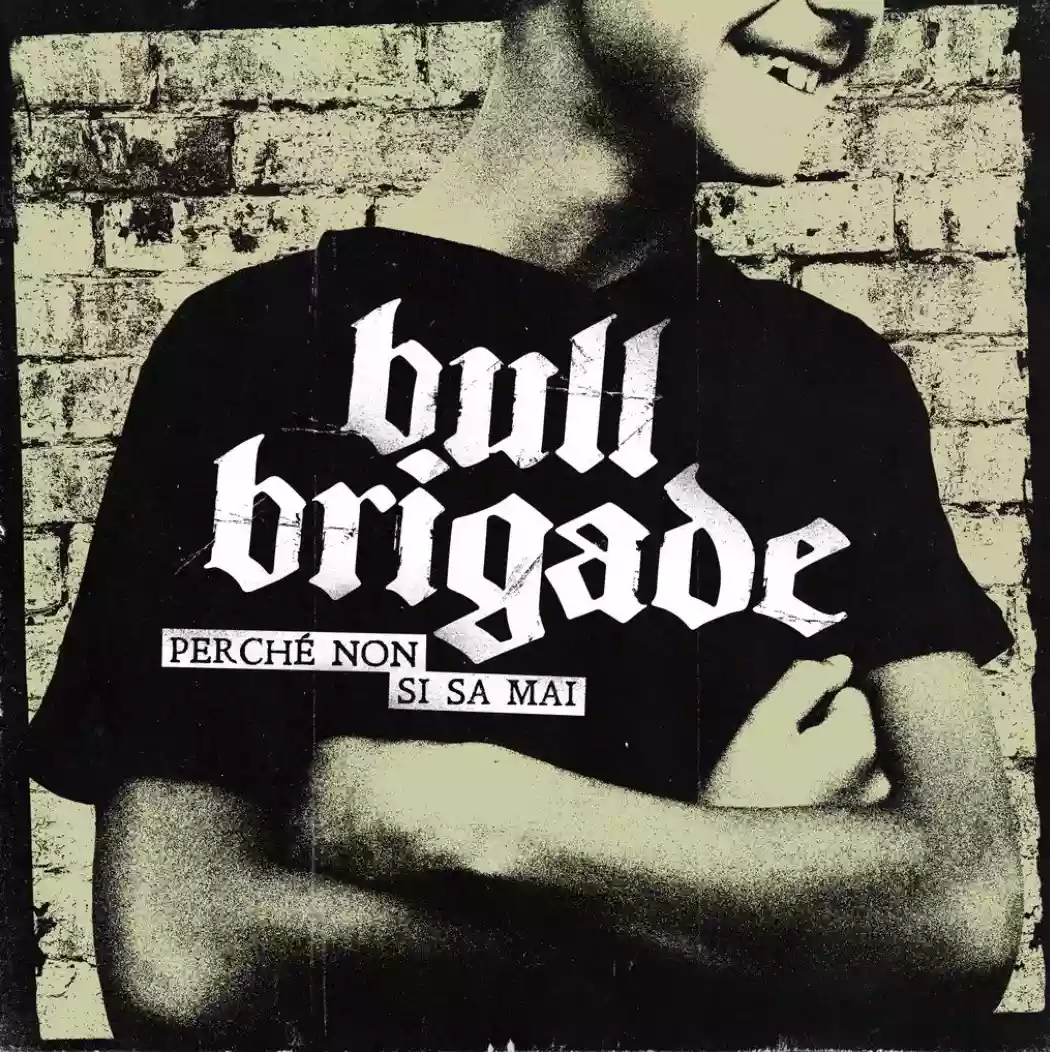
“Perché Non Si Sa Mai” is Bull Brigade’s most collective album, released at the most important phase of their path: that of reconfirmation.
Thinking they completely missed the mark would be a big mistake.
First: because the band draws heavily from a series of influences already emerged—not without some doubts about how they would be received—in the previous chapter.
Second: because the emotional core of the songs shifts completely.
The cardinal points remain unbreakable: Turin, the outskirts, the Toro, echoes of an industrial past that has lost its centrality leaving only the shards. But today there are children who are growing up.
As a father, I can say it’s almost guaranteed, at some point, you see yourself in your own child. As a son, I can say that becoming a parent often brings up childhood memories that reemerge without much politeness—nostalgic and violent.
Eugy lost his father about ten years ago—a hobbyist musician himself, the one who “con questa musica come malattia / che mi dicevi ‘guarda che quando inizi / dopo non va più via’”—and I imagine that from his current place, it is just as normal to allow himself to drift into memories, returning to the tenderness of those first listens.
And lying, maybe, may be useful to pin a sheriff’s badge of the punk-police to your chest, but the singer-songwriter-hued rock that shapes the album’s moods is a familiar sound for an entire generation.
The album intro, recited by a historic figure from Turin’s countercultural movement like Mario Spesso, rolls out the carpet for a renewed lyricism, even at the risk of going too far. Dropping random English words, for instance, makes some passages awkward and clumsy.
The orchestrations paint a grey sky, but never a dead one:
"Vécio, anche se siamo vecchi
Abbiamo ancora bisogno
Di promesse da farci
Di una città per provarci”
The rhythmic assaults of the past give way to broad pop flourishes, the pride and sense of belonging that once were, now replaced by egotism. The result is a series of refrains that are hard to imagine squeezed among the classics of the repertoire in a live set.
There’s no doubt that the band wanted to look forward, instead of relying on a more than tried-and-true formula. After all, let’s admit it: to keep ‘doing the Nabat thing’ would have been grotesque.
It’s equally true that “Il Fuoco Non Si È Spento” is the kind of record you write once in a lifetime, if you’re lucky.
On a second listen, it’s clear that Bull Brigade have changed their perspective, but missed focus.
The NOS is well and truly spent, and the new material can be seen as the transition album towards a new phase. Not everything is to be thrown away, “Perché Non Si Sa Mai.”
Ad maiora.
Loading comments slowly
Summary by Bot
This review examines Bull Brigade's album 'Perché Non Si Sa Mai,' focusing on its punk energy and Italian roots. It discusses the band's style and attitude, noting both the energetic highlights and areas where the album falls short. The critique is balanced, mentioning the strong moments without overlooking the album’s weaker aspects. Bull Brigade's place in the Italian punk scene is acknowledged. Overall, the review offers a moderate opinion, suggesting the album may suit genre enthusiasts.
Bull Brigade
Bull Brigade are an Italian Oi!/street punk band from Turin, led by Eugenio Borra. Emerging from the Youngang/Banda del Rione lineage, they’re known for the city-centric classic Strade smarrite (2008), followed by Vita Libertà (2016), the melodic-leaning Il Fuoco Non Si È Spento (2021), the English-language Stronger Than Time (2020), and Perché non si sa mai (2026). Their lyrics revolve around Turin, friendship, love, and working-class pride, while their sound evolved from Oi! toward more melodic punk/hardcore.08 Reviews
Other reviews
By MosMaiorum84
The album packs a punch with punk energy, but it doesn't always leave a lasting impression.
