
 •
Rating:
•
Rating:
THE REVIEW
Summer is mating season for the male drone. The queen bee controls the hive, and all the male specimens, who are nothing but mere servants, aim for her. They fight stupidly for her conquest, having sex with her until death, generating offspring. The effort is so significant that shortly after mating, the male drone falls to the ground, exhausted, lifeless. The few who survive are driven away by the queen bee.
I never thought of them as stupid. On the contrary. Maybe dying of sex isn't exactly in my plans, but I like to think that at that precise moment, the bee feels like the center of the universe. Perhaps they are born that way. They have no choice; it's ingrained within them, coded. They probably know that once they accomplish it, they will no longer experience the thrill of flying. But it doesn't matter, they just do it, and once done, they lose their life. Who knows, maybe with the awareness of having succeeded. Maybe his sacrifice allows someone else to be born. It gives meaning to his existence.
Sometimes I envy the bee. Not so much for the sex, perhaps also, but because it knows what it wants, knows it, and takes it. It pays its price. An exorbitant price, a price that prioritizes quality over quantity. Other times I wonder if it makes sense. To die like that, suddenly... But sometimes history gives you the answers...
Because, you see, sometimes you can get on a plane and never come back home. What a decade of contradictions the 50s were, in America. The United States emerged victorious from World War II, it was the years of newfound serenity and the country's tremendous growth. The years of televisions, the years of Coca-Cola, the years of Marilyn Monroe. The years of Martin Luther King's non-violence, the years when people put to music the serenity needed after an impossible decade, worldwide.
And that figure embodied Elvis, the true icon of the 50s. Seeing that white guy dance like a demon in ''Jailhouse Rock'' dressed as a convict drove the new generation crazy, who assimilated his ways and style. Probably the kids were already ready for all this, except, perhaps, for that blonde guy who set the piano on fire after the performance. Yet, skin color was still cursedly decisive, rooted in a culture still too attached to racial differences. And if you were black and you weren't Sam Cooke, it was a damned struggle to convince anyone to give you a chance. ''Johnny Be Good'' and ''Tutti Frutti'', from this perspective, were the best the black market could offer, until then circumscribed between Miles Davis and Muddy Waters, to different and past-rooted musical genres.
Meanwhile, in 1957, while everyone danced to Bill Haley and ''Rock Around the Clock'', a young boy with a funny face and thick glasses, played in Texas venues with his high school friends. That country and gospel were unbearable. The record labels imposed it; it was necessary. It was perhaps the encounter with Elvis that paved his way. But the times were not yet ripe, especially in a small town like Lubbock. Even as Presley-mania took form, rock'n'roll was still labeled as evil and hostile. Parents prevented their daughters from listening to it, the church deemed it deviant and adverse for the new generations.
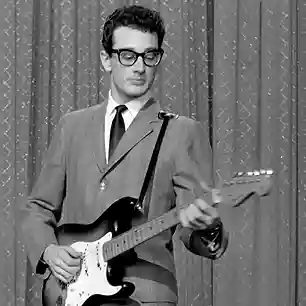
Buddy Holly appeared as an anti-hero. His figure, at times naive, contrasted with the transgressive and wild one that was popular. The one of Elvis, of Little Richard. Seeing a bespectacled guy who might look like your son so aware of his means gave a real jolt to the music world. Live appearances often pictured him in a tuxedo, with a tie, or with a funny black bow tie. His disheveled hair, his voice, clear and clean, tending to stutter, whispering light tongue twisters. He had an uncommon inventiveness; he was one of the first to rebel against record companies and insisted to those few who accepted him that he would write his own songs. He was the other side of the coin.
One day, while rehearsing with Joe B. Mauldin and Jerry Allison, something wasn't right. There was a damn buzz in the background. And it wasn't a faulty tape, but a cricket perched somewhere. That's where they took the name The Crickets (the crickets). ''That'll be the day'' was the first successful track. The title borrowed a line from a John Wayne movie (''Verrà il giorno''). The guitar plucked like never before, the drums beat strongly. The success was phenomenal. Hits poured out one after another. ''It's so easy'' was electric, ''Words of Love'' paved the way for the Beatles, who did a cover. There were also tracks that everyone knows without knowing the artist or title, like the unforgettable ''Everyday''.
But Lubbock was too small and cramped for a group of boys who wanted their chance. The dream had a name, it was called New York. The Big Apple was a damn enticing idea, it was the perpetual yearning. It was so advanced that it provided record opportunities to exponents of the new musical movement. The period of greatest fame began. Buddy experimented a lot, introduced new instruments, took some risks. He alternated appearances with the Crickets and solo performances. The success became global. ''Peggy Sue'', named after Jerry Allison's girlfriend, climbed the charts. It's catchy, strong, and direct. It pleases both old and new audiences. Buddy collaborated with several artists. He met Eddie Cochran, who tragically died in an accident in 1960, and Ritchie Valens. He married Elena Santiago, a Puerto Rican girl, in the summer of 1958, and they honeymooned in Acapulco. All this, at the height of his success. Success that did not last more than 18 months.
Ritchie Valens wasn't supposed to take that plane. Tommy Allsup, a lifelong session player, pulled a coin from his pocket. It landed tails. He went to inform Buddy that he would go by car in place of Ritchie. Along with them was Richardson, known as Big Bopper. Tommy Allsup didn't know he had just saved his life.
It was 1959. An inexperienced pilot, poor flight conditions. Maria Santiago was expecting a child, she was one month pregnant. She didn't want him to leave, tried in every way, but that tour was too important. Of the Beechcraft Bonanza, only scraps remained, among the cornfields. The first tragic day in rock history. Someone defined it as the day the music died.
1959 wasn't just about accidents and Fidel Castro. By a strange twist of fate, it was also the year when, for the first time, the peace symbol was displayed. Buddy Holly was a wonderful bee. He lived his season, pushed it to the max, to the point of letting go without regrets. Maybe he, too, at some point, felt like the center of the universe. But just as the bee ignores that it will lose the thrill of flying, perhaps Buddy was also unaware of that strange pact he made with destiny. And destiny made him die at 23, giving him life only in the immortality that his figure and music would assume in the years to come.
12 years later, Don McLean put to music the reflections of that day through the pain of someone young and still naive, distributing newspapers informing about an accident and a bride left widowed. He didn't remember if he cried on that February 3, which he defined as ''the day the music died''. A song that was enigmatic from the very first verses, never fully explained by the New York singer-songwriter. But I believe Mr. Donald McLean was wrong. The music didn't die that day, quite the opposite. What died was the bee of Lubbock.
The rest, was rock'n'roll.
Loading comments slowly
Summary by Bot
This review reflects on Buddy Holly's unique role and impact in 1950s rock'n'roll amid a turbulent cultural era. It discusses his musical innovation, rise to fame with The Crickets, and his tragic death in 1959, known as 'The Day the Music Died.' Despite the tragedy, the review asserts Holly's enduring legacy in music history and his influence on future generations, highlighting his artistry and rebellious spirit.Tracklist Lyrics
Buddy Holly
Buddy Holly (born Charles Hardin Holley, 1936, Lubbock, Texas) was an American singer-songwriter and guitarist who helped define early rock and roll with The Crickets. His innovative songwriting, recording techniques, and concise, melodic hits influenced generations. He died in a plane crash on February 3, 1959.03 Reviews
