
 •
Rating:
•
Rating:
THE REVIEW
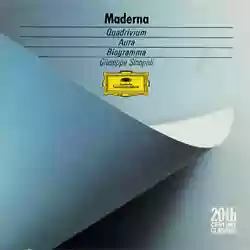
Three essays of Bruno Maderna's orchestral mastery are featured in this CD, which collects pieces from the last years of activity and life of the Venetian composer. "Quadrivium" from 1969 is a piece for 4 percussionists and 4 orchestral groups: besides the number 4, the title alludes to the medieval classification of sciences, in which music was accompanied by arithmetic, geometry, and astronomy. It also alludes to aleatory sections of the piece (governed by random decisions) in which the conductor has the ability to vary the entries of the four groups and make spontaneous decisions, like at a crossroads, a quadrivium indeed.
These 36 minutes of "Quadrivium" are intense and evocative: the percussion is the protagonist both in the "noisy" component of instruments with indefinite pitch, and in the intriguing timbres of xylophones, vibraphones, marimbas, glockenspiels, and tubular bells (each of them, in the lineup, in pairs). The rest of the orchestra is treated with patches of color, thus, from episode to episode, the different instrumental families resonate, for instance, strings or brass, never mixed with one another but in the foreground on their own, albeit for brief interludes. The long finale is magical, characterized by a persistent cluster of strings in the high register that, in the last ten minutes of the piece, constitutes the sonic background on which the final calls of the percussion and then the harp animate until the conclusion.
We find the same stylistic vivacity in the shorter pieces "Aura" (16 minutes) and "Biogramma" (14 minutes), both from 1972. In the former, the diaphanous color of the strings steals the scene, with as many as 54 instruments divided into six groups, while the percussion plays a complementary role; in the latter, the musical texture is more nervous and fragmented, with frequent pauses emphasizing the internal articulation of the piece.
This CD thus contains three successful testimonies of Maderna’s presence in Italian avant-garde music during the late '60s and early '70s. It can represent a good opportunity to rediscover this composer, who is rarely mentioned today, unjustly.
Loading comments slowly
Summary by Bot
This review highlights three key orchestral pieces by Bruno Maderna — Quadrivium, Aura, and Biogramma — from his late creative period. The CD is praised for its intense percussion, innovative aleatory sections, and vivid orchestral colors. It is considered an excellent chance to rediscover a rarely mentioned maestro of Italian avant-garde music from the late 1960s and early 1970s. The review appreciates the stylistic vivacity and textural variety of the compositions.Tracklist
01 Quadrivium (1969) For Four Percussionists And Four Orchestral Groups (36:30)
02 Aura (1972) (16:18)
03 Biogramma (1972) (13:59)
04 ♩= 66ca (07:19)
05 ♩= 126-132 (01:05)
06 ♩= 120ca (02:16)
07 ♩= 66ca (03:38)
08 ♩= 120ca (00:23)
09 ♩= 84ca (02:43)
10 Tempo Generale Da ♩= 42 A ♩= 84 - Tempo Generale ♩= 66-72 (02:22)
11 Section A: ♩= 52 (01:16)
12 ♩= 60ca (03:10)
13 Section B:♩= 42ca (04:21)
14 ♩= 60ca (01:52)
15 ♩= 60ca (04:10)
16 Section C (03:20)
17 ♩= 100ca (01:23)
18 Lento: ♩= 48-52ca (05:12)
19 ♩= 72-80ca (02:36)
20 ♩= 92-100ca (02:34)
21 ♩= 126-132ca (01:51)
22 [Conclusion] (11:25)
23 ♩= 72ca (03:51)
Bruno Maderna
Bruno Maderna (1920–1973) was an Italian composer and conductor central to the postwar avant‑garde. He co‑founded the RAI Studio di Fonologia in Milan, taught at the Darmstadt Summer Courses, and championed new music internationally as a conductor. His catalog spans pioneering electronic works, three oboe concertos, and distinctive late orchestral and stage pieces.03 Reviews
