
 •
Rating:
•
Rating:
THE REVIEW
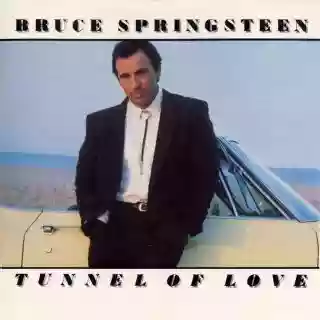
An album for Valentine's Day. When "The Rising" hit the market in 2002, a label stuck on the front of the album read "The first album with the E-Street Band since 'Born In The U.S.A.'", testament to the fact that there are many, even Springsteen's own advertising agents, who don't give much consideration to this "Tunnel Of Love" from 1987. Here, in fact, even though its members are objectively relegated to sporadic session men, the E-Street Band is still there to accompany the Boss in his entrance into the adult world, more responsible, more fragile; from the cover, you can already see a more mature man, in a suit and no longer in jeans and a t-shirt, without a bandana but in a leather tie, with a divorce behind him and a strong desire to sing about it.
In 1987, Bruce Springsteen had already decided that his career couldn't continue by always delivering Esquire/Telecaster chops like in "Born In The U.S.A." or in the Francisean poverty of the compositions in "Nebraska", thus releasing an album that might have seemed anomalous but was proof that time passes and experiences help to grow. Even for him. The music contained here has a significantly lower impact compared to everything Bruce Springsteen had accustomed his listeners to, from those who had in mind the fiery aspect of the Boss and his desire to scream emotions to those who more pleasantly remember the folk and strongly intimate soul; these have always been the two sides of the artist, two extreme sides that here, for the first time, merge. Exceptions are "Spare Parts" and "Cautious Man", still tied to the dual soul just described, but the rest of the album takes it upon itself not to shout anymore or even whisper, but to speak as a grown person. On a textual level, Springsteen temporarily abandons the voices of his people, his society, his America and writes his most personal and autobiographical album that appeared up to that point, while musically, he turns towards softer arrangements almost always supported by synthesizers and drum machines.
After the a-cappella intro of "Ain't Got You" which talks about his own success, "Tougher Than The Rest" outlines what will be the predominant style of the album: slow compositions revolving around the female figure, here still described as a symbol of salvation, somewhat like in the immortal "Thunder Road" twelve years earlier. However, it will remain the only case: in "Brilliant Disguise", chosen as a shocking lead single in a 1987 that still had "No Surrender" in its ears, there are all the confessions of a man who sees his couple's life falling apart without knowing whom to blame, in the heartbreaking "One Step Up" those of someone sitting alone at a bar counter brooding over memories, in "When You're Alone" the photographs of what was and a banal yet burning truth ("when you're alone, you ain't nothing but alone") while in "Walk Like A Man" the faded images of a child retracing his dad's footsteps on the beach, spreading his arms not to lose balance. The shadow of your father descending on you, is there perhaps something more reassuring? In these, as in other slightly more sustained compositions such as "Tunnel Of Love" or "All That Heaven Will Allow", you can see how Springsteen has learned over the years to touch more finely the strings of melancholy, a sentiment that reaches its maximum expression and beauty in the concluding "Valentine's Day", the only reference to Valentine's that I appreciate, to listen to when remembering a figure that has given us so much and you see it disappear into the mist. A final farewell with a lump in your throat and teary eyes but trying to smile, and let those revel in their damn ignorance who always confuse what is sad with what is ugly.
The album turned out to be confusing for those who at the time still had the image of the Boss as one of the ultimate artistic and commercial expressions of American Rock and instead came out with an intimate and autobiographical work, steeped in the sound inherited from the fading 80s. Bruce Springsteen is like this, he goes in fits and starts, in 1982 he amazed with his stripped and solitary release "Nebraska" after the galloping and choral Rock'n'Roll of "The River", now after "Born In The U.S.A." he decides it's time to lay down the hatchet and look in the mirror. Such high peaks, apart from "The Ghost Of Tom Joad" (1995), will not be reached again.
Goodbye Boss, I always hope it isn't a farewell.
Loading comments slowly
Summary by Bot
Tunnel Of Love marks Bruce Springsteen's transition into a mature artist exploring personal and emotional themes. The album blends soft rock and introspection with autobiographical lyrics, reflecting on love, family, and life's struggles. It features a nuanced departure from his earlier high-energy rock, favoring synth and drum machines while retaining the presence of the E-Street Band. The album, initially misunderstood by some fans, remains a profound and heartfelt work in Springsteen’s discography.Tracklist Lyrics Videos
Bruce Springsteen
Bruce Springsteen (born 1949 in Freehold, New Jersey) is an American singer-songwriter and bandleader best known for his work with the E Street Band. His career spans from the 1960s/1970s to the present, with landmark albums such as Born to Run, Darkness on the Edge of Town, Nebraska and Born in the U.S.A.90 Reviews
Other reviews
By Night87
Tunnel of Love serves as an instrument to create a division between those drawn by fashion and those who understand Springsteen's poetics.
Bruce’s voice is chilling and creates a true masterpiece in 'One Step Up'.
