 •
Rating:
•
Rating:
THE REVIEW
We are in 1998, and by now Bruce Dickinson is negotiating his return to Iron Maiden, a band from which he had separated to embark on a solo career that ultimately did not receive all the recognition (especially from the public) that was hoped for.
Bruce recorded, a year earlier, "Accident Of Birth," a solid classic heavy metal album, somewhat Maiden-like, which raised his stock after the disappointing "Balls To Picasso" and "Skunworks." Yet Bruce finds the will and the strength, just as his return to the Iron Maiden is about to materialize, to write and record a new album, which will turn out to be his favorite, as he often admitted. The line-up is the tried and winning one with which Bruce recorded the previous "Accident Of Birth," and this is the first very wise choice; the second is to lean towards a very hard sound, even more so than the last one's.
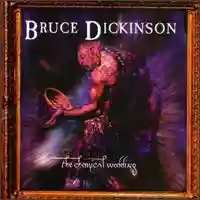
The album is a kind of concept album with the subject being the life of the English painter William Blake; the dark, grim, and enveloping lyrics wonderfully reflect Blake's way of living and painting; one of his paintings serves as the album cover. Musically speaking, the album picks up exactly where “Accident...” left off; ready, set, and you hear a few drum hits and immediately enter the powerful guitars of Roy Z and Adrian Smith, and so begins “King in Crimson,” powerful and very hard even in the lyrics. The song unfolds on a perfect pair of solos and has a catchy chorus for live audiences. The second track is “The Chemical Wedding,” beautiful in the chorus, one of those tunes that stay inside you, dramatic, slow, and epic, which fascinates and immediately lends itself as an important presence in concerts. “The Tower” is faster, and with this song, one understands Bruce's grace period; if the first songs might have suggested that Bruce was in decent shape, with this one, there's certainty that Bruce is in GREAT shape. The song begins with two serpentine guitars and then Bruce's voice comes in to raise the rhythm and tone.
“Killing Floor,” from which a nearly nonsensical video was made, with Bruce and Adrian having fun pretending to be waiters at a restaurant where Satan himself goes to spread chaos, is more sinister, and it is the single from the album; in fact, it is slightly more commercial than the others, but this does not in the slightest affect the value of this angry piece. “Book Of Thel” is a grand ride that at times recalls “Darkside Of Aquarius,” complex, enveloping, dark, ominous, the epicenter of the entire album, a track to remember. “Gates Of Urizen” is instead a tormented semi-ballad, whose verse is sweet, smooth, both in the sound and in Bruce's voice, which then becomes strong and aggressive in the chorus, which perhaps leaves a bit of dissatisfaction due to its repetitiveness but remains a good track with excellent appeal to live audiences. “Jerusalem” is a beautiful song with very medieval sounds, which also starts softly and then rises, but is of a clearly superior thickness to the previous track. The solo is magnificent, and at the end, there's the voice of Arthur Brown, one of Bruce's youth idols, who with a deep voice proclaims some verses. With “Trumpets Of Jericho”, much harder sounds are touched, almost thrash, but it's a great piece, fast and with a chorus, tinged with a certain sarcasm (“at the trumpets of Jericho, still the walls remain”), where Bruce gives his best, with two dizzying solos and with a perfect structure.
“Machine Man” is also violent, perhaps remains slightly less impressed on the listener, but it's a well-crafted track that somewhat recalls the Irons, while the final “The Alchemist” concludes the album in great style: it starts slow, soft, then comes the beautiful chorus and finally, after two other beautiful solos, comes the masterstroke, the highlight of the entire album: on the sweet initial melody, the chorus of “Chemical Wedding” is sung sweetly, almost whispering: “and so we lay, we lay in the same grave, a chemical wedding day” and thus ends the most beautiful album of Bruce.
An absolute must-have for any self-respecting metal fan.
Loading comments slowly
Summary by Bot
The Chemical Wedding is Bruce Dickinson's favorite solo album, marking a return to a heavy, Maiden-like sound with powerful lyrics inspired by William Blake. Featuring strong guitar work and memorable tracks like 'King in Crimson' and 'The Chemical Wedding,' it stands as a high point in Bruce's solo career. The album's dark concept and excellent musicianship make it a must-have for metal fans. The review highlights the album's intensity, depth, and live appeal.
Bruce Dickinson
Bruce Dickinson is an English singer best known as the lead vocalist of Iron Maiden, with a substantial solo career spanning hard rock and heavy metal releases.13 Reviews
Other reviews
By cliffburton86
The Chemical Wedding possesses the spirit of Brave New World and epic choirs reminiscent of Iron Maiden.
The bassist, Casillas, surprised me the most, managing bass lines in the manner of Steve Harris… he knows his stuff!
