
 •
Rating:
•
Rating:
THE REVIEW
In relation to his musical talent, Eno is someone who has had a tremendous stroke of luck, there's no doubt about it. I just devoured his detailed biography but I haven't changed my mind. Imagine, at the beginning the guy couldn't even play a melodica at school but then... Brian Peter George St. John le Baptiste de whatchamacallit, he drew more or less like I did, quite poorly, and dreamed of a life as a rockstar. Pretty much like we all did. Then, on a train, instead of the conductor, he met Andy Mackay and then Bryan Ferry. Just like that, he turned two knobs on a toy synthesizer that he built himself with Bostik and plasticine, and everyone shouted a miracle! Including the world's best guitarist, a certain Robert "King Crimson" Fripp, who fortunately hadn't lost his mind yet for that busty Toyah Wilcox. Well, what can I say, in an instant our Brian Eno found himself catapulted, with feathers on his head like Malgioglio, on live TV at Top of The Pops and he totally rocked!
Then everything else happened. He met the "others," all always inevitably attracted to his elusive personality and supposed but never quite evident visionary genius. Something like "Sacchi's luck" in other words. And in the football metaphor, we can say there was a fateful moment when having Brian Eno on your team meant an easy win. Ask Ultravox or Devo who had him stop by their studio one evening just for a greeting and found themselves with him in the credits of their debut as producer. But he hadn’t done anything, just like with Tom Verlaine's Television who then disavowed him. Not to mention the lesser known but very talented Urban Verbs who gladly did without his advice at the threshold of their debut album. Yes, sure, then came the great loves, the real ones. And then the evidence of his elusive talent seemed obvious. I'm referring to the revered "trilogy" with Bowie, the "holy" partnership with the absolute genius David Byrne, and the "freeze-drying" of U2. And from then on, it was all downhill, up to the Sanremo finish line... It's history now, an incredibile success story for this Leonardo Zelig of Rock, capable of baptizing the New York no wave of the stinking CBGB’s with nonchalance and, only a few years later, (pretend to) sing, in Modena with the national Lucianone, two meters from the Pope. All with absolute lightness and without ever really writing a half-successful song.
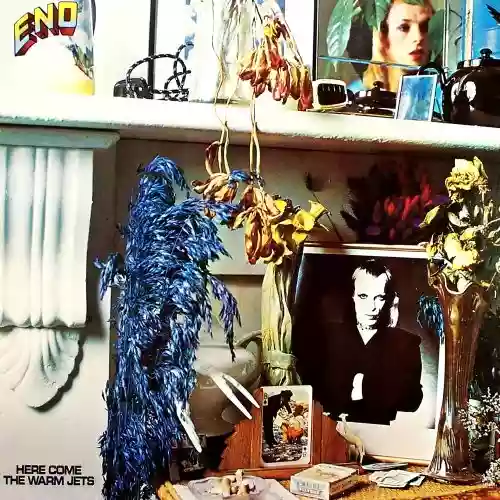
Now I want to contradict myself immediately though, because there was a key moment when Brian "can't play a damn thing" Eno was also writing great songs, or maybe he just imagined them since he didn't know how to string two chords together. At that time, around 1973, Brian could have "simply" become a great singer and rock performer, a Marc Bolan just a tiny bit less rowdy. And to think he had just been mistreated by Roxy Music, a story everyone knows, deemed cumbersome and useless by Brian "for your pleasure” Ferry. A pity, because "our Brian" at that moment was brilliantly tuned to the Glam Rock wavelength and soon would have been onto New Wave and Punk too, a casual or conscious precursor of the sounds that would come. His debut album "Here come the Warm Jets" fully testifies to this moment and from this magnificent record I would like to go back to writing, from a perspective free of the customary reverence for the character but no less analytical for that.
In truth, I'll give you a first level of reading that I still find correct. "Here come the Warm Jets" is a quite conventional collection of songs, partly derivative, under which the potential of the character can be glimpsed, in some respects. Period. But immediately after, there's a second level, and from this perspective, more attentive and aware, one discovers the forerunners that will birth the "myth Eno". Here he is, the man capable of simply combining experimentalism and quotation, castanets with the cello, the rubber duckies of his bathtub with supersonic jets, he who today detests them and only travels by bicycle. On the one hand, there's the canonical artist who writes, sings, twiddles, and makes up like a stripper in front of the mirror. Let's say a Renato Zero with streaks. On the other, we discover for the first time the absolute visionary who has already understood where rock music will end up and dares to mock the critics and company. The friends (many) who stand by him during the recordings of "Here come the Warm Jets" do the rest. The big Fripp first of all, the shy god of guitar. And John Wetton, Paul Rudolph, Simon King, Robert Wyatt, and of course Phil Manzanera, Andy Mackay, and Paul Thompson, all out on parole from Roxy. I don't know whether it was chance, the aforementioned sacchian luck, or a simple intuition. But the freedom Eno leaves to his guests, instead of turning into anarchy, becomes cohesion, sonic compactness. The intro of "Needles in camel’s eye" is already a verdict. It's an important opening where the wall of guitars and synthesizers is on the same plane as Eno's multitrack voice, and the final effect conquers and overwhelms. A moment later, the diversion of "The Paw Paw Negro Blowtorch" quickly becomes a real and intriguing song. And when the whimsical guitar enters, it's pure spectacle, with Eno even managing to place a two-finger synthesizer solo. And it's not over yet. In the fade-out comes a synthesizer loop that introduces the riff of "Baby's On Fire", the song which for most critics and fans will remain the centerpiece of the whole album. In this vaguely "motorik" song, Eno becomes a vocal interpreter as never before, experimenting his vaguely nasal singing with the most aggressive tone possible. The song grows until the decisive guitar solo by Mr. Fripp, not just a simple solo, but an electric bolt that literally burns the listener to ashes, more or less like a space halberd of Goldrake. Here it is, the avant-garde quietly enters the album tracks but does so on tiptoe, sneaking between songs without ever disrupting the coherent intention desired by the artist. The vaguely dadaist approach of the lyrics is matched by the protagonist's unabashed pop vocation and the memorable melodies that emerge from it. Such as in the next "Cindy Tells Me", my favorite. Let's all get on the school bus and go back to the 50s mood, stuff on which bands like the Bay City Rollers built a career (thankfully a short one). "Cindy" is a hypothetical single that could have been number one on Mars for weeks and weeks, just as "Seven Deadly Finns" could have been sometime later. Eno, however, is not satisfied with the melodic serenity of the piece and decides to disturb the mood and the elaborately crafted pop purity, extracting a distorted feedback from the guitar line and placing it in front of the guitar itself, for another solo that, again, becomes memorable. Sure, "Mister" scores every time, as "bisteccone" would have said. The next piece once again gets serious and openly flirts with the idea of "free music" that Eno had in mind. "Driving me backwards" lazily and defiantly unfolds at the beginning over a couple of sparse chords, an uncomfortable musical bed on which a karaoke-like singing builds an unexpected atmosphere of tension. Then comes the total guitar of Fripp which again reshuffles the cards. End of the first side, a lot to digest. We've understood that we haven't understood. And that's the strength of the record, you never know what to expect from the next song.
The second side of the record opens comfortingly with the melancholic pop nursery rhyme of "On some faraway beach". We are obviously by the sea and have our feet in the fresh water, all with eyes closed dreaming on those piano notes (yes, because it is said there are no fewer than 27 layered!). All in a constant crescendo, until the final apotheosis, when Eno's voice breaks the hesitation and takes over the song in a somewhat Albanian manner. Nothing like "Bogus Man", here the symmetry with which Brian gradually fades his "own" synthesizers in favor of the piano and its residual notes, preview for free that music with which he will fill airports, movie theaters, and lunar stations. Certainly more aggressive is the following "Blank Frank" where Fripp's guitar, obviously filtered through Eno's equipment, builds a deconstructed and psychopathic melody, just like the character told by the lyrics. "Blank Frank" will also be the opening piece of the brief and maligned '74 English tour, where the Winkies will try in vain to play it decently, listen to the pathetic attempt on YouTube... Roxy's drummer, Paul Thompson, rises and gives his muscular imprint to the following "Dead Fingers Talk", a dull march for distant and detached voice. They say the piece spoke ill of Brian Ferry but if it does, it does so in a totally subliminal manner because it's really hard to catch. The next song, "Some Of Them Are Old", has a complicated structure beneath an appearance of simple lullaby. To a keen ear, there won't escape the accumulation exercise of sax tracks and multitracks, the improbable synthesized dobro solo, and the rarefied and almost immobile ending. The outro becomes intro and sets the stage for the majesty of the last track, titled like the whole record "Here come the Warm Jets". And here it is, the hot air from the engines, the kind that if you walk in front of it will blow off your wig and dentures. Announced by a frenzied synthesizer, "Here come the Warm Jets" is a futuristic and forward-looking mantra. Eno had imagined it warm and impetuous, just like jet engines. And so it proves to be. The guitars press on for a while before Simon King's drums emerge in the distance, almost belonging to another song that someone is playing in the next room. Then even the drumming fades slowly, allowing Eno to recite his enigmatic verses full of hope and promises, at least that's how I get them. "Here come the Warm Jets" is a thrilling song that closes a record, in my opinion, much more intense than it might seem to a superficial listener who only perceives its bright aesthetic/musical side. And I'm not trying to overinterpret it at any cost. Every time I listen to it, it seems so pregnant with distant soundscapes, of manic and meticulous details, of nuances and densities. The truth is that "Here Come the Warm Jets" reveals something new with every listen and paves the way for an incredible musical career. And then I really like the idea, perhaps not very original but sincere, that supported a free and courageous music, obstinately linked to some form of revolution, whether musical, sexual, or perhaps just stylistic. In this, "Here come the Warm Jets" still reveals itself today as an extremely bold album, to the extent that it has inspired generations so much. Eno's true gift was indeed to release from the chains of convention the creativity in the musicians who followed his example, those who were open to applying their intelligence to music without limits of eclecticism. "Here come the Warm Jets" is an album that has built a parallel world to explore, with its songs so different from one another that have had the capacity or perhaps only the chance to merge together in a truly impressive way. A unique record that I have loved very much, in which the traditions of seventies rock music are reworked with the very idea of going beyond and dismantling them. A transversal theme that creates juxtapositions rather than coherence, insecurities rather than axioms, research and exploration rather than certain models. There remains the evidence of the great luck that Eno had on that train, otherwise, we would be here talking about gnocchi instead of masterpieces of rock music...
Loading comments slowly
Summary by Bot
This review offers a detailed and nuanced examination of Brian Eno’s debut album 'Here Come the Warm Jets.' It highlights the blend of conventional glam rock with avant-garde experimentation, supported by contributions from notable musicians like Robert Fripp. The album is praised for its visionary qualities and lasting influence, revealing new layers with each listen. The review balances admiration with critical insights into Eno’s unique approach and luck in the music industry.Tracklist Lyrics Videos
Brian Eno
Brian Eno is a British musician, composer and producer, widely recognized as a pioneer of ambient music and an influential collaborator and producer across rock and electronic music since the 1970s.43 Reviews
Other reviews
By francis
These are masterpieces for which the very word "review" is an unforgivable offense and impudence.
Brian Eno proves to be an absolute genius: in the title track he even manages to move by always using the same riff and starting the vocals after two minutes.
By luludia
A melody like a magic lantern or crystal ball, then the aristocratic ennui of the voice.
Here we inhabit a world between chance and control, between the wheel of fortune and science.
