
 •
Rating:
•
Rating:
THE REVIEW
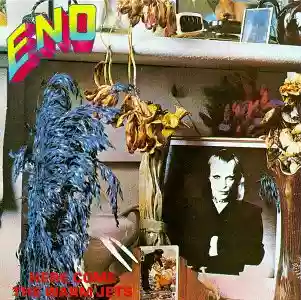
This is an album that seems not to enjoy privileged attention when it comes to the most famous "inventor" in the history of rock, and I think the time has come to pay him the rightful tribute and due importance, because, let's be clear, these are masterpieces for which the very word "review" is an unforgivable offense and impudence.
A few years ago, Todd Haynes and Michael Stipe already thought about giving new luster to Brian Eno's debut album by including the two glam classics "Needle In The Camel's Eye" (steeped in dandy nostalgia and with the essential support of Phil Manzanera) and "Baby's On Fire" (a perverse and tribal divertissement sonically "spoiled" by Robert Fripp) in the soundtrack of the controversial "Velvet Goldmine," but the fact remains that compared to other works like "Another Green World" or "Before And After Science", "Here Comes The Warm Jets" (which, for what it's worth, is on record the best-selling album of solo Eno) certainly occupies a position of lesser prominence in musical critic considerations.
A fact, in my opinion, absolutely inexplicable.
Lightyears ahead of contemporaries (Roxy Music, who indeed veered towards chart-topping soul funk, and Bowie included), tracks like "Dead Finks Don't Talk" or the superb "The Paw Paw Negro Blowtorch" (to which "Boys Keep Swinging" by the White Duke owes much) leave me open-mouthed for their originality of arrangements and production, the freshness of the melodies, their actuality which has remained virtually unchanged over the years (and more than 30 years have passed).
These are sparkling tracks, in which Eno uses the pop song format to delve into his experimental versatility, finding the right compromise between captivating solutions, glam aesthetics, and sound exploration, reaching in this "disequilibrium" paradoxically a perfect balance, where despite everything happening sound-wise, the lightness of the songs is not distorted in the least but rather enriched, tantalized.
In particular, I find it fantastic that Eno tried to write seemingly frivolous hits while simultaneously conducting bold experiments... according to my theory that a great artist must be able to write three-minute pop songs that never bore, Eno proves to be an absolute genius: in the title track he even manages to move by always using the same riff and starting the vocals after two minutes.
This is because, as I often maintain, it's much easier to have 8 minutes at your disposal to put in as much extravagant stuff as possible than to condense it all into three minutes without putting melody and immediacy at risk... for example, Brian Eno's pop songs have this merit, and this is where the great value of his music is measured.
In conclusion, I almost regret having discovered this great album so late, even though my mom had the tape of this album (because in the '70s it was fashionable to "pass tapes" among friends, not cassettes, but tapes!) but it was all worn out....yet she told me that Brian Eno did his best work when he wore eyeliner and, as always, she was right.
Loading comments slowly
Summary by Bot
This review celebrates Brian Eno's debut album Here Come The Warm Jets as an underrated masterpiece that blends experimental versatility with catchy pop melodies. Highlighting its originality, glam aesthetics, and fresh production, the review argues the album deserves more recognition alongside Eno's other works. The reviewer praises Eno's ability to craft three-minute pop songs that remain engaging and innovative even after 30 years.Tracklist Lyrics Videos
Brian Eno
Brian Eno is a British musician, composer and producer, widely recognized as a pioneer of ambient music and an influential collaborator and producer across rock and electronic music since the 1970s.43 Reviews
Other reviews
By luludia
A melody like a magic lantern or crystal ball, then the aristocratic ennui of the voice.
Here we inhabit a world between chance and control, between the wheel of fortune and science.
By Nevadagaz
Here come the Warm Jets reveals something new with every listen and paves the way for an incredible musical career.
Eno was brilliantly tuned to the Glam Rock wavelength and soon would have been onto New Wave and Punk too, a casual or conscious precursor of the sounds that would come.
