
 •
Rating:
•
Rating:
THE REVIEW
Imagine the scene: about ten years ago, the Y2K nightmare, that ignoble puppet Flat Eric, Aqua's “Barbie Girl,” and a (then) skinny fifteen/sixteen-year-old boy, already a fanatic of any sound that was even slightly distorted and rhythmic, with the exception of the dentist's drill (still a great enemy of this now ex-boy, ex-high school student, ex-skinny but eternally a rocker).
This boy, a bit agitated due to his young age, but who, alongside a practical dynamism typical of being young and rebellious (rebellious towards what? No one ever figured out) associates a personal contemplative philosophy, where rock was experienced as a transcendental if not even mystical experience.
The religion of rock, to be better conceived and experienced, therefore obliged this adept/priest/preacher to the constant and attentive reading of the sacred scripts narrating the epics of its protagonists and the philosophy of which they were conscious minstrels.
The fifteen/sixteen-year-old boy, around 1:30 p.m., on an unspecified day between Monday and Thursday (it wasn't Friday, being the last day of the “work” week, and consequently the happiest, I would have remembered it) enters a well-known bookstore in Chiavari, spending all the time between the end of regular lessons and the start of remedial classes, takes from the raised floor of the bookstore a volume from the GIUNTI editions (I think), it's a little book dedicated to the classics of Heavy Metal.
It's not so much the names, mostly (then) unknown to this youngster raised on bread and Litfiba, that stir curiosity, no, but primarily what catches the eye the most: the covers.
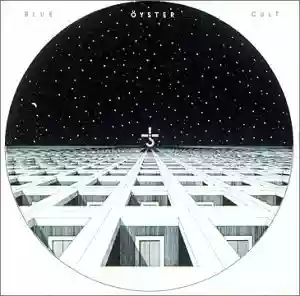
Strong images, powerful colors, give a sense of arrogant vigor and already cited rebellion: there's the monstrous robotic feline of Judas Priest's “Defenders Of The Faith,” the angry and excited face of John Gallagher in Raven's EP “Mad,” and then this cover, without abominable creatures or faces with crazy expressions, no, there aren't even “hysterical” colors to highlight an already imagined atmosphere of unparalleled sonic madness, that cover, so distant in time (early '70s) and space (deepest universe) gave a sense of unease and attraction difficult to describe.
An immense “carpet” of many square rooms, of which the end was not visible on the horizon, overshadowed by an unknown symbol and a dark sky with icy stars acting as guardians in a world –apparently- uninhabited by any form of life.
Okay, we agree that a book or a record shouldn't be judged by the cover, but on the other hand, the eye also wants its share, and that boy –who was none other than myself, was it clear?- influenced by the aesthetics of that front cover of the record recorded in New York about thirty years earlier, began to love what in his opinion is considered as one of the greatest stars-and-stripes bands of all time.
We are talking about the Blue Oyster Cult, and the record in question is indeed the eponymous album recorded in 1971 (released the following year, in January 1972, a few months after the recordings ended); the record that in itself cannot be considered “heavy metal” as currently understood, though sparse in production, presents ten tracks of pure visionary hard rock: both in the musical part and even more in the lyrics, mostly written by the manager-producer -sixth member-friend Sandy Pearlman.
The honor of opening goes to the roaring “Transmaniacon MC,” a sort of anthem of a ramshackle band of satanic bikers, but we hardly notice that in just over three minutes we've already arrived at “I'm on the lamb but I Ain't No Sheep,” I'm a lamb but not a sheep… honestly the meaning of the song still escapes me, it is understood that it talks about a journey in Canadian land, among huskies and glaciers on which sleds run: maybe the members of the Transmaniacon MC are present, leading a race in the land of the maple leaf.
Mystery of the lyrics and appeal of mystery in general, which indeed accompanies the themes of the “American Black Sabbath.”
But here we come to the third track of the long playing, in my personal opinion, the most beautiful of the whole work, and one of the five most beautiful in the entire production of the group: “Then came the last days of May,” lyrics and music entirely written by guitarist Donald Roeser (alias Buck Dharma) who besides demonstrating his vocal ability delights us with delicate yet sustained blues-style phrases.
Mostly cryptic lyrics, the temporal location suggested already in the title, “…then came the last days of May,” but set where? Who are the protagonists of the story? Undefined characters, each with money in their pockets that according to the “narrator” would have taken them far away, but far where? Maybe to the west? But what kind of west is it?
It starts in a “barren land without desert sand” where “the Sun was just a dot” and ends in a “cold and sterile” place.
Perhaps the “sacks and balance to measure things” (who knows what “things”) and “the driver (who) said the border is just the bluff” suggest they are Mexican immigrants, who knows: it is only understood that the story will end badly.
It seems the journey is the main theme of this record, in fact, the fourth track is not coincidentally called “Stairway to the Stars,” which together with the following, “Before the Kiss, a Redcap,” will be one of the band's concert highlights: triggering motives for a rhythm-hungry audience.
Rhythm that is certainly not lacking in the much-renowned and famous “Cities of Flame with Rock and Roll,” which along with the chronologically subsequent “Astronomy,” “Burning for You,” “Godzilla,” and especially “Don’t Fear the Reaper,” will become a trademark of B.O.C..
But let's take small steps, before reaching the aforementioned eighth track, in between come “Screams” and “She’s Beautiful as a Foot”: both shrouded in a halo of darkness, the first marches at a sustained but not intrusive speed, the second instead is decidedly slower and more cadenced. They are connected as if they were a single track, divided only by a drum roll.
After the previously mentioned “Cities of Flame with Rock and Roll,” here comes “Workshop of the Telescopes,” lyrics with scientific-science-fiction or even astronomical references, it goes by quickly, four minutes averagely marked by two very pleasing guitar solos and a fascinating and occult riff.
The closing is given by “Redeemed,” very “easy” sounds, almost country in both sound and lyrics, a classic car radio song… oops… from US highway.
For those like me who own the remastered version on CD, there are also four bonus tracks from a demo recorded on July 21 and September 11, 1969, by the Soft White Underbelly, who would then become the Stalk Forest Group and in 1971, with the entry of Joe Bouchard on bass, definitively into the Blue Oyster Cult: the first three are original tracks (“Donovan’s Monkey,” “What Is Quicksand,” and “A Fact About Sneakers”), and the last a cover of soulman Bobby Freeman, “Betty Lou’s Got a New Pair of Shoes”: the sound is quite different from that of the upcoming BOC, it is akin to a sort of quirky East Coast Doors.
A definitely raw record, but not disparageable for that; undoubtedly epochal though dated, but it's for this reason lovable: a perceivable trace of skill and originality and of a success (more than deserved) that would not be long in coming.
If you find yourself with ten euros in your wallet and don't know how to spend them (maybe they are all in tedious coins) and you feel like listening to some good music, this record could represent for you –dear readers- an invitation to know (for those who unfortunately had no opportunity to be aware of its existence) and to love a unique and unlabelable band, or to love it even more and understand its genesis.
Enjoy listening, and may rock be with you all.
P.S.= As today falls on December 8, my memory goes to two great musicians though of parallelly opposite genres: John Lennon, of whom today marks the thirtieth anniversary of his assassination, and Dimebag Darrell, whose anniversary of his assassination, occurring six years ago, also falls today. For both by a madman.
In any case, bullets are not enough to kill music, good music, the one made with blood, spit, soul, heart, lived day by day, pain for pain, joy for joy, and perceived as a religious faith.
Loading comments slowly
Summary by Bot
This heartfelt review reflects on Blue Öyster Cult's 1972 debut album as a visionary hard rock record that transcends typical heavy metal definitions. The reviewer shares personal memories of discovering the band through its intriguing album cover and explores the album's themes of mystery, rhythm, and poetic lyricism. Standout tracks like 'Then came the last days of May' highlight the band's musical and lyrical depth. The album is praised as a raw yet epochal work that remains lovable and influential.
Blue Öyster Cult
Blue Öyster Cult is an American rock band formed in New York in 1967, known for dark, theatrical hard rock blending sci-fi, horror, and occult-tinged storytelling. The group’s classic era spans the early-to-mid 1970s and includes influential albums and staples like “(Don’t Fear) The Reaper.”22 Reviews
Other reviews
By vellutogrigio
"The album is recommended to 70s rock enthusiasts and those who wish to delve into the musical background of many punk, rock, and no wave bands that emerged in the New York area starting in the late 70s."
"She's Beautiful as a Foot (...) surprisingly foreshadowing the traits of Sonic Youth and much of the grunge or related scene (Nirvana, Smashing Pumpkins), expressly indebted to BÖC."
By FlavioMetal
The music was hard, the lyrics cryptic, and the attitude was that of intellectual bikers who, with songs never heard before, could literally drive you crazy.
At that time, it was the flag of the new American Heavy Metal.
