
 •
Rating:
•
Rating:
THE REVIEW
It's unlikely that your metalhead friend, when discussing the Sabs, will bring up the albums from the late seventies, as if wishing to forget that those LPs even existed.
It's pointless to deny that after 1975's "Sabotage"—considered by many to be the last truly noteworthy LP before the Ronnie James Dio era—things weren't going well in Birmingham. Tour after tour and an impressive six albums in five years were starting to take their toll, and at this point, anyone would have begun to show some, uh, "wear and tear." Add to this the fact that the band was floundering amidst countless legal battles, and with the explosive rise of punk, bands like Led Zeppelin and the Sabbath themselves were beginning to seem like dinosaurs to many, you were left wondering just when the final extinction would occur.
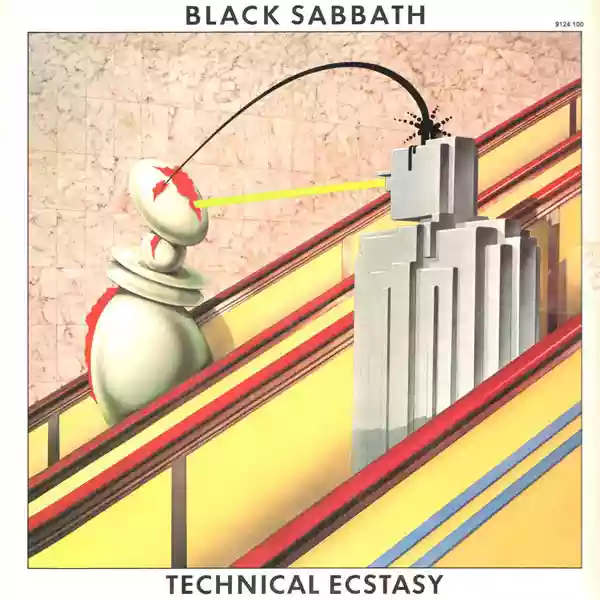
Tony Iommi and company, despite everything, shut themselves in the studio—more Iommi than the others, to be honest—in an attempt to produce something worthwhile, but apparently, they didn't know where to start. By then, keyboardist Jezz Woodruffe had also joined the four, and ultimately ended up writing much of the music, though the general atmosphere was one of distrust. In the end, however, the album finally hit the stores, greeted with indifference. Sales were poor and perhaps even the cover image didn't help much, despite its appeal.
But what about the music? Let's say that "Technical Ecstasy" is a "varied" album, perhaps too much so. If in the past each Sabs album was characterized by a peculiarly evolved sound—the distorted blues of the debut, the proto-doom of "Master of Reality," the prog influences of "Sabbath Bloody Sabbath"—"Technical..." seems to lack a clear direction, often appearing disorienting and all over the place.
"Back Street Kids" kicks off with a bang, with a galloping rhythm and Ozzy screaming into the microphone like in the glory days: a great track to open the album. It breaks no new ground, but that's just fine. "You Won't Change Me" definitely reaches higher peaks, with Iommi in top form and Woodruffe's keyboard taking the lead, complemented by anguished lyrics that shape a track with the desperate tones reminiscent of the golden days. "It's Alright" is a welcome surprise: Ozzy hands the microphone to Bill Ward for a pop song that betrays all four's love for the Fab Four, delicate and catchy. "Gipsy", which closes side A, winds through lengthy solos from a very well-performing Iommi and prog atmospheres, marking another point in the album's favor. Side two opens with "All Moving Parts (Stand Still)", a perhaps more canonical track but still pleasing, buoyed by its rather quirky lyrics. "Rock 'n' Roll Doctor" is truly avoidable, a piece that would only make sense as a B-side to some single: its presence on the album perfectly captures the confusion reigning within the group at the time. The album resumes with "She's Gone", which seems to pick up the thread begun years earlier with "Changes" on "Volume 4": synthesizers rule in a slow, sadness-laden track, elevated by an Ozzy in a state of grace. The grand finale is entrusted to "Dirty Women," a powerful and well-structured track, a mini-compendium of the many facets of "Technical Ecstasy."
As mentioned earlier, sales were a disaster and apparently even the Sabs themselves weren't too satisfied with the final result: during the subsequent tour, tracks like "It's Alright" and "She's Gone"—in their own way, the most experimental of the LP—were left out of the setlist, focusing solely on the more impactful pieces.
All things considered, "Technical Ecstasy" is still a pleasant album to listen to, with several peaks and some stylistic missteps, witnessing the Sabbath moving away from their hard rock roots towards a more chameleon-like rock, with synthesizers and melodies becoming an integral part of the group's sound. The imperative was "keep up with the times": sometimes they succeeded admirably, sometimes less so.
When contextualizing the album's release, however, one realizes that, to the ears of the 1976 audience, all these experiments would have seemed entirely indifferent, and the Sabs appeared to many as a band that had already had its day. To return to rock's Olympus, the Birmingham four would have to wait until the early 1980s, but the magic of their best times was now a memory: Tony Iommi would continue to lead Black Sabbath through countless lineup changes, and Ozzy would embark on a hugely successful solo career. But that is indeed another story.
Loading comments slowly
Summary by Bot
Technical Ecstasy captures Black Sabbath during a challenging period, experimenting with new sounds and styles. The album is uneven, with standout tracks but also weaker moments. It reflects the band's struggle with internal conflicts and a changing music scene. Despite poor sales and mixed reception, it offers some notable songs worth exploring. The album marks a transitional phase before Black Sabbath's resurgence in the 1980s.
Black Sabbath
Black Sabbath are a British heavy metal band formed in Birmingham in 1968. The classic lineup featured Ozzy Osbourne, Tony Iommi, Geezer Butler and Bill Ward, with later acclaimed eras fronted by Ronnie James Dio and Tony Martin. Their influence spans generations; the group released the comeback album 13 in 2013 and concluded with a final tour in 2017.92 Reviews
Other reviews
By CycoCiccio
"Technical Ecstasy, except that it sounds like something already heard."
"Sometimes melodic, sometimes charged, always on the verge of exploding, they run out of the fuse before making the bang."
By Starblazer
"Technical Ecstasy is a bit like the 'Virtual XI' of Black Sabbath: a courageous and innovative album that unfortunately wasn’t understood."
"The album closes with 'Dirty Women'... showcasing a long guitar solo where Iommi truly shines."
