 •
Rating:
•
Rating:
THE REVIEW
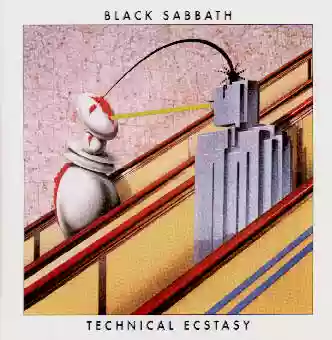
Today, bands that strictly define themselves as metal are not infrequently accused of excessive stylistic prolixity. Ironically, those who first forged metal (almost) never allowed themselves the luxury of releasing an album that was the same as its predecessor. And indeed, many things can be said about this “Technical Ecstacy” (1976), except that it sounds like something already heard.
We also remember that starting from the second half of the seventies, many of the major exponents of the hard rock genre suffered an impressive stylistic involution (although, in many cases, it was more of a search). And the phenomenon did not spare the Black Sabbath. Even they, in an attempt to renew their sound, after six albums as pioneers, allowed themselves a slowdown. Let's say half a slowdown, considering the necessity of a compulsory passage towards the imminent rebirth, and because some tracks have nonetheless remained in the fans' hearts. “Dirty Women” above all, not coincidentally included in the setlist of the live performance of the historic reunion. However, it was certainly difficult for any Sabbath aficionado to come to terms with this abrupt change of direction: “Sabotage” (1975), with its heavy riffs, still echoed too strongly in the minds of the most die-hard headbangers (who weren't called that at the time, but allow me the term). While the subsequent (and not for that reason undervalued) “Never Say Die” (1979) was both, in terms of sound choice and a high-level compositional experiment, the same cannot be said of this work.
“Technical Ecstacy”, even before being monotonous, seems to be rather trapped in the dense sound chosen by the band, which dulls its adrenaline cut without adding any elegance. “Back Street Kids” opens the record, immediately delivering this sad verdict. Not bad, yes, but the sound that emerges is a hybrid with premature genes, which would have deserved at least a few more months of gestation. The same goes for “Rock ‘n’ Roll Doctor” (which even had a video) and “All Moving Parts”. Episodes not to be despised, but always incomplete in something. Sometimes melodic, sometimes charged, always on the verge of exploding, they run out of the fuse before making the bang. That abomination named “It’s All Right” is almost frightening, where Bill Ward improvises as a last-minute singer, making us almost forget all his booming rhythmic talents with a twisted backbone. The openings of the choruses in “Gipsy” are certainly more on point, which the band would have done better to emulate if they truly wanted to progress beyond their overused formulas.
I still stick with a three because ultimately, I consider myself a fan, and I just can't bring myself to completely criticize them. It might be more accurate to talk about a nearly achieved sufficiency, but the heart wants what it wants (and two and a half stars are not included among the possible ratings).
Loading comments slowly
Summary by Bot
Technical Ecstasy marks a departure from Black Sabbath's classic heavy sound with mixed results. While the album showcases attempts at evolution and contains memorable tracks like "Dirty Women," it is often seen as incomplete and stylistically uneven. Fans may struggle to fully embrace this shift, but the reviewer's loyalty keeps the rating moderate.
Black Sabbath
Black Sabbath are a British heavy metal band formed in Birmingham in 1968. The classic lineup featured Ozzy Osbourne, Tony Iommi, Geezer Butler and Bill Ward, with later acclaimed eras fronted by Ronnie James Dio and Tony Martin. Their influence spans generations; the group released the comeback album 13 in 2013 and concluded with a final tour in 2017.92 Reviews
Other reviews
By Starblazer
"Technical Ecstasy is a bit like the 'Virtual XI' of Black Sabbath: a courageous and innovative album that unfortunately wasn’t understood."
"The album closes with 'Dirty Women'... showcasing a long guitar solo where Iommi truly shines."
By Rainbow Rising
"Technical Ecstasy seems to lack a clear direction, often appearing disorienting and all over the place."
"All things considered, Technical Ecstasy is still a pleasant album to listen to, with several peaks and some stylistic missteps."
