
 •
Rating:
•
Rating:
THE REVIEW
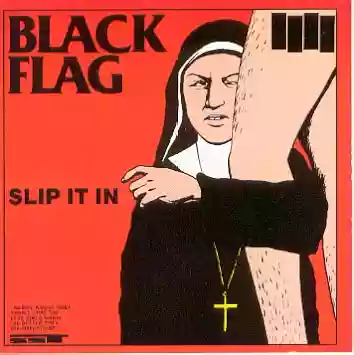
1984 was the pivotal year for hardcore punk: it saw the release of historically significant works like Hüsker Dü's "Zen Arcade", one of the few great alternative records that found commercial success, and Minutemen's "Double Nickels On The Dime", an album that cemented their status in the pantheon of the genre's exponents (despite being their most experimental effort). For Black Flag, however, it was the year to move towards heavier directions, while still remaining fairly faithful to the nihilistic hardcore they had championed in 1981 with their masterpiece, "Damaged". The result of such experimentalism was "Slip It In", whose actual merits were overshadowed by the success of the aforementioned "Damaged".
Usually, title tracks disappoint ("It's A Shame About Ray" by the Lemonheads serves as a valid example), yet "Slip It In" reveals itself as a captivating opener: it begins with a well-crafted bass line by newcomer Kira Roessler; Greg Ginn's guitar improvisations then make a notable impact. The track is a sensual duet between Henry Rollins and the then fifteen-year-old Suzi Gardner (future singer/guitarist of L7): over Gardner's orgasmic moans, exquisitely spasmodic guitar riffs rise along with a solo that becomes the piece's dominating spire. The lyrical climax occurs in the chorus, where Rollins, with an air of superiority, launches the heavy invective: «You say you don't want it, but then you slip it on in». The following track, "Black Coffee", doesn't disappoint either: with a metallic and noisy attitude, it unfolds between sudden pauses and memorable riffs, boasting a solo rich in passion yet sparse in notes. Rollins' hoarse and sick voice is maximally exalted in the fast-paced "My Ghetto", a fleeting hardcore piece in the style of colleagues Hüsker Dü, which expresses despair in nihilistic screams and the sounds of an amplifier that opens and closes the track, its title unfortunately recalling a topos of rap lyrics.
The Hüsker Dü, if not surpassed, are at least matched in the excellent "Wound Up": with a tense atmosphere, it climaxes in a Ginn solo that would astonish the Sex Pistols and Ramones, who never managed to pull off anything decent in their lives. In some vocal postures, Rollins vaguely recalls Jeffrey Lee Pierce of "Sex Beat", but this should be considered a fairly subjective and subtle comparison. Complementing it is a simple yet well-framed rhythm section.
The hardcore becomes a faded memory in "Rat's Eyes", where (unfortunately) metal holds the reins, even Rollins' voice is distorted and desperately attempts to adapt to the genre, clearly not in his wheelhouse. The band tries to recreate in this piece atmospheres too heavy that inevitably denature their typical sound, making it feel forced.
The hardcore-heavy metal fusion, on the other hand, is perfectly represented in the instrumental "Obliteration", where the instruments seem skillfully disconnected from each other: Ginn's guitar performs an eloquent monologue while the drums indulge in various deviations and the bass solemnly executes its martial loop.
The real innovation of "Slip It In" was a conception of track length unthinkable at the time for hardcore bands, whose songs barely touched the two, at most three minutes in duration. Black Flag demonstrated that a hardcore track could easily last even seven minutes, and to support this, they painted the concluding "You're Not Evil".
"Slip It In" suffers greatly from an inferiority complex compared to "Damaged", which boasted gems such as "Depression", "Rise Above", "Gimmie Gimmie Gimmie" and "T.V. Party"; for this reason, it will remain the most underrated album of the Californian band.
Loading comments slowly
Summary by Bot
Slip It In marks a significant, though underrated, shift in Black Flag's sound towards heavier and longer tracks. The album balances hardcore punk roots with experimental and metal influences, highlighted by strong performances from Henry Rollins and the new bassist Kira Roessler. Despite its overshadowing by the band's earlier classic Damaged, Slip It In stands out as a pivotal and innovative 1984 release in the hardcore genre.
Black Flag
Black Flag are an American band widely recognized as a foundational act in hardcore punk, formed in Southern California and closely associated with guitarist and primary songwriter Greg Ginn.14 Reviews
Other reviews
By alessioIRIDE
Pop this album into the stereo, light up a nice cigarette, and open the first beer... let the party begin and don’t you worry about a thing.
Henry Rollins is one of the least talented singers in history, but one of my favorite singers.
