
 •
Rating:
•
Rating: THE REVIEW
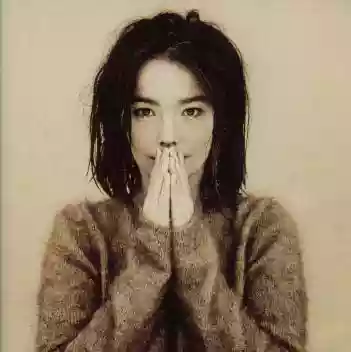
A rather modest and simple photograph: a woman dressed in a frayed sweater, hands gently resting on her face, almost as if to further conceal an already manifest and quite conspicuous aura of shyness and naivety. Back in 1993, the style of the highly eclectic Björk did not remotely foreshadow the ethereal/fairy-tale/magical/mysterious/enigmatic "extravagances" of her later works, primarily Medulla and Biophilia: in the focal center of the then Grunge trend, characterized by simplicity and sobriety (at least from a look perspective) totally opposed to the magnificent splendor of mainstream pop shows, the Icelandic sprite at her "debut" perfectly fit the mood of the time. Yet, beyond that dull cover, beyond the opening photo that seems to have been taken in post-war Soviet Russia, was an authentic little musical gem packaged, a blend of sounds, fantasy, sentiment, sophistication, sensuality, and mood.
Debut presents itself as a special intimate-artistic journey in sound experimentation, in which even noises, off-key notes, and the calls of nature are not set aside, refused, or disdained, but on the contrary, immersed and blended in a grand dance/trip-hop cauldron. The times of the extreme maturity of Medulla, in which nature and artifice compose a single, unique work of meaning and spirituality, are still far away, yet there is already the perception of holding in hand a work refractory to the commercial pop box, a sort of multi-faceted, multi-colored "Rubik's cube" to compose, recompose, and savor to the last piece.
And the tracklist starts with a dynamite-like explosion of sounds, noises, and bass: Human Behaviour, Celtic-folk march Sinead O'Connor style with evident ambient-trip hop inspirations, is the vital soul of the album, the sum of all its abstract and sensory perceptions, the culmination of the dialectic between light and darkness. A small leap then brings us to the frivolous eurodance/techno of Big Time Sensuality and Crying, to the fresh and sunny tribal-ambient litany of the oriental Venus As A Boy, and to the house pearl of Violently Happy, one of the best expressions of alternative dance of the '90s.
Experimentation, eclecticism, it was said: here then are the unplugged "off-key notes" of maddened brass instruments in The Anchor Song, the slamming doors, the noisy crowd of a party, and the pseudo-adolescent vocal tone inscribed in the danceable context of There's More To Life Than This, the ethereal, super relaxing and evanescent trip-hop/ambient infusion of One Day - almost anticipating the hyperuranic effluvia of Bachelorette and Medulla. Worthy of note, finally, are Like Someone in Love, a triumph of strings and old school serenade romance, Play Dead, melancholic, even heart-wrenching and desperate trip-hop expression, and the funkified cabaret dance (with a tribal ending) of Aeroplane.
Spontaneously sneaking into the nineties debate between pop commerciality and pure, genuine alternative eclecticism, the very first Björk's Debut managed perfectly to wear the traits of one and the other, bringing out a chameleon-like double game - still unripe and incomplete - that winked at appreciators of all music, of all sound art, of whatever melody could reach the ears, mind, and heart of the attentive listener. And the Björk tale was just beginning...
Björk, Debut
Human Behaviour - Crying - Venus As A Boy - There's More To Life Than This - Like Someone In Love - Big Time Sensuality - One Day - Aeroplane - Come To Me - Violently Happy - The Anchor Song - Play Dead
Loading comments slowly
Summary by Bot
Bjork's Debut album, released in 1993, is a groundbreaking mix of trip-hop, folk, and experimental music that perfectly captured the 90s alternative scene. The review highlights its unique sound blending ambient, techno, and ethnic influences, praising tracks like 'Human Behaviour' and 'Big Time Sensuality'. Despite a modest album cover, the music offers a sophisticated journey that hints at Bjork's evolving artistry. The album balances commercial appeal with genuine alternative experimentation, setting the stage for her future work.Tracklist Lyrics Videos
04 There's More to Life Than This (recorded live at the Milk Bar toilets) (03:21)
Read lyrics05 Like Someone in Love (04:33)
Björk
Björk Guðmundsdóttir is an Icelandic singer, songwriter and producer known for her solo work since the early 1990s (after earlier projects including the Sugarcubes). She is noted for vocal experimentation, genre-defying albums and inventive live shows.40 Reviews
Other reviews
By bauer
I find myself completely captivated by her voice and the beauty of the songs.
More than just something to own, it’s to be hung in your room next to your Monet or Van Gogh.
By MarcoP
It definitely belongs among the 10 essential albums of the nineties not so much because it is a precursor of a certain genre but for the originality with which it handles Dance, Pop, and Electronic.
Aside from her creative genius, Björk enjoys a natural gift, her unmistakable voice, which besides being an added value, is also her strength.
