
 •
Rating:
•
Rating:
THE REVIEW
A unique musician, Billy Bragg.
Just think that the most evident and unexpected recognition he received came from Rancid, a group that didn't (and doesn't) have much in common with him. I quote the first verse of «The Wars End», a track from their album «... And Out Come The Wolves»: «Little Sam was a punk / His mother didn't understand him / She sneaked into his room and destroyed Billy Bragg's records / She didn't want him to listen to that communist ranter ...». And then, there's Lars Frederiksen, who in his debut with the Bastards, covers the anthem-like «To Have And To Have Not» from our artist.
And again, what about the fact that his best work is a classic transitional album? When has it ever happened that a transitional album is also an artist's best? It's as if «Give'em Enough Rope» was the best Clash album!
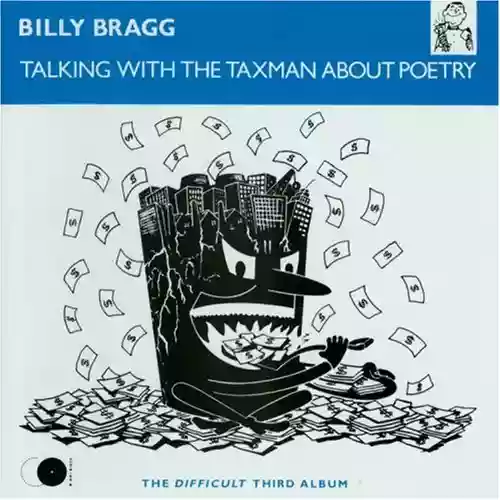
«Talking With The Taxman About Poetry», released in 1986, is indeed a transitional album, an ideal bridge between the Billy Bragg who was and who he would become later.
Originally, Billy Bragg was a one man band, an angry grandson of Woody Guthrie, someone who wanted to sound like the Clash but didn't have a guitarist, bassist, or drummer to accompany him, so he did it all by himself and roamed around with his electric guitar and amplifier on his shoulder, discovering a better England and world, even though, ironically, in one of his most famous songs (so to speak), «A New England», he claimed he didn't want to change the world, just find another girl.
All his original work is collected in a double LP titled «Back To Basics», a record to be listened to in small doses (one side at a time, at most) to ensure the validity of the proposal is not overwhelmed by the inevitable stylistic monotony: try, dear DeBaser reader, to listen for two hours to someone who abuses an electric guitar and sings in incomprehensible slang, and then you'll tell me!
But Billy Bragg, besides being listened to, must above all be read, having one of his strengths in the lyrics: more than with the guitar, he killed fascists with words.
Of the «all guitar and commitment» Billy Bragg, there are some remarkable examples in this album, especially «Ideology» and «There's Power In A Union», as well as the homage to Vladimir Mayakovsky, from whose work the album is titled (it has little to do with it, but my most amusing memory related to this work is that of a "show-off" critic who, to impress, translated the title as «Talking About Poetry With The Taxi Driver»).
But above all, what arouses interest is the anticipation of what Billy Bragg would become: the deepening of more introspective themes and a more complex and airy musicality give the songs a depth previously unknown. And so, the lively «Greetings To The New Brunette», the ironic «The Marriage», and the cabaret-like «Honey I'm A Big Boy Now», those very songs you wouldn't expect from Billy Bragg, are admired. But how can we not also mention «Wishing The Days Away», or the poignant «Levi Stubbs' Tears», until you realize that this album is a treasure chest containing twelve gems.
Billy Bragg would release other excellent records - at least «Don't Try This At Home» and the Woody Guthrie tribute of «Mermaid Avenue» together with Wilco should be remembered - but unfortunately, he would never reach the heights of «Talking With The Taxman About Poetry» again.
Of Billy Bragg, someone wrote that «... his music is a shield erected against human pettiness and the greed of the powerful ...»: for this reason alone, «Talking With The Taxman About Poetry» should be listened to at least once and never forgotten.
Loading comments slowly
Summary by Bot
Billy Bragg's 1986 album 'Talking With the Taxman About Poetry' is a landmark transitional work showcasing his evolving sound and incisive political lyrics. The review praises its mix of folk-punk energy and introspective songwriting through standout tracks like 'Ideology' and 'Greetings To The New Brunette.' Recognized by artists like Rancid, this album remains Billy Bragg's high point and a vital listen for fans of politically conscious music.Tracklist Lyrics Videos
Billy Bragg
Billy Bragg is an English singer-songwriter and activist, born in 1957 in Barking, Essex. Blending punk energy with folk tradition, he’s known for incisive political songs and tender personal ballads. He collaborated with Wilco on Mermaid Avenue, setting Woody Guthrie’s lyrics to new music, and wrote enduring songs like A New England and Waiting for the Great Leap Forward.05 Reviews
