 •
Rating:
•
Rating:
THE REVIEW
Before I start, in forming an opinion about something, the views of others should only serve as advice and not as an infallible influence that falls upon us like something undeniable. Nonetheless, sometimes opinions are so unanimously positive or negative that they make you waver, standardize your taste, and you give in. You risk being convinced that, for example, Dark Side Of The Moon is a masterpiece even before you’ve heard it, or that Apocalypse Now is unbeatable even if you haven’t seen a single frame of it. But everyone says so…
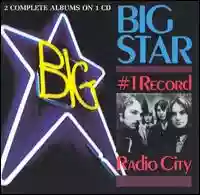
On a smaller scale, this happened to me with the first two albums by Big Star, the legendary Memphis band led by two guitarists, Alex Chilton (also a vocalist) and Chris Bell. After their first album, aptly named #1 Record (1972), the two were praised for a songwriting symbiosis worthy of Lennon/McCartney, but Bell decided, after misunderstandings with his partner, to leave the quartet, which became a trio with Chilton as the undisputed sole leader.
This formation produced the follow-up to #1 Record, Radio City (1973), and broke up before releasing their third album, which came out posthumously in 1978 (Third/Sister Lovers, which I haven’t unfortunately heard but which you already have a review of).
Big Star and this pair of albums became cult classics almost immediately after being largely ignored commercially, a kind of 1970s Velvet Underground. But I can’t see it that way. All the innovation, freshness, originality, and taste attributed to these four young men I found to be quite negligible, and very diluted.
Let's start by saying that the Bell-Chilton album seems much more substantial to me, simply because Bell has an excellent melodic vein reminiscent of post-Beatles/Stones rock giants, and he knows how to soften and filter Chilton's excesses; the other tends to use a powerful, expressive voice in a very predictable and anonymous manner, as if from song to song he's always talking about the same subject.
Their signature sound is the alternation between acoustic folk and hard-rock blues parts; and this is very wise, making everything more varied and digestible. It's a shame that the average quality of the songs makes this strategy wasted.
There are some great ballads, such as the simple yet genuine “Thirteen,” covered far and wide, “The Ballad Of El Goodo” (which I dedicated, at 16, to a girl and she had her parents call me), and the syrupy yet adorable “Give Me Another Chance” (and this one I’ve covered to death!!).
But then what? A thousand little choruses, a thousand guitar strums on the usual chords already tried by all the best artists (from Led Zeppelin to Rod Stewart) of the previous 5 years. Songs about India that seem like a mix between a Christmas jingle and “Sloop John B” by the Beach Boys (“The India Song”) and a continual sense of inconsistency that reappears every now and then.
But if the problem with the first album is perhaps that it's too superficial, going in one ear and often out the other, the problem with the second is that everything is weighed down by the indulgence of the leader, who must and/or wants to do everything alone. A bit like the syndrome Damon Albarn suffered with Think Tank. And thus, everything becomes almost indigestible, or at least confusing. The precision of once has turned into pop schizophrenia, with three-minute songs that don’t know where to go, unable to hold onto a chorus, constantly changing chords, not out of experimentalism but due to a suspected inability to give a clear shape, a definite body to some excellent ideas (even if there are outstanding exceptions including the evergreen “September Gurls” or the successful “You Get What You Deserve”).
This leaves me with a bitter taste; I bought this CD and held it in my hands like it was an invaluable treasure. But is it???
Loading comments slowly
Summary by Bot
The reviewer challenges the legendary status of Big Star’s first two albums, appreciating some melodic strengths especially on #1 Record, but criticizing Radio City for its inconsistency and indulgence. While some songs stand out as timeless, overall the albums fail to impress the reviewer fully. The experience leaves a mixed impression despite the albums' cult recognition.Tracklist Lyrics Videos
Big Star
Big Star are an American power-pop band from Memphis formed in 1971 by Alex Chilton and Chris Bell with Jody Stephens and Andy Hummel. They released three seminal albums—#1 Record (1972), Radio City (1974), and Third/Sister Lovers (recorded 1974, released 1978)—that were commercial failures but became hugely influential. The group later reunited in 1993 and performed through 2010.04 Reviews
Other reviews
By Lewis Tollani
An astonishing sequence of genuine pop gems unfolds through the grooves of this vinyl.
These are the characteristics through which Bell and Chilton chase the dream of writing perfect pop songs.
