
 •
Rating:
•
Rating:
THE REVIEW
About 13,500 km separate Kanazawa, the capital of Ishikawa Prefecture on the Sea of Japan, from Brescia and, just so you know, thanks to the mighty means of DHL, this distance can be covered by 4 vinyl records in just 4 days! Of course, it doesn’t always go like that; last time I had to wait almost a month before the long-awaited package of AAA vinyls Japan press, which departed from Tokyo but was entrusted to the Japanese postal service, finally arrived at my home. I suppose this should be enough to explain the theory of relativity: time and space are not absolute, but relative to the observer—or to the... courier!
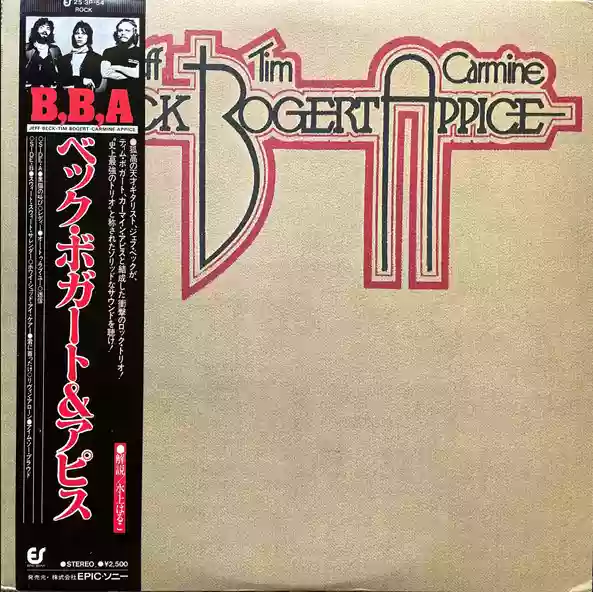
Time... Of course, for a musician "keeping time" is an essential condition. Nevertheless, Mr. Jeff Beck didn't care that, in the years straddling the late '60s and early '70s, everything was happening at breakneck speed. Just consider, for example, the evolution of the “Power Trio” model, a transformation we can use as a “litmus test” for those changes that shook up music and broadened the rock scene. In the '60s, the trio was synonymous with improvisational freedom and expansive blues (Cream and the Jimi Hendrix Experience), but by the early '70s, it became the structural foundation for the birth of Hard Rock and Prog (ZZ Top and Grand Funk Railroad on one hand, Rush and Emerson, Lake & Palmer on the other). Thus, in 1973, the creature born from the union of the talented guitarist with singer/bassist Tim Bogert and drummer/singer Carmine Appice—a power trio with the rather uninspired name “Beck Bogert & Appice”—arrived at an inopportune time, as their first (and only) studio album was a rock record with blues, funk, and psychedelic rock elements that would have received a much warmer reception had it been released in 1969 or, at the latest, ’70.
In fact, the three first discussed working together back in 1967, when Bogert and Appice were still the rhythm section of Vanilla Fudge, and Beck was itching to form his first solo band after his furious departure from the Yardbirds. But on that occasion, Beck went on to form the Jeff Beck Group, while Bogert and Appice continued with Vanilla Fudge for a while longer (later forming Cactus). It’s hard to say exactly what Beck was looking for in the rhythm section of Vanilla (and of Cactus): judging by the result, maybe he just wanted to play as loudly and intensely as possible; he certainly had Led Zeppelin in mind, and since he couldn’t count on Jones & Bonham, he settled for the next best pair with similar affinities (for more, see the nice review by @IlConte: https://www.debaser.it/vanilla-fudge/out-through-the-in-door/recensione).
Jeff Beck’s guitar is obviously the highlight of the album, delivering the usual sense of technical and melodic inventiveness; Tim Bogert’s bass is also unique in keeping the rhythm without ever overshadowing Jeff’s performance, but every time he's given a riff at the end of a phrase, he grabs it and makes the most of it. Not to mention Carmine Appice’s fantastic drumming—an unstoppable force, even in the most delicate moments. In fact, perhaps Carmine is the real core of this album, thanks to his skill in firmly holding together the tense nerve of the songs. Jimmy Greenspoon on piano and Danny Hutton on backing vocals, both from Three Dog Night, plus Duane Hitchings on Mellotron and piano, complete the studio band.
Noisy as damnation and full of experimental zeal, Jeff, Tim, and Carmine start off strong with “Black Cat Moan”, a blues by Don Nix (who also co-produced the album with the trio), featuring biting slide guitar, deep and hefty bass lines, and Appice pounding the drums in a truly direct way for a simply overwhelming result. The following originals, “Lady” and especially the ballad “Oh to Love You”, wink at radio play (of the time, obviously!) and spotlight the group’s “commercial” side: the first is a thoroughly virtuosic track right from the intro, with the three showing off their technical mastery, and the second is a classic ballad marked by a fine “underground” bassline. There is, however, a small problem, particularly evident in the four originals evenly split over each side: the vocals are mostly forgettable, and don’t expect much from the lyrics either, which are banal right from the choice of song titles. “Being a trio, Tim and I decided to sing,” recounts Appice. “Back then, it wasn’t so much about the songs, it was more about the way you played. The songs were just a means to improvise.” And this is, in summary, the best review of the album, where we find displays of technique and imagination that are astonishing, but notice: all this is despite the original material, and not thanks to it.
When, on the other hand, they play songs with melodies and lyrics credited to others, they’re absolutely magnificent! The following “Superstition” is the perfect example. Stevie Wonder, a long-time admirer of Beck, invited him to play in the sessions for his album “Talking Book”; Beck promptly accepted, on the condition that Wonder would write him a song. “Stevie wrote Superstition specifically for me as part of a trio,” says Beck. “Our version was decidedly metal for the time, although Stevie hated it so vehemently you could practically taste it.” The problems actually began when Berry Gordy, the Motown boss, heard it. Convinced it would be a big hit, Gordy insisted that Wonder redo the song and release it himself. BBA ended up releasing their version months later—and what a version! Jeff Beck stabs guitar riffs here and there into an arrangement missing Stevie’s clavinet and keys, yet the result is still explosive. “Sweet Sweet Surrender,” another ballad with vaguely psychedelic tones by Don Nix, kicks off side two, followed by the rock of “Why Should I Care,” while “Lose Myself With You” stands out for a fine demonstration of Beck’s mastery of the wah wah pedal. “Livin’ Alone” also boasts a high level of quality, especially in regards to Beck’s guitar work. “I’m So Proud,” a soul classic by Curtis Mayfield, closes the set with an intimate and very evocative atmosphere that soothes the fiery rockettari spirits of the preceding tracks.
Ultimately, “Beck, Bogert & Appice” is a varied and thoroughly pleasing album, with several moments of the highest caliber—perhaps not very original (you often get the feeling you’ve heard that riff or melody before), but which was certainly released at least three years too late. But allow me to suggest this thought: if “time cannot be a determination of external phenomena, belonging neither to shape nor place...; but on the contrary determines the relationship of representations in our inner state” (Kant), then—for my inner state—the four pearls added to the collection are brand new (even if they were released between ’69 and ‘74).
Finally, remember that “Memory is the intelligence of idiots” (Albert Einstein), and, remembering this, you will therefore feel a little idiotic… Meanwhile, I, trying to play the smart one, lose myself in oblivion, lower the stylus onto the vinyl and pretend that “Beck Bogert & Appice” was released in 1969—or today, since the time of events is different from our own!
Side 1
- Black Cat Moan (Don Nix)
- Lady (Appice, Beck, John Voorhis "Tim" Bogert, Pete French, Duane Hitchings)
- Oh to Love You (Appice, Beck, Bogert, French, Hitchings)
- Superstition (Stevie Wonder)
Side 2
- Sweet Sweet Surrender (Don Nix)
- Why Should I Care (R. Kennedy)
- Lose Myself with You (Appice, Beck, Bogert, French)
- Livin' Alone (Appice, Beck, Bogert)
- I'm So Proud (Curtis Mayfield)
Loading comments slowly
Summary by Bot
This review explores the powerful combination of Jeff Beck, Tim Bogert, and Carmine Appice in their self-titled debut album. It highlights their masterful musicianship and the unique blend of rock and fusion elements. The review appreciates the chemistry between the artists and acknowledges the album's impact on the classic rock genre. It considers this album a memorable product of the early '70s supergroup era. The overall opinion is favorable, rating the album 4 out of 5.Tracklist Videos
