
 •
Rating:
•
Rating:
THE REVIEW
Whoever wants to restore communism has no brain, whoever doesn't miss it has no heart. Words of Vladimir Putin.
The Banda Bassotti have a heart but lack brains.
On March 17, 2001, the Banda Bassotti organizes an impromptu concert at the Villaggio Globale social center in Rome. They are returning from a series of performances in the Basque Country alongside Negu Gorriak, but there are a hundred comrades on trial for seditious demonstrations held in the capital on December 16, 2000, on the occasion of the visit of Jorg Haider, an Austrian politician who has long openly expressed his neo-Nazi sympathies. Rome is an open city par excellence, but a barrier must arise somewhere. The Banda make their living as construction workers and are the first to raise the barrier: the concert at Villaggio Globale is an initiative to raise funds in support of the comrades on trial.
The tour in the Basque Country is just behind them, but now is not the time to rest, there's another concert to set up. The Banda Bassotti is like this, take it or leave it: if something needs to be done, it's done, and I do it, sing those from the Assalti Frontali posse, and it is no coincidence that they are tuned on the same wavelength. Similarly, years earlier the Banda hurriedly flew to Nicaragua to help the local population build a school. From this story, the Gang drew a splendid song in «Storie D’Italia» and then guitars and paths crossed with the Banda.
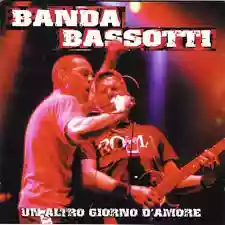
The word spreads fast and like wildfire. On March 17, 2001, over 9,000 people converge on Villaggio Globale to attend the Banda Bassotti concert: nothing like this has ever happened in Rome. From the Basque Country, Fermin Muguruza and Kaki Arkarazo from Negu Gorriak also arrive: Fermin plays two classics from the Kortatu repertoire with the Banda, «La Linea Del Frente» and «Zu Atrapartu Arte», Kaki records the concert and then pours heart and soul into ensuring that this concert becomes «Un Altro Giorno D’Amore».
The Banda Bassotti plays with extreme vigor for over two hours, effortlessly rolling out many of those tracks that have made them an institution in Rome, regardless of their intentions. In those days, if you ask the rebellious youth where the hardcore-punk heartbeat of the Roman scene is, they invariably point to San Lorenzo, the headquarters of Banda Bassotti and the Roman antagonist scene; there you’ll find Radio Onda Rossa, where you can catch «Allo Skader Dell’Ora», an indispensable broadcast for airing the signals sent out by Bassotti from all over.
Strictly speaking, the Banda Bassotti is not a punk or hardcore group, for genre coordinates it is undoubtedly better to rely on the programmatic «Beat Ska Oi»: immediate and direct music, raw. But the Banda has the great merit of introducing new elements: on March 17th, the first rudimentary version of what would soon become a permanent brass section appears on stage, culminating in the beautiful «Así Es Mi Vida», a heartfelt and emotional (and exciting) tribute to protest songs of every time and place.
The sound flows like lava and carries with it slogans so outdated they become incomprehensible: power to the people, the last bourgeois justice has vanished, the glorious red star of the east, bella ciao.
Whoever wants to restore communism has no brain, whoever doesn't miss it has no heart.
It takes a great heart and no brain to love the Banda Bassotti.
I, like the over 9,000 who flocked to Villaggio Globale on March 17, 2001, love the Banda Bassotti and with all the heart I have left, hope that sooner or later Uncle Scrooge's money bin gets raided.
Loading comments slowly
Summary by Bot
This review highlights Banda Bassotti's live album 'Un altro giorno d'amore,' recorded during a landmark 2001 concert in Rome aimed to support political comrades. Known for their raw 'Beat Ska Oi' style, the band delivers a vigorous and emotional performance that intertwines punk, ska, and protest themes. The album captures their unyielding activism and their role as a voice of Rome's rebellious youth. Introduction of a brass section adds new depth to their sound, enriching this passionate, powerful record.Tracklist Lyrics Videos
Banda Bassotti
Banda Bassotti is an Italian ska‑punk collective from Rome, active since 1987, known for working‑class roots, left‑wing activism, and a hard‑charging blend of ska, Oi!, and punk. After a late‑90s pause, they returned with the landmark live set Un altro giorno d’amore (2001), followed by tributes and originals steeped in social struggle.04 Reviews
Other reviews
By marcello
I couldn’t imagine a better comeback for a band after a long hiatus.
The band, which evidently draws from the Clash, surpasses them in musicality, lyrics, and personality.
