
 •
Rating:
•
Rating:
THE REVIEW
Hunting is the oldest story mankind has ever told itself.
Because the moment a human being chases another living creature with the intent to catch it, a relationship is set in motion that strikes at the raw nerve of existence itself.
The question of who we are when we stop pretending to be civilized.
The ancient Greeks, in their high foresight, not by chance reserved for hunting an exclusive goddess, Artemis.
Nocturnal beauty, armed with a bow, virgin and ruthless, not goddess of war—something political and collective—but goddess of the Moment in which you are alone in the Forest, the animal stands before you, and there is no one else to decide what happens next.
Conrad brings all of this into the dark forests of the Congo, and in Heart of Darkness, Kurtz is the final answer: what does man become when he stops hunting animals and begins hunting himself, when the stakes are to understand just how far one can go before never coming back.
Fritz Lang, in M. The Monster of Dusseldorf, perhaps builds the greatest film about hunting ever made, understanding what later cinema often forgets—that the hunt always creates between pursuer and fugitive a paradoxical intimacy, involuntary, that changes them both. Herzog takes the logic to visionary delirium: his characters hunt neither animal nor man, but an idea, and the forest hunts them back toward their own madness with the patience of one who knows they have all the time in the world.
Yes, to cite Conrad and Herzog in a Netflix production sounds like a provocation not even that clever, a nocturnal rant, child of an immediate viewing and not much cold reflection. But ultimately, descending into the drifts of our times and references, the villain Ben is nothing but the transfigured and deformed son, on our AMOLED screens, of Kurtz and Zaroff and Chigurh—a ritualistic predator who has shed all civil superstructure down to the raw bone of animality. The one who hunts not out of hunger but to define himself, to affirm he is the highest point of the chain—the Apex, indeed, the limit beyond which there is nothing else. Sasha is the prey carrying inside herself a loss so immense it has transformed her, like the great prey of literature, from Ulysses to Ripley to Clarice Starling: true pain, the kind that has already brought you to the edge of the void and stared you in the eyes, does not make you more fragile, but gives you the ability to see in the dark, to read intention behind a gesture. And the film in its unawareness is the bearer of a miracle, given its lineage: it has the intelligence to understand that the real role-reversal never takes place in the action but in the understanding.
On that night — spoiler — in the canyon, where Sasha looks at Ben and tells him what she has learned: that she saw his fear even before he revealed it, that the Absolute Predator fears above all else the moment when there will be nothing left to hunt, and ultimately must face his own Soul and his Ghosts.
------------- ----------------- ----------------------- ----- - --------------- ------ – -------- - – - -
Netflix, in recent years, has built a formidable factory for producing action films for mass consumption; same shape, same flavor, same lack of surprises. Movies with enormous budgets, stellar casts, slick special effects and a soul you’re still looking for with a lantern. Netflix calls them "event movies," and in a sense they are: they are events in the sense that they drop, make noise on social media for a week, then vanish into deep algorithmic space.
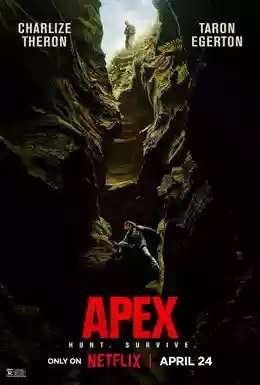
Apex is not exactly a masterpiece—it doesn’t sell itself as one, and it would be dishonest to do so—but it is something different, and this difference has a wild flavor that deserves serious discussion. The director is Baltasar Kormákur, the Icelander who already showed he could make solid things with Everest and Adrift, someone who treats nature as a character in its own right and not just decorative scenery—and here, the same approach can be felt in the skin of the film, in the visual texture of the Blue Mountains of New South Wales, in that sharp, unforgiving light of the Australian outback that pardons no one and gives no discounts, not even to the camera lens. There is something vaguely Herzogian in the setup, and the comparison isn’t far-fetched: Werner Herzog, in his best films, has always treated nature as an ANTAGONIST force, almost moral, utterly indifferent to human survival—AMEN—
And Kormákur absorbs the lesson, unable to do anything but slavishly copy the Masters. The Australian outback of Apex is not the picturesque backdrop that Netflix usually sells you with drones and symphonic music: it’s a living trap, a hostile entity, something that breathes and waits for your next move.
The plot, finally, in short: Sasha, a die-hard mountaineer, loses her partner Tommy during an ascent of the Troll Wall in Norway—one of those faces that are scary even in photos. He slips, she can’t hold him, he falls into the void. And she carries this with her like a boulder over the following five months, which bring her to Australia, Tommy’s home turf, to go solo kayaking along the Grand Isle Narrows and perhaps throw his lucky compass into the sea, in a gesture with all the power of a personal funerary rite. So far, it’s cinema of grief, cinema of processing. But no, because on her road she meets Ben, and the film completely changes its skin.
Ben comes across as friendly, guides her into his den giving advice on the best route, intervenes when two crude hunters make passes at Sasha in the worst way, seems like the down-to-earth, good-natured Australian who knows the woods and lives in peace with it. Then he steals her duffle, offers a breakfast with a strange human taste at the camp, then brings out a crossbow and a boombox, puts on the Chemical Brothers’ "Go," that big beat stuff from the ’90s that rattles your eardrums and the world, and tells her: you have until the end of this song to run. Then I’ll come get you. There it is, the moment the film reveals it has something wild inside, and there’s the narrative climax, the driving mechanism of the relentless hunt, of man reduced to his barest instinct—this is precisely the territory where Apex moves with the most assurance, the most honesty and awareness of its congenital limits.
The relationship between Ben and Sasha is the true heart of the film, and the film constructs it with surprising intelligence. Anyone would be surprised. At first, there is the surface politeness, the unspoken codes of those who face nature head-on, a kind of silent fraternity among adventurers. Then that kindness reveals itself for what it was: bait, trap, perfect simulation of humanity by something that has abandoned humanity long ago. But the role-reversal is what saves the film from becoming a purely mechanical exercise: Sasha is not simply the prey, she is a woman who has already faced similar battles, that literal void on the Troll Wall. She has already looked death in the face, watched it take her husband, and that experience emptied her but has also, paradoxically, prepared her. And this dark preparation rises in the most beautiful and important scene of the film, that night—spoiler—in the canyon, when the two are chained together by a twist of steel cable, with Ben’s leg shattered and rotten and Sasha having to keep him alive long enough to use him to climb back up the cliff. That night, she speaks to him. She does it strategically but also because it is True. It’s the truest thing inside her. She tells him: You know what all this taught me? It taught me to see in the Dark. Not with my eyes. Eyes are useless in true darkness. You have to move as if light will never come, as if light is an illusion that day grants you so you’ll pay for it at night. I let Tommy go. I opened my fingers and let him fall. And I remained in the absolute darkness for five months, and in that darkness I learned to see. I saw you. I saw you before you bared your teeth. I saw the way you looked at the woods as if you owned them, as if I was already inside you before you even met me. And you know what else I saw? I saw you’re afraid. You’re afraid it will end. You’re afraid of the moment when there’s nothing left to hunt, and you’ll have to be alone with who you are. This is the moment when Apex stops being a survival thriller and becomes a film about the relationship between pain and perception, between loss and the ability to read the world. Sasha has developed something like a dark sixth sense, a seer in the oldest sense of the word: She who has looked into the abyss and returned with knowledge others do not and cannot have. Screenwriter Jeremy Robbins said that, in every version of the script, that moment was always the hardest to write, and that, in his opinion, Ben in that moment sees his mother in Sasha—there’s a moment of unexpected vulnerability in him, and he realizes that killing her like that would go against the ritualistic dimension around which he has built his whole identity. This is deep psychology, the kind of complexity that certain blockbusters haven’t forgotten—they never knew how to cultivate it.
The ending is an act of pure poetic justice: Sasha does the same thing she did with Tommy—she opens her fingers—but this time she knows exactly why she does it and what it means. And then, on the beach, she throws Tommy’s compass into the sea. She is no longer the broken widow, no longer the prey: she is a woman who has climbed the hardest mountain of all, that of forgiving herself.
And now it’s time to stop. One must do what must be done, and the language must change, must rise to the slopes of Beauty, must make itself worthy in a way that language rarely manages to be worthy of its subject.
*Les sanglots longs des violons de l’automne blessent mon cœur d’une langueur monotone.*
Paul Verlaine knew what he was talking about. He knew that true beauty is never ornamental, never static, never tranquil: it is a restlessness, it is a long pain like the autumn violins, it is something that wounds you precisely because it is too perfect to be endured for long without something in you breaking. Charlize Sarah Theron, born in Benoni, South Africa, on August 7, 1975, is this. She is the sanglots longs made flesh. She is the langueur monotone that seizes you when you look at something so beautiful it hurts, that sweetest wound Verlaine called boredom and which is not boredom at all: it is contemplation on the edge of the abyss. In Apex, Charlize’s beauty is never decorative, never detached from the danger surrounding her: it is a beauty that sweats, that bleeds, that drags itself over rocks barefoot and barehanded, and remains beauty all the same—in fact, it becomes even more beauty, becomes something almost intolerable to behold.
Like looking at the sun during an eclipse.
Like standing too close to a burning flame.
The cheekbones, the gray-green eyes, the symmetry of that face that seems the ultimate geometric argument for the existence of a hidden order in the universe: all this is not shown off in the film but is earned, conquered scene after scene in blood, among shadows and in dust, and when she finally climbs the cliff, barefoot, without a harness, with Ben falling beneath her, that beauty is devastating.
Intangible and divine, like Verlaine’s violins which continue to play even after the music should have ended.
Apex is not the most beautiful film of the year. But it is the film that contains the most beautiful thing of the year. And sometimes, that’s enough.
Loading comments slowly
Summary by Bot
The review praises 'Apex', directed by Baltasar Kormákur, for its compelling storytelling and strong direction. The film is highlighted as a gripping cinematic experience. Rated 4 out of 5, it's recommended for its engaging plot and execution.
Baltasar Kormákur
Icelandic film director, producer, and actor known for blending Nordic grit with mainstream intensity in films like 101 Reykjavík, Jar City, Contraband, 2 Guns, Everest, Adrift, and Beast, as well as the TV series Trapped.01 Reviews
