
 •
Rating:
•
Rating:
THE REVIEW
My passions in 2000: essentially two. Motta Girelle and Álvaro Recoba.
Pedantic consequence: two splendid 13-year-old boy boobs and a friendzone park that made the cup of friendship envious. Nothing, I was disliked by coolness in every form. While the popularity of the right guys was rewarded with sticky kisses and handshakes around the latest guy, my big butt and I were sweating to trade some Kadabras.
In short, never a joy. And then there was Lippi, I mean.
A guy like that couldn't listen to the cool music of the cool kids at school, let's talk: Green Day with "She"? Who the hell had ever seen such a She? Please, not the Blinc, then. If I had a bullet, I would have reserved it for DeLonge. That childish and nasal whine… For God's sake, better a fit of temper. The three, in actions and intentions, were the perfect copy of those who teased me at school.
And they were doing such banal things.
Going out with a girl? But speak to me about what really matters, come on.
The mentor on duty came even for me, eventually. Usual school trip, usual older kids.
Physiological desire for emulation. "The new Bad Religion is out. It's great."
Bad Religion, what a suggestive name. Let's give it a chance: those catechism lessons on Saturdays just didn't go down well.
"The New America" saved my adolescence. I never understood why everyone despised it (and still despises it). The reason for me is simple: it’s 2000, punk rock has reached the sunset of its revival; old-fashioned rock mannerisms are no longer (so) sexy for the majors, seduced and drugged by the nu metal of Korn, SOAD, and Limp Bizkit. The compliant majority of critics and the ignorant masses do the rest. And BR become daguerreotypes in a laser game. Harmless anachronism.
Then it's true that the Sony/Atlantic affair leads to slightly softer sounds, that Todd Rundgren in the booth has a fondness for the radio-friendly and is considered a jerk by 4/5 of the band, but I don't see dramas. Rather, I hear bold choices. And a partial return to origins.
Because "You've Got a Chance" is nothing but a splendid melodic hardcore manifesto, an anthem, like the whole album, of the revenge of the underdogs, the revenge of the forgotten. At every level, at school just like in the trenches. Brian Baker paints with octaves one of the most intense tracks of his career: react, win the game. If the band of "No Substance" was a valid alternative, this is precisely the excellent original.
"The New America" is a continuous web of Shakespearean doubts: it is perceived in the unconscious fear for the future (a new unexplored millennium frightens everyone, as in "I Love My Computer" and in "It’s a Long Way to the Promise Land") and in the schizophrenia of the arrangement: tracks à la No Control are interspersed with interesting and new rhythmic options, like the powerful "A World without Melody," where, however, the Californian matrix is more than recognizable.
Many gambles, therefore, but (almost) all won: only a myopic ear, in fact, could label the continuous rhythmic jolts of "1,000 Memories" and "A Streetkid Named Desire" as commercial: if in the first the epic pace reigns before resolving in a galloping chorus, the second strikes for compositional variety: a true "Bohemian Rhapsody" branded Graffin, it is perhaps the most underrated track of Bad Religion. Certainly, much less accessible than a "Let Them Eat War."
The restless soul of the album does not even deny itself a ballad: "Whisper in Time" sincerely moves, recovering the emotional coordinates of the impetuous "Marked." Left disappointed a bit by "Believe It," the only track Mr. Brett participates in. What can I say? A bland midtempo that drags on, three harmless minutes that underline how landing at a major is often an overinflated and blind scapegoat.
Moreover, the most hardcore kids should really explain to me when the hell this album got sold to the mainstream, because, besides the agitated power pop of "The Hopeless Housewife," there's a terrifying triptych: "Let It Burn," "The Fast Life" (with Hetson playing a leading role!), and above all the elegy of "Don’t Sell Me Short" constitute a pogo park of chills. This is the other heavyweight of the album: nihilistic and disillusioned, a melancholic assault on the most unshakable and hypocritical dogmas, pulverizes any criticism of our alleged sellout. Had it been written in 1988, it would be on every Mohawk chart.
So, don't underestimate The New America. True, on the Billboard 200 there are 87 positions between it and Enema of the State, but only because the world is crap. Moreover, Fat Mike said it sucks. What better guarantee of quality?
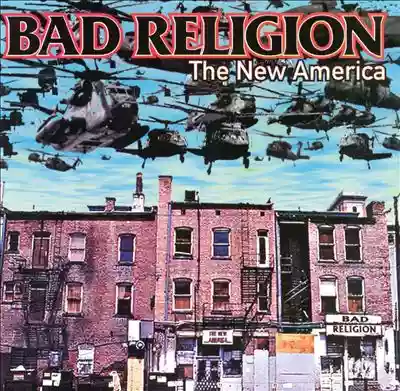
P.S.: the cover reproduced here is the U.S. edition: the patriotic Atlantic, in fact, did not appreciate the original concept (reproduced in the European edition), depicting three subjects saluting the American flag while holding a gun.
P.P.S.: it’s the last album with drummer Bobby Schayer, plagued by a shoulder injury :-(
Loading comments slowly
Summary by Bot
This review celebrates Bad Religion’s 2000 album The New America as a bold and emotionally charged punk rock record that captures the fears and hopes of a new millennium. Despite mixed mainstream reception and changes in sound influenced by producer Todd Rundgren, the album offers standout melodic hardcore anthems and thoughtful social commentary. The reviewer personally connects with the album as a soundtrack for outsider resilience and underdog revenge. It is positioned as an underrated classic deserving of more recognition.Tracklist Lyrics Videos
Bad Religion
Bad Religion is an American punk rock band formed in Los Angeles in 1979, known for pioneering melodic hardcore and for close ties to Epitaph Records.27 Reviews
