
 •
Versione 1
Rating:
•
Versione 1
Rating:
THE REVIEW
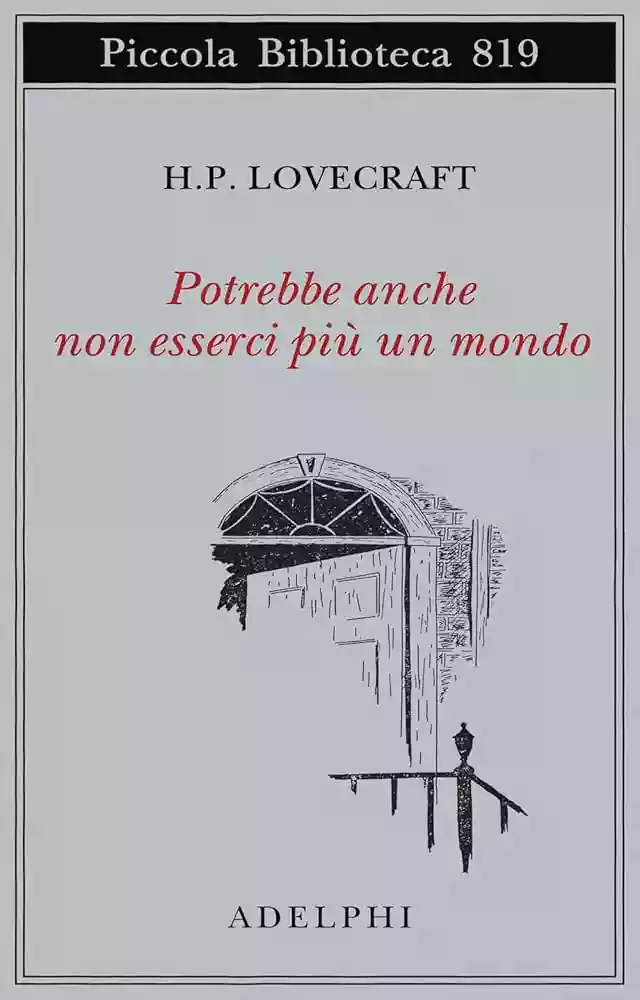
With There Might Not Even Be a World Anymore, Adelphi presents an editorial project that is as restrained as it is significant: the standalone publication of a single, very long letter by H. P. Lovecraft. This is not a narrative text nor an essay conceived for print, but an epistolary document which, removed from its private function, is offered as a literary object and a direct testament to the author’s thought.
It is necessary to clarify that the letter is not unpublished in an absolute sense. In an abridged form and with substantial cuts, it had already appeared in the volume L’orrore della realtà, edited by Gianfranco De Turris and Sebastiano Fusco for Edizioni Mediterranee. In that context, the text was included in a broader project aimed at presenting Lovecraft as an essayist and theorist of the fantastic. In the Italian publishing landscape, together with Lettere dall’altrove published by Mondadori, L’orrore della realtà remains one of the very few volumes to contain Lovecraft’s epistolary material. Adelphi, instead, chooses to isolate a single letter, transforming it into an independent book and highlighting its character as an intellectual manifesto.
The content of the volume immediately challenges the widespread image of Lovecraft as an author devoted exclusively to cosmic horror. Here, there are no alien entities or apocalyptic visions, but rather a long and nuanced reflection on history, civilization, taste, and decadence. The prose is argumentative, at times obsessively rational, devoid of any concession to literary effect. Lovecraft does not narrate: he presents, organizes, judges.
It is precisely in this judgment that the most problematic aspect of the text powerfully emerges. The letter reveals a profoundly conservative Lovecraft, explicitly hostile to democracy, and convinced that political and cultural equality represents a factor of decline rather than progress. Democratic modernity is seen as a leveling downwards, a process that sacrifices competence, hierarchy, and tradition on the altar of quantity and consensus. From this perspective, civilization does not advance: it deteriorates. Lovecraft defends an elitist view of culture, founded on selection, taste, and historical continuity.
This ideological stance retrospectively sheds light on Lovecraft’s fiction as well. The famous cosmic pessimism, often read in metaphysical or scientific terms, here takes on a historical and political significance: horror arises not only from humanity’s insignificance in the universe, but from the conviction that cultural structures are irreversibly compromised. The title of the volume — Potrebbe anche non esserci più un mondo — should be read in this sense: not as an apocalyptic announcement, but as an observation of the fragility of Western civilization under the pressures of democratic modernity.
The letter proceeds by accumulating arguments, often reiterating them, and builds a compact, sometimes rigidly schematic discourse. This can make the reading demanding, but it also contributes to restoring the image of an intellectually coherent Lovecraft, little inclined to compromise and totally lacking in self-censorship. There is no attempt here to be acceptable to the contemporary reader.
The operation by Adelphi, supported by the care and translation of Ottavio Fatica, thus takes on a precise value: exposing Lovecraft in his entirety, without filtering or softening his positions. The volume does not aim to rehabilitate nor to condemn the author, but to display him at the point where his worldview appears most clear and most uncomfortable.
Potrebbe anche non esserci più un mondo is a book that does not expand the Lovecraftian myth, but rather highlights its ideological foundation. A text intended for discerning readers, interested not so much in the fantastic imaginary as in the mental structure that generated it. A book that, precisely because of its clarity and intransigence, continues to disturb.
Loading comments slowly
Summary by Bot
This review delves into 'Potrebbe anche non esserci più un mondo' by H.P. Lovecraft, highlighting the chilling atmosphere and the mastery of cosmic horror. The reviewer praises the evocative storytelling and the book's ability to unsettle readers. It is celebrated as a significant work for fans of Lovecraft and horror fiction. The overall impression is highly favorable, with the book receiving top marks.
H.P: Lovecraft
Howard Phillips Lovecraft (1890–1937) was an American author known for weird fiction and cosmic horror, and for creating what is commonly called the Cthulhu Mythos.02 Reviews
