
 •
Rating:
•
Rating:
THE REVIEW
Hello, Roadrunner Records? Listen, I wanted to report a printing error on the cover of the Atreyu CD I bought. What’s wrong with it? Well, the name written on the liner notes is correct, everything has been meticulously taken care of, but then the music recorded on the CD doesn’t seem to have anything to do with the American band. What do you say? There is no error of any kind? What I listened to is indeed Atreyu? I apologize and thank you for your courtesy, goodbye!
Do you remember that band that was top of the class in the metalcore scene? Well, you should know that it no longer exists. Atreyu, loved or hated as they were, are preparing to make a big step towards the mainstream with the album "Lead Sails Paper Anchor," released two years after their previous work.
Everything begins with the farewell to Victory Records and signing with Roadrunner Records. The production of the new album was entrusted to John Feldmann, who has already worked on decidedly commercial projects like Hilary Duff, Ashley Simpson, and Good Charlotte.
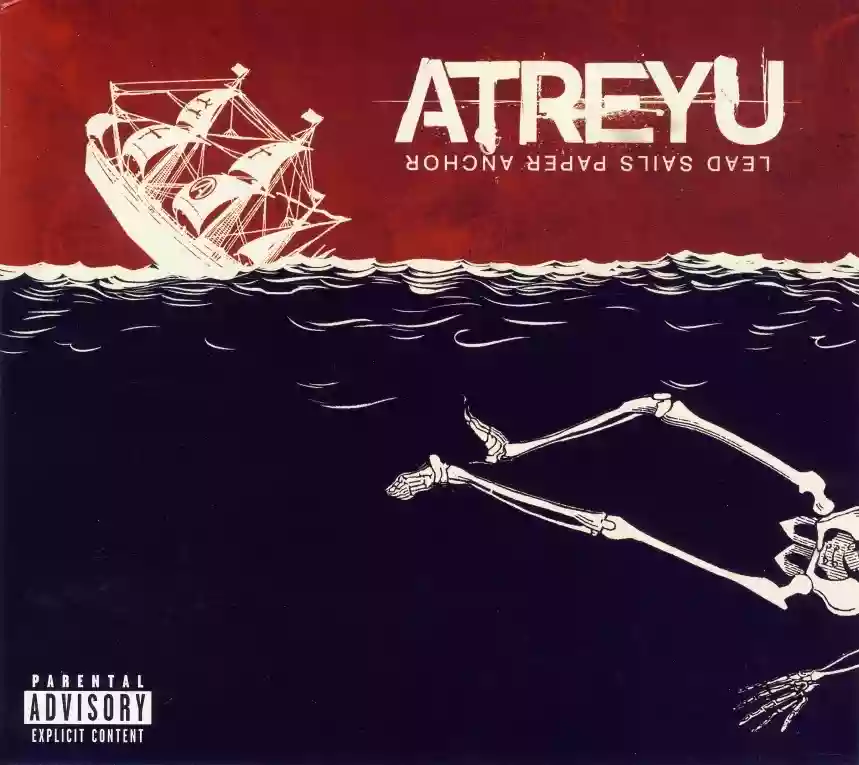
The first sore point is definitely the cover because that of "A Death-Grip On Yesterday" impressed us with its refinement and originality, worth the price of the CD alone. The new artwork, however, is of questionable taste, but it best represents the atmosphere in the Atreyu camp: a sinking ship and a skeleton announce the band's decline and the death of their metalcore.
Let’s move on to the songs. The most evident change is almost the complete disappearance of the screamed parts by singer Alex Varkatzas, in favor of more melodic tones, showing how he has significantly improved his singing. Good or bad? I'd lean towards the latter because since the singer learned to sing, Atreyu has moved towards a formula predominantly consisting of emo allure sprinkled with pop-punk simplicity.
The album opens with "Doomsday," a song that is quite indicative of the new course taken by Atreyu: a verse halfway between screamed and sung, and an unequivocally catchy chorus, in which the voice of drummer Saller stands out; the same approach is taken with "Honor," another song with a similar structure that certainly doesn't stand out for originality but is notable for its detachment from the band's typical lyrical themes. "Falling Down" is instead an atypical piece for the band, led by a Green Day-like rhythm and a melody that is always catchy but forced, a symptom that the band struggles to navigate a field so far removed from their original genre. In the first single "Becoming The Bull," distant thrash metal influences a la Slayer are combined in a song that reminds of Avenged Sevenfold, but still endowed with some interesting and original parts.
But perhaps the album's most successful song is "When Two Are One," which skillfully combines a heavy metal rhythm adorned with exquisitely technical solos (definitely approaching the old Atreyu) with Varkatzas' screamed singing, which comes back to prominence. "Lose it" is also well-crafted, with its strong metal-core and emo influences, and it features an excellent intertwining of Varkatzas and Saller's voices, but from this point, the album returns to lower levels, offering less inspired songs among which "Can’t Happen Here," the episode perhaps closest to the old Atreyu, and "Slow Burn," dominated by an instrumental dance rhythm in the style of Panic! At The Disco and a shamelessly emo chorus, stand out. Of certainly lower quality is the sing-song "Blow," a forcibly glam song where the band once again ventures into too steep territories without adding originality, while the concluding ballad "Lead Sails (And a Paper Anchor)," though not a masterpiece, is enjoyable in its soft and impactful yet simple melodies.
If it's true, as the band itself admits, that the quintet wanted to broaden its musical horizons, evolving and renewing itself, it's also true that this move, subsequent to a major contract, can cause some raised eyebrows, also noting that this musical eclecticism seems in many songs forced and not very inspired (especially "Falling Down" and "Blow"). The main problem of this new work is indeed its connection to the previous ones: Atreyu has changed perhaps without respecting that musical base that was their identity, their distinctive trademark, which could have made a new work of theirs appreciated even if very different from the others (as done, albeit with completely different dynamics but in an effective way, by Thrice with "Vheissu"). Those approaching the world of Atreyu for the first time with this album might certainly find it interesting, but those who were already fans of the band will find it in many parts unrecognizable, though perhaps still able to appreciate it.
Loading comments slowly
Summary by Bot
This review of Atreyu's album Lead Sails Paper Anchor discusses the band's departure from their metalcore roots towards a more mainstream and melodic sound. The vocal style has shifted from screamed to melodic singing, leading to mixed feelings. The production by John Feldmann and the switch to Roadrunner Records mark a clear step toward commercial appeal. Some songs recall their earlier style, but overall the album is viewed as a forced attempt at musical eclecticism. Newcomers may find it interesting, while longtime fans might find it unrecognizable.
Atreyu
Atreyu are an American metalcore band formed in Orange County, California, in 1998. After breaking through with The Curse (2004) following their debut Suicide Notes and Butterfly Kisses (2002), they went on hiatus in 2011 and reformed in 2014. In 2020, original vocalist Alex Varkatzas departed and drummer Brandon Saller moved to lead vocals, steering the band toward a more alternative metal direction.07 Reviews
