
 •
Rating:
•
Rating: THE REVIEW
So: regarding Asia, I believe there's always been a bit of confusion, especially about the genre that the band proposed. There are those, like me, who leaned more towards the term "80s prog," those who coined the term (which I myself have not at all hesitated to use) "pomp rock," those who chose arena rock, and those who more "simply" discussed FM rock, or AOR rock, whatever you want to call it, in short, the mainstream rock of the early eighties. The way I see it, being that there was a temporary directional change at the beginning of the '80s (lasting, except for Genesis, only the few years at the start of the decade) in the style of the surviving prog bands, which would wink (and I believe with good qualitative results) at more American and fresh sounds, or at artists and tastes more catchy (Yes and Buggles as father and son), I believe that even Asia—supercombo born "in the eighties and for the eighties," between three prog-men and one who played "Video Killed The Radio Star" and did "owa owa" all the time—in their project of reaching and broadcasting on all rock radios globally, did not deviate much 'philosophically' from those bands protagonists of the seventies, who in the eighties desired not to be overwhelmed by the 'new wave', indeed, if possible, to ride it.
In their first but also in their second album, Asia managed to go even further: instead of good pop rock songs, even danceable ones, they devoted themselves to epic rock, a bit kitsch, but we were in the 1980s, and who would notice? So they let themselves be guided by the young Downes, the true soul-mind of the project, and took a corridor leading to certain space pop-rock typical of the time. Thus, aware of their technical possibilities and stimulated, at the same time, by what was being heard around the radios, they decided to engage with the new daring talents, and on their own field, convinced that greater substance, charisma, experience, habit and attitude to quality writing, confidence with the term 'masterpiece', and executive technique translated into handfuls and handfuls of points in their favor. Success, bolstered by these enormous potentials (I forgot that there is also the need to evaluate the worldwide fame of the four formers), came inevitably, as a closed box... Yet there was something with which, it really seems, the members of this band never confronted: themselves. Was there ever a time when they truly questioned the quality of what they were writing, playing, recording, selling? Did they ever have the impression that people like them could have done infinitely better than "Asia" and "Alpha"?
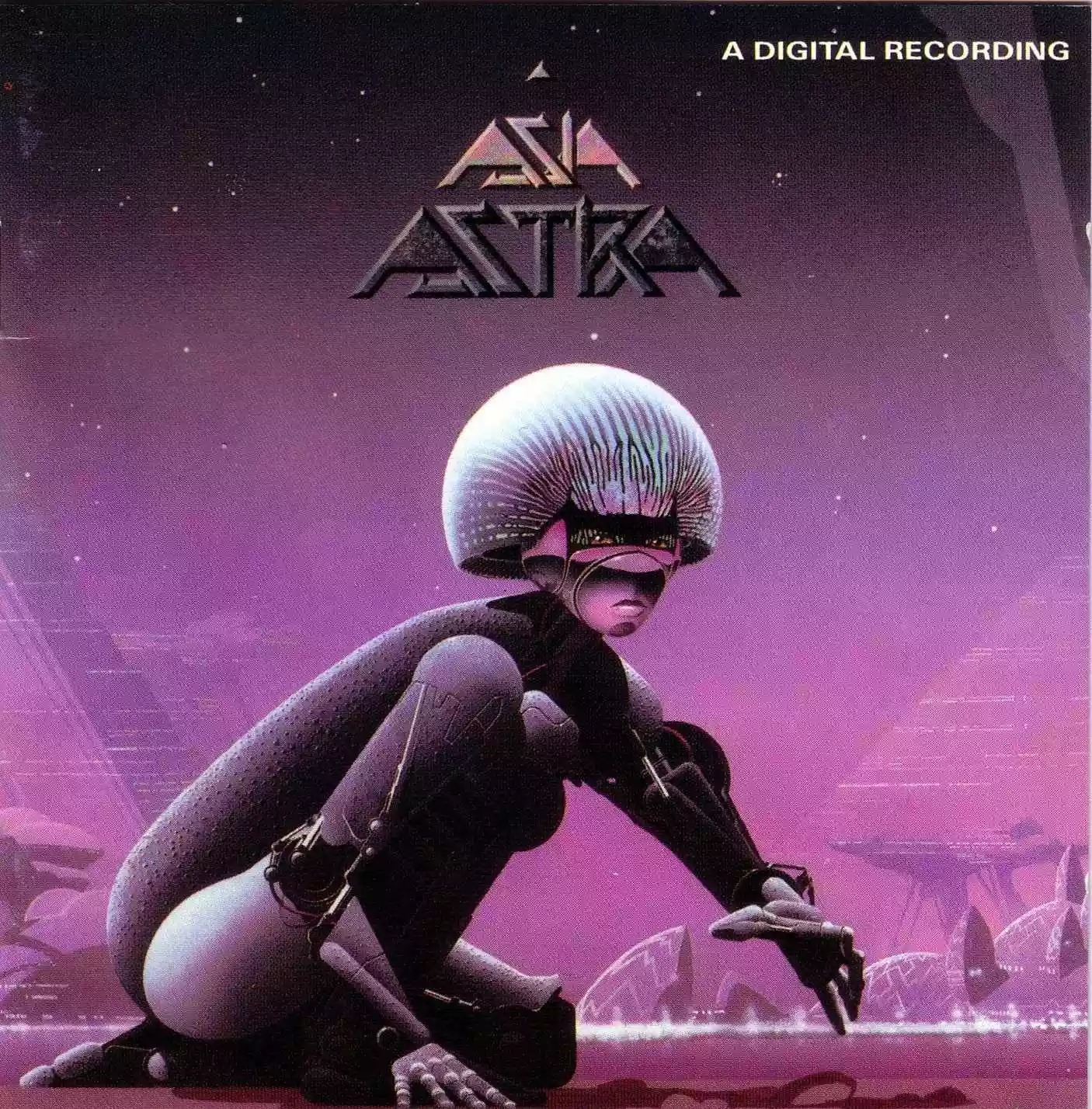
In 1985, Steve Howe had already left the band, disappointed by the failure of "Alpha." In his place, they recruited a certain Mandy Mayer, a long-haired half-Canadian half-Swiss, guitarist of Krokus, a central-European band of 'normal' metal and AOR rock, precisely one of those bands that roamed the radios that Asia, from 1982 onwards, tried to storm. The guy, probably aware that the phenomenon of AOR and 80s metal wouldn't survive long, abandoned everything, Krokus and Krauts to go play with the giants. Worst-case scenario, at least he would increase his chances of becoming an exceptional session man. And then, playing with Carl Palmer... Enters "Astra," unquestionably the album with the ugliest cover in the entire history of the band. And, as evidenced by the choice of the new guitarist, pomp rock was by then on its last legs. Only the initial and final tracks remain. The first, "Go," a single with modest outcomes, starts like a church anthem and continues like a templar charge... It becomes immediately apparent that Mayer is reliable and solid. The closing track, "After The War", instead, is the version of 10,884 AD BB XIV (see review of "Alpha") of "Cavalleria Rusticana" (it's specified that Sicily, in 10,734 AD BB XIV, became Asian territory as it passed into the hands of Bangladesh, which allowed that nation to exploit Sicilian labor "at an even lower cost"). Pomp is also the horrible ballad "Love Now Til Eternity".
In the middle, "Voice Of America", with a chorus that seems to come out of a Rocky soundtrack (Asia would 'limit' themselves to giving a track to the famous movie "Over The Top" by Stallone, the one, to be clear, about arm wrestling), whose Special medieval-sounding part surprised no one by the 1980s. The shot doesn't get elevated in "Too Late", in Toto style, also with a hackneyed Special this time between pseudo-music boxes, nor in "Rock And Roll Dream", unlistenable, with no head or tail, until the liberating accelerated ending, where Downes can finally stretch his phalanges and phalanx. Unworthy, "Suspicion".
More interesting is "Hard On Me", rock for radio with a greater dose of keys. It's a pity that some of them, rather than having Geoff Downes' flair, seem to be played by maestro Olmi of "Non È La RAI", due to their sloppiness and banality. Note, when the piece "stops", a certain resemblance to the famous "Jump" by Van Halen. Asia is less catchy than David Lee Roth and his associates in the 'year of (dis)-grace 1984' version, they would also have obligations as a supercombo, but it's the chart they want. And they want it with such vigor that "Wishing" has verses that resemble the rock version of "Last Christmas" by Wham! "Countdown To Zero" is decent, dark and apocalyptic, based on Wetton's interpretative wisdom and his valid bass lines.
"Astra" would remain well away from the charts, marking yet another step back in terms of success and quality. After losing Steve Howe's touch and songwriting, Geoff Downes would find himself without a vocalist, a bassist, and with the most consistent songwriter alongside him in composing tracks: John Wetton would surrender to the 'evidence' and take other paths (except to return aboard the spaceship half a decade later). One is left to wonder: what evidence did Wetton surrender to? The "monetary" evidence (the lack of success) or the qualitative one? In short, the same question I asked myself after Howe's departure... But here it's even worse. Did Wetton realize that the (terrible) tracks that didn't bring him the desired money are almost all signed by him for three albums out of three?
Loading comments slowly
Summary by Bot
This review critically examines Asia's album Astra, noting the band's shift from their early 80s prog and pomp rock success to a less inspiring sound. The departure of key members like Steve Howe and the arrival of Mandy Mayer failed to revive their quality. While technically proficient, Astra suffers from uninspired songwriting and lacks the catchiness of prior works, resulting in commercial and artistic decline.Tracklist Lyrics Videos
Asia
Asia are a rock supergroup formed in 1982, widely associated with AOR/pomp rock and arena-oriented songwriting despite members’ progressive-rock backgrounds. The classic lineup is frequently cited as John Wetton, Geoff Downes, Steve Howe, and Carl Palmer, and later eras discussed in the reviews include John Payne on vocals/bass alongside Downes.14 Reviews
